Molara Wood is one of my favorite bloggers and one of my first blogging friends. She is a Nigerian writer and arts journalist, based in London. Her blog is unselfishly used to promote other Nigerian artists primarily. Molara doesn't often write about politics, I think after reading this, we wish that she will more often. I think her post is a good starting point to discuss the Darfur Crisis. Molara's blog is WORDSBODY.
“Never Again” is the mantra we hear over and over again, when people talk of the horror of the 1994 Genocide in Rwanda. Then, the World (and in this sense, the World is the International community and the ones who hold the balance of power, led by the US. The World of course is also the United Nations, which to its eternal shame, was able to do absolutely nothing in Rwanda). Yet the World acted in Yugoslavia. More people were killed in Rwanda in 100 days, than in over 9 years of the Yugoslavia Campaign. As Romeo Dallaire once said: "The World is Racist".
We all know what happened in Rwanda in 1994. I will never forget the television news footage of bloated human bodies floating like mutant mushrooms upon Lake Victoria. So many. So many were they, that one couldn’t even see an inch of water in some places. How can I ever think of Lake Victoria again without re-imagining that nightmarish footage?
Now it is Darfur. The World again is being its (or is it her?) old useless self. The World is being racist again. Not only are the people being killed in Darfur as black as night, they are Africans - a terrible thing to be if you want the World to care about you.
What is more, the Dead, Dying and Displaced of Darfur are Muslims. I don’t know which is the worse thing to be in the current World order - African or Muslim. The people of Darfur have a terrible Double Whammy of an albatross round their necks.
In the last few days, the anxiety over Darfur is choking. Sense of asphyxiation worsened by helplessness and the horror of what we know: that time is running out. And why this anxiety? After all, Darfur has been with us for some time. An estimated 200,000 people have been killed in Darfur since 2003. The World has been busy twiddling its thumbs.
And so the new anxiety. And how inadequate a word is ‘Anxiety’. But what word should we grasp and attempt to speak, to express the unthinkable?
And is the new ‘anxiety’ because Hollywood liberal George Clooney spent 5 days with his father in Darfur in April, and in the last few days urged the US government to do something about “the first Genocide of the 21st century”?
Or is it because earlier today, faith leaders in Britain (remarkable, in light of Pope Benedict’s grossly unwise remarks about the Prophet Mohammed; Pope John Paul II, how irreplaceable you were!) - Anglican (Church of England), Islam, Jewish - led by Cormac Murphy O'Connor (leader of the Catholic faith in Britain) prayed at the door of 10 Downing Street. A prayer/letter was also read on behalf of Archbishop Desmond Tutu - you can’t have more moral integrity than that… [I don’t know whether the last few sentences comply with the rules of composition, but what is composition in the face of genocide?]… All these faith leaders came to express their anxiety at the front door of power in London earlier today. They were met at the door of Downing Street by Baroness Amos (don’t know why Blair himself couldn’t do it). We are told that Blair has written to fellow European powers urging action in Darfur. I don’t know that Blair’s gesture is not just another case of twiddling thumbs.
And the anxiety… African Union Peacekeepers have to leave Darfur by September 30. The Government of Sudan (in effect, an Arab government in the North) has refused to agree to a UN peacekeeping force in the region. They are adamant in this stance.
And the fear now, is that the government and its Janjaweed are planning The Final Solution to the Darfur 'Problem'. Genocide! And the World twiddles its useless thumbs. When it’s all over and done with, the World will again chorus: Never Again.
The World is Racist.Molara Wood
Wednesday, September 20, 2006


Saturday, September 16, 2006
The Third Camp is about Real Lives
Interview with Hamid Taqvaee
Third Camp TV
Maryam Namazie: You wrote the Manifesto of the Third Camp against US Militarism and Islamic Terrorism, which many people are now supporting. Why did you feel the need to write it?
Hamid Taqvaee: If you have a look at the political situation of our era, it seems that there are mainly two forces that actually determine everything in the political arena in the Middle East, the west and even the world. These two forces are the USA and its allies on the one hand and Islamic terrorism on the other. But the fact is that it is not only these two. What we are saying is that neither of these two forces actually represents people. Even people living in Islamist societies, and I can say especially those people, are not represented by political Islam, or by Islamic governments such as the Islamic Republic of Iran. The Third Camp addresses that force which represents the majority of people of the world – a majority which has no interest in the war between these two poles of Islamic and US-led terrorism. They reap no benefits from their war.
In the conflict between the two in Afghanistan, Iraq, Lebanon, Palestine, it is people who are actually sacrificed. People have no reason to take part in this. But the question is what do they do? Must they stay home, witness the carnage that is unfolding before their eyes and do nothing? Of course not. The Third Camp enables people to make a stand against both poles of terrorism in our era. Since people are losing everything in this confrontation, we must establish and organise a third movement. The third camp is a movement not an organization; it is a movement against political Islam and US militarism.
Maryam Namazie: It’s not yet well known but one gets the sense that it is crucial…
Hamid Taqvaee: Yes, it is not well known and that is why one of our main aims is to introduce the movement to as many people as we can. I believe public opinion on the whole is with us. If they come to know about what we are saying, if they were able to find out our goals and purpose, I think they would join us. In Iran, and countries like it, I can say with confidence that more than 90 percent of the people are with us and that we are representing them. They are with us against Islamic terrorism; they are against US militarism. I think we can say that about today’s Iraq and other Middle Eastern societies that have been at the frontlines of the conflict. In Europe, too, people know what is going on after September 11, Madrid, London, Bali. Even in western countries, where people are faced with massive media propaganda, I believe that most people if they knew about us, if they heard what we say and represent, they would join us. They would join the third camp movement. As I said, I think the third camp represents a majority of people in any given country. They just need to know that such a force and movement exists, and that it is active. They would join as soon as we were able to reach them.
Maryam Namazie: I think that is one of the things that we are witnessing. When you talk to activists who are reaching out to people, they say that a lot of them feel a sense of relief that there is this human alternative and they don’t have to choose between bad and worse.
Hamid Taqvaee: Exactly.
Maryam Namazie: There has been an immense amount of support for the Third Camp, but also some criticism. It would be good if you could address some of them here. Some are saying that it is wrong to gather opposition to both US militarism and political Islam since one can’t deal with both at the same time and also because they say, both are not equally important. Groups like the Stop the War Coalition believe that the main issue is Empire or US imperialism.
Hamid Taqvaee: This is not new. As far as I remember, since the start of my political life, I have heard this sort of position from anti-imperialist activists. They ask “What is the main problem?” but never ask for whom and in what context. They imply that there is one main problem for every single person in our era. And they always say that the main problem is imperialism. During the Cold War, there were two different groups. One of them would say that the main enemy or the main problem was the Soviet empire; the other would say it was the US and western empire and they had ongoing discussions with each other. Now that the US is the only superpower, everything has become even more simplified for them. Now we have only one empire to address!
But let’s think of this from the point of view of women in the world, for example. In Islamist societies, or for women who are considered Muslim, what is the main problem? The empire or political Islam? For women in Afghanistan, Pakistan, Iran, Iraq, Algeria, and even Muslim women in Scandinavia, Europe, and the US, what is their main problem? Their problem is that political Islam forces them to wear the hijab, prevents girls from playing with boys, and even allows 9 year old to ‘marry’, which is nothing more than legalising child sexual abuse. Political Islam is a massive movement and from their point of view, from the point of view of millions and millions of women, the main problem is not the empire or US imperialism.
Maryam Namazie: But in countries like Iraq, for example, it is US imperialism that has wreaked havoc….
Hamid Taqvaee: OK, but what about Iran? For 27 years, not only women, but a majority of the population have had no rights. In any sense of the word, the Islamic Republic of Iran is an every-day terrorism ruling Iran. In Iraq, too, Islamic sects are fighting each other and slaughtering children. Sunnis killing Shiites and vice versa. In Iraq, both the US and its allied forces as well as Islamic groups are killing left, right and centre in the name of democracy or resistance! It doesn’t matter what they call it! They are killing people everyday.
People, civilians, who have no interest and no participation in the resistance, get slaughtered. We don’t have resistance as such in Iraq. We have different Islamic and nationalist factions and the occupying forces of the US and Britain fighting each other. That is the situation in Iraq.
Maryam Namazie: Darren Cogavin has written a piece in the Blanket criticising Anthony McIntyre’s article in the same publication in defence of the Third Camp. He says that one of the most basic tenets of consistent democracy is solidarity with mass-based rebellions against occupation, national oppression and colonial rule when they actually occur.
Hamid Taqvaee: Again with the mass-based something! Mass-based what? Hitler relied on the masses. Initially in Iran, Khomeini had the masses with him. So what? Masses can go wrong and most of the time - when there is no left or progressive force present - they do. It happens all the time, everywhere. Masses go and vote for Bush in America and regret it after a few months. It happens everywhere. So don’t talk about ‘the masses,’ ‘what the masses say’ and ‘what the masses don’t say’. That is one point. The other point, even in this context, is that there are no masses behind Islamic forces in Iraq, Iran, and Afghanistan. That is a big lie. Like the mass media, it categorises all people living in the Middle East as automatically supporting political Islam because of where they were born. This is a big lie. It’s as if to say you are with Tony Blair because you were born in Britain since he is your prime minister! This is the same nonsense they spew about the Iranian people. There are no ‘masses’ behind political Islam, even in Iraq, in my opinion. The masses in Iraq want peace; they want a normal life; they want to get rid of all of the forces - Islamist and western - that are making life intolerable. They want to get rid of all of them so they can get on with their day-to-day life, go to school, have hospitals, have electricity, running water… That’s their main problem not resistance against the empire or the democracy that the empire wants to give them. They are defending life. So we have to have a force representing life in Iraq and in fact the masses are with that force. If there is not such a force there, we have to go and create it and organise it - a force defending life against both those poles and fighting against both of them. Going back to old terminology and Cold War logic won’t get us anywhere. Speaking of what the masses want doesn’t help. You don’t determine politics by what people say but by what they really need. What they really want. Even if they don’t know it. Even if nobody represents them. You have to find out what it actually is – it’s not subjective but objective. And you have to go out and be the voice of the people. And represent what they want and need and organise them around that and create a political force against the so-called “resistance” and forces for “democracy”. None of the two poles represent people in Iran, in Iraq, or elsewhere in the world. They merely represent different camps of the ruling classes.
Maryam Namazie: Let’s leave the masses out of it for now; the same writer says that the biggest obstacle to US domination in Iraq and the Middle East is the armed resistance without which US imperialism might well be preparing for a full scale invasion of Iran. So basically he says the manifesto contradicts itself because it is actually this very political Islamic resistance that has stopped the US from entering Iran.
Hamid Taqvaee: With this logic, one could say, ‘if there was no US forces in Iraq, Islamic forces would make the country much worse than what we have in Iran today. Women in Iraq would be in a much worse situation if they had a regime like Iran’s.’ The problem with this writer is that he doesn’t see both poles in the conflict. Automatically, he thinks that whoever resists the US is good. Is pro-people. That’s wrong. This sort of logic has never worked throughout history and it doesn’t work here either. It is not the case that because the US is against the people, therefore, whoever resists the US is with the people. The same logic would be the reverse in Iran. The Islamic Republic is against the people based on what it has done for the past 27 years ruling Iran, and the US is against the Islamic Republic of Iran so the US is with the people of Iran. That’s wrong! That sort of logic won’t get us anywhere. It depends what point of view you are looking at it from. If you look at it from the point of view of only opposing the Islamic Republic in Iran then you will conclude that the US is pro the people. And if you think of it in terms of only opposing the forces that are occupying Iraq, you will come to the conclusion that Moqtada al-Sadr or Islamists in Iraq are with the people. Either way, this is incorrect.
The point is that you don’t have to choose between these two poles. We have to go and create a third camp against both. That’s the whole point.
Maryam Namazie: He goes on to say that the third camp is social chauvinist and “has chosen to position themselves against the growing movement challenging US imperialism arms in hand at a time when revolutionary Marxism is most urgently needed.”
Hamid Taqvaee: Revolutionary Marxism defends itself and defends the people. If there is a force that we can refer to as “revolutionary Marxism”, why doesn’t this force go and create and organise its own movement? Why do we as Marxists have to support somebody else all the time? In the Cold War, why did we have to support the Soviet Union vis-à-vis the USA? And why now, do we have to support Islamists against the USA. And every time, we have a big enemy – the empire or whatever they call it - and we have to support those who are seen to be against it. Why shouldn’t others support us? Why are we not creating our own movement with our own political aims and goals and calling on everybody to come and support us!
There are Islamists against the USA. Fair enough. I accept that. We are against the USA as well. Why shouldn’t Islamists have a discussion among themselves about supporting Marxists? And actually when Marxism was more fashionable in the 60’s, we did have this sort of thing. There were so many religious groups that called themselves ‘Marxist’. Now it is the opposite. Now some Marxists call themselves ‘Muslim’ and that is the main problem of the anti-US movement. The upper hand in this movement is with the Islamists, unfortunately. And Marxists like the one you are quoting, always think Marxists have to go join a big front and support somebody else against the US. If today, it is Sheikh Nasrullah or Hizbullah, then we must all go and support them. At the time of Khomeini, they supported Khomeini. But then you think of it from the point of view of ordinary people. People in the streets. Public opinion all over the world. They don’t buy this sort of logic because it has nothing to do with their real lives. They don’t go by terminology and abstract concepts of ‘who is the main empire of this era?’ They don’t think that way. They simply think about what benefits them; what’s for them and what’s against them. And the people of Iran who have been living under the yoke of Islamic rule know what Islam is. It doesn’t matter whether you tell them that Islam is against the US. It it not their criteria. What is important, and really matters is not the Islamic Republic-US relationship, but the relationship of both of these poles with the people. That’s the way we Marxists should judge and criticise different political movements, parties, and governments. So again referring even to Marxists as a political group or party or movement and then demanding that we as Marxists go and support political Islam or Islamic forces is just ridiculous.
Maryam Namazie: The author goes on to say that the manifesto ‘recycles the odious garbage of Samuel Huntington’s The Clash of Civilizations, directing liberals outside the ranks of the ‘Irrelevant Left’ to enlist in the crusade for western secular and enlightenment values against savage, fanatical Islam.’
Hamid Taqvaee: Why must the achievements of humanity, secularism, defending human beings, humanity, civil society and so on belong to the west or to the east or... They belong to the human race. They are the results of thousands of years of human history. They are latest achievements in politics, sociology, and science. The same way that everybody uses the latest achievements of technology, for example, everybody uses a TV, cars, and planes. In the same way we have social and political achievements that belong to human beings. One of them is secularism; another is civil society; another universal values. They are defended in any country all over the world. So they don’t belong to any one culture at all. Saying they do has to do with relativism. People like the author think that culture is a relative thing. So to them we have Islamic culture, western culture, eastern culture, and when we are defending the achievements of human beings, the achievements of science, technology, sociology they just put us in one of those categories. They say: ‘you are defending western culture’. In reality, east or west is irrelevant. Human beings, humanity, the human race has the same values everywhere in the world. We believe that secularism, having a civil society is a good value and it is good for everybody. Everybody benefits from it; it doesn’t matter whether you were born in Iran or in France. Civil society is one of the latest achievements of human history. It doesn’t belong to any culture and we don’t divide cultures in this way. We believe and support the culture that defends humanity and human beings and oppose the culture which is against them. If you think about it, you will see that a culture which is against human beings belongs to a class which rules across the world. They have different versions: the Islamic culture defends the ruling class in Iran, the Islamic Republic of Iran belongs to that eastern culture and the culture of Mr. Rumsfeld and Bush belongs to the ruling class in the USA and it is in the category of western culture.
The above is an edited transcript of Maryam Namazie’s interview with Hamid Taqvaee on Third Camp TV on August 29, 2006. The programme can be viewed on Third Camp
See also: Maryam's Post at Renegade Eye about The Third Camp Manifesto.Maryam Namazie
Third Camp TV
Maryam Namazie: You wrote the Manifesto of the Third Camp against US Militarism and Islamic Terrorism, which many people are now supporting. Why did you feel the need to write it?
Hamid Taqvaee: If you have a look at the political situation of our era, it seems that there are mainly two forces that actually determine everything in the political arena in the Middle East, the west and even the world. These two forces are the USA and its allies on the one hand and Islamic terrorism on the other. But the fact is that it is not only these two. What we are saying is that neither of these two forces actually represents people. Even people living in Islamist societies, and I can say especially those people, are not represented by political Islam, or by Islamic governments such as the Islamic Republic of Iran. The Third Camp addresses that force which represents the majority of people of the world – a majority which has no interest in the war between these two poles of Islamic and US-led terrorism. They reap no benefits from their war.
In the conflict between the two in Afghanistan, Iraq, Lebanon, Palestine, it is people who are actually sacrificed. People have no reason to take part in this. But the question is what do they do? Must they stay home, witness the carnage that is unfolding before their eyes and do nothing? Of course not. The Third Camp enables people to make a stand against both poles of terrorism in our era. Since people are losing everything in this confrontation, we must establish and organise a third movement. The third camp is a movement not an organization; it is a movement against political Islam and US militarism.
Maryam Namazie: It’s not yet well known but one gets the sense that it is crucial…
Hamid Taqvaee: Yes, it is not well known and that is why one of our main aims is to introduce the movement to as many people as we can. I believe public opinion on the whole is with us. If they come to know about what we are saying, if they were able to find out our goals and purpose, I think they would join us. In Iran, and countries like it, I can say with confidence that more than 90 percent of the people are with us and that we are representing them. They are with us against Islamic terrorism; they are against US militarism. I think we can say that about today’s Iraq and other Middle Eastern societies that have been at the frontlines of the conflict. In Europe, too, people know what is going on after September 11, Madrid, London, Bali. Even in western countries, where people are faced with massive media propaganda, I believe that most people if they knew about us, if they heard what we say and represent, they would join us. They would join the third camp movement. As I said, I think the third camp represents a majority of people in any given country. They just need to know that such a force and movement exists, and that it is active. They would join as soon as we were able to reach them.
Maryam Namazie: I think that is one of the things that we are witnessing. When you talk to activists who are reaching out to people, they say that a lot of them feel a sense of relief that there is this human alternative and they don’t have to choose between bad and worse.
Hamid Taqvaee: Exactly.
Maryam Namazie: There has been an immense amount of support for the Third Camp, but also some criticism. It would be good if you could address some of them here. Some are saying that it is wrong to gather opposition to both US militarism and political Islam since one can’t deal with both at the same time and also because they say, both are not equally important. Groups like the Stop the War Coalition believe that the main issue is Empire or US imperialism.
Hamid Taqvaee: This is not new. As far as I remember, since the start of my political life, I have heard this sort of position from anti-imperialist activists. They ask “What is the main problem?” but never ask for whom and in what context. They imply that there is one main problem for every single person in our era. And they always say that the main problem is imperialism. During the Cold War, there were two different groups. One of them would say that the main enemy or the main problem was the Soviet empire; the other would say it was the US and western empire and they had ongoing discussions with each other. Now that the US is the only superpower, everything has become even more simplified for them. Now we have only one empire to address!
But let’s think of this from the point of view of women in the world, for example. In Islamist societies, or for women who are considered Muslim, what is the main problem? The empire or political Islam? For women in Afghanistan, Pakistan, Iran, Iraq, Algeria, and even Muslim women in Scandinavia, Europe, and the US, what is their main problem? Their problem is that political Islam forces them to wear the hijab, prevents girls from playing with boys, and even allows 9 year old to ‘marry’, which is nothing more than legalising child sexual abuse. Political Islam is a massive movement and from their point of view, from the point of view of millions and millions of women, the main problem is not the empire or US imperialism.
Maryam Namazie: But in countries like Iraq, for example, it is US imperialism that has wreaked havoc….
Hamid Taqvaee: OK, but what about Iran? For 27 years, not only women, but a majority of the population have had no rights. In any sense of the word, the Islamic Republic of Iran is an every-day terrorism ruling Iran. In Iraq, too, Islamic sects are fighting each other and slaughtering children. Sunnis killing Shiites and vice versa. In Iraq, both the US and its allied forces as well as Islamic groups are killing left, right and centre in the name of democracy or resistance! It doesn’t matter what they call it! They are killing people everyday.
People, civilians, who have no interest and no participation in the resistance, get slaughtered. We don’t have resistance as such in Iraq. We have different Islamic and nationalist factions and the occupying forces of the US and Britain fighting each other. That is the situation in Iraq.
Maryam Namazie: Darren Cogavin has written a piece in the Blanket criticising Anthony McIntyre’s article in the same publication in defence of the Third Camp. He says that one of the most basic tenets of consistent democracy is solidarity with mass-based rebellions against occupation, national oppression and colonial rule when they actually occur.
Hamid Taqvaee: Again with the mass-based something! Mass-based what? Hitler relied on the masses. Initially in Iran, Khomeini had the masses with him. So what? Masses can go wrong and most of the time - when there is no left or progressive force present - they do. It happens all the time, everywhere. Masses go and vote for Bush in America and regret it after a few months. It happens everywhere. So don’t talk about ‘the masses,’ ‘what the masses say’ and ‘what the masses don’t say’. That is one point. The other point, even in this context, is that there are no masses behind Islamic forces in Iraq, Iran, and Afghanistan. That is a big lie. Like the mass media, it categorises all people living in the Middle East as automatically supporting political Islam because of where they were born. This is a big lie. It’s as if to say you are with Tony Blair because you were born in Britain since he is your prime minister! This is the same nonsense they spew about the Iranian people. There are no ‘masses’ behind political Islam, even in Iraq, in my opinion. The masses in Iraq want peace; they want a normal life; they want to get rid of all of the forces - Islamist and western - that are making life intolerable. They want to get rid of all of them so they can get on with their day-to-day life, go to school, have hospitals, have electricity, running water… That’s their main problem not resistance against the empire or the democracy that the empire wants to give them. They are defending life. So we have to have a force representing life in Iraq and in fact the masses are with that force. If there is not such a force there, we have to go and create it and organise it - a force defending life against both those poles and fighting against both of them. Going back to old terminology and Cold War logic won’t get us anywhere. Speaking of what the masses want doesn’t help. You don’t determine politics by what people say but by what they really need. What they really want. Even if they don’t know it. Even if nobody represents them. You have to find out what it actually is – it’s not subjective but objective. And you have to go out and be the voice of the people. And represent what they want and need and organise them around that and create a political force against the so-called “resistance” and forces for “democracy”. None of the two poles represent people in Iran, in Iraq, or elsewhere in the world. They merely represent different camps of the ruling classes.
Maryam Namazie: Let’s leave the masses out of it for now; the same writer says that the biggest obstacle to US domination in Iraq and the Middle East is the armed resistance without which US imperialism might well be preparing for a full scale invasion of Iran. So basically he says the manifesto contradicts itself because it is actually this very political Islamic resistance that has stopped the US from entering Iran.
Hamid Taqvaee: With this logic, one could say, ‘if there was no US forces in Iraq, Islamic forces would make the country much worse than what we have in Iran today. Women in Iraq would be in a much worse situation if they had a regime like Iran’s.’ The problem with this writer is that he doesn’t see both poles in the conflict. Automatically, he thinks that whoever resists the US is good. Is pro-people. That’s wrong. This sort of logic has never worked throughout history and it doesn’t work here either. It is not the case that because the US is against the people, therefore, whoever resists the US is with the people. The same logic would be the reverse in Iran. The Islamic Republic is against the people based on what it has done for the past 27 years ruling Iran, and the US is against the Islamic Republic of Iran so the US is with the people of Iran. That’s wrong! That sort of logic won’t get us anywhere. It depends what point of view you are looking at it from. If you look at it from the point of view of only opposing the Islamic Republic in Iran then you will conclude that the US is pro the people. And if you think of it in terms of only opposing the forces that are occupying Iraq, you will come to the conclusion that Moqtada al-Sadr or Islamists in Iraq are with the people. Either way, this is incorrect.
The point is that you don’t have to choose between these two poles. We have to go and create a third camp against both. That’s the whole point.
Maryam Namazie: He goes on to say that the third camp is social chauvinist and “has chosen to position themselves against the growing movement challenging US imperialism arms in hand at a time when revolutionary Marxism is most urgently needed.”
Hamid Taqvaee: Revolutionary Marxism defends itself and defends the people. If there is a force that we can refer to as “revolutionary Marxism”, why doesn’t this force go and create and organise its own movement? Why do we as Marxists have to support somebody else all the time? In the Cold War, why did we have to support the Soviet Union vis-à-vis the USA? And why now, do we have to support Islamists against the USA. And every time, we have a big enemy – the empire or whatever they call it - and we have to support those who are seen to be against it. Why shouldn’t others support us? Why are we not creating our own movement with our own political aims and goals and calling on everybody to come and support us!
There are Islamists against the USA. Fair enough. I accept that. We are against the USA as well. Why shouldn’t Islamists have a discussion among themselves about supporting Marxists? And actually when Marxism was more fashionable in the 60’s, we did have this sort of thing. There were so many religious groups that called themselves ‘Marxist’. Now it is the opposite. Now some Marxists call themselves ‘Muslim’ and that is the main problem of the anti-US movement. The upper hand in this movement is with the Islamists, unfortunately. And Marxists like the one you are quoting, always think Marxists have to go join a big front and support somebody else against the US. If today, it is Sheikh Nasrullah or Hizbullah, then we must all go and support them. At the time of Khomeini, they supported Khomeini. But then you think of it from the point of view of ordinary people. People in the streets. Public opinion all over the world. They don’t buy this sort of logic because it has nothing to do with their real lives. They don’t go by terminology and abstract concepts of ‘who is the main empire of this era?’ They don’t think that way. They simply think about what benefits them; what’s for them and what’s against them. And the people of Iran who have been living under the yoke of Islamic rule know what Islam is. It doesn’t matter whether you tell them that Islam is against the US. It it not their criteria. What is important, and really matters is not the Islamic Republic-US relationship, but the relationship of both of these poles with the people. That’s the way we Marxists should judge and criticise different political movements, parties, and governments. So again referring even to Marxists as a political group or party or movement and then demanding that we as Marxists go and support political Islam or Islamic forces is just ridiculous.
Maryam Namazie: The author goes on to say that the manifesto ‘recycles the odious garbage of Samuel Huntington’s The Clash of Civilizations, directing liberals outside the ranks of the ‘Irrelevant Left’ to enlist in the crusade for western secular and enlightenment values against savage, fanatical Islam.’
Hamid Taqvaee: Why must the achievements of humanity, secularism, defending human beings, humanity, civil society and so on belong to the west or to the east or... They belong to the human race. They are the results of thousands of years of human history. They are latest achievements in politics, sociology, and science. The same way that everybody uses the latest achievements of technology, for example, everybody uses a TV, cars, and planes. In the same way we have social and political achievements that belong to human beings. One of them is secularism; another is civil society; another universal values. They are defended in any country all over the world. So they don’t belong to any one culture at all. Saying they do has to do with relativism. People like the author think that culture is a relative thing. So to them we have Islamic culture, western culture, eastern culture, and when we are defending the achievements of human beings, the achievements of science, technology, sociology they just put us in one of those categories. They say: ‘you are defending western culture’. In reality, east or west is irrelevant. Human beings, humanity, the human race has the same values everywhere in the world. We believe that secularism, having a civil society is a good value and it is good for everybody. Everybody benefits from it; it doesn’t matter whether you were born in Iran or in France. Civil society is one of the latest achievements of human history. It doesn’t belong to any culture and we don’t divide cultures in this way. We believe and support the culture that defends humanity and human beings and oppose the culture which is against them. If you think about it, you will see that a culture which is against human beings belongs to a class which rules across the world. They have different versions: the Islamic culture defends the ruling class in Iran, the Islamic Republic of Iran belongs to that eastern culture and the culture of Mr. Rumsfeld and Bush belongs to the ruling class in the USA and it is in the category of western culture.
The above is an edited transcript of Maryam Namazie’s interview with Hamid Taqvaee on Third Camp TV on August 29, 2006. The programme can be viewed on Third Camp
See also: Maryam's Post at Renegade Eye about The Third Camp Manifesto.Maryam Namazie
Tuesday, September 12, 2006
Interview with a Survivor of the 1948 Exodus (My Mother)
The following was an interview I used for a paper, and after it passed, I decided to publish it on my own blogspot. Due to the heated discussions, I witnessed earlier, I decided that this interview should be published (with the kind permission of Comrade Renegade) over here. I hope it stimulates not only debates, but incourages people to dwell on the history of Palestine... MFL
Introduction
In his book, Birth of the Palestinian Refugee Problem, the Israeli scholar Benny Morris divided the famous brutal Palestinian Exodus into 4 major waves. Even though the exodus started as early as 1923, the 1948 was divided into four stages. The Ramli town was supposed to suffer the most horrific exodus of all the four waves. By the time of the third wave in 1948, the Hagganah became known as the Israeli Defence Forces (IDF) and launched an offensive on the Lydda (currently known as Lyd) since it contained an airport. Afterwards, the IDF halted and allowed the terrorist militia Irgun to run an offensive on Ramli, which is not far away from Lydda. The Palestinians there were villagers with minimum military infrastructure. The militants were poor peasants with barely any weaponry and any military experience, but successfully blocked two Irgun offensives till the IDF itself decided to invade the Ramli town and crush all resistance. After Ramli fell to Israeli occupation, the IDF forced 50,000 of its people to go walking from Ramli to Ramallah. Plenty died on the road from Ramli to Ramallah. The map can be found here.
The Interview
Interview with a Survivor of the Ramli Exodus(Benny Morris’s Third Wave)The following interview is with a daughter of a pharmacist and a municipality in Ramleh. His wife, who was in 1953 Vice President of the Women’s Arab Palestinian League, which was active on varieties of activities. These people are survivors of the Exodus. The daughter will answer some questions concerning the exodus, and sheds light as a case study from the eyes of a survivor.
What do you remember of the Exodus, since you lived it in 1948?
“It was in March 1948, when we left the Lydda Airport, and we arrived to Beirut. My father left us in Beirut, after renting a house, and returned to Ramli because he did not want to leave his homeland. He kept visiting us from time to time. When Ramli fell in 1948, and its people were forced to walk from Ramli to Ramallah, my father was in Beirut visiting us. He knew that Ramli fell to Israeli hands, and I remember it very well, because it was like a funeral to us. My father and mother kept crying, and one of my older sisters: “Are we poor? How can we survive?”.
Did you hear of the enforced exodus on Ramli?
“We knew directly when we saw our parents crying, and during this time, two of my uncles, who were refugees, came from there, and lived with us. We were about 30 people in an average house. We furnished bed sheets everywhere, in the kitchen, and in the living room. I was seven years old, but we were too young to think about our fate, but I knew that my father left his degree from the Syrian Protestant Collage (Currently American University of Beirut), and everything there. I remember very well the shock of them talking that there is no longer a home to return to. Afterwards, so many of our relatives arrived, from those who survived the terrible march to Ramallah. They told us that the Israeli Army placed a large sheet on the ground, and forced the women to throw their jewelry and accessories in it before leaving, which left them with nothing that may have a value to sell in the future. They robbed everyone before starting the great march.”
What did you hear from the survivors of the great march from Ramli to Ramallah?
“Many children and sick people died with no proper burial. The Israeli soldiers never allowed them to perform a proper funeral, the marching refugees used to cover the deceased’s face with a handkerchief or a small sheet. The ones who underwent the Exodus were actually the women, children, and the elders in a most brutal manner. The young were detained in Ramli, and one of them was my second cousin. They took away there weapons, and then imprisoned them. They were tortured later, and then afterwards they were used as exchange prisoners."
Your Second Cousin (a Palestinian Christian) was detained, and why is that for?
"My cousin "hidden name" was his name. He was in the military informal command for the defense of Ramli against the Jews. He was wounded in the battle for Ramli, and I remember they operated on him (the Red Cross), without pain relievers. Being blond with blue eyes, one of his Jewish friends, after six months smuggled him to Ramallah, by hiding him in the Red Cross vans.
Do you remember anything on the encounters of your cousin against the Israelis?
“We avoided talking to him about the topic because it brought bitter memories of a lost home, fortunes, relatives, and friends. All he mentioned was that the King Abdullah of Jordan said that they should resist and the next day they will receive re-enforcements. In the same evening, Ramli fell.”It is funny because history mentions that Ramli, twice blocked an Irgun invasion, and the King never arrived, didn’t your cousin suspect Arab treason?“All we remember that our surviving relatives kept saying that Palestinian tragedy was an Arab treason within plenty of other Arab treasons.”
What about those who arrived to Lebanon, how did they manage to live?
“The ones who were educated, they started working with the same rights the Lebanese, while the poor ones lived in camps relying on Arab aid, and they kept hoping that they will return back. Actually till now, a lot still have the keys to their houses over there in the hope that they will return back home.”
What about the camps and your mother working with them, anything happened over there?
“Many groups and delegates used to visit people from Europe in the camps. One day, members of the British Parliament were visiting the Sabra camp, and my mother was one of the escorts/guide through out the camp. She was explaining to them the bad situation in the camps, when she told them: ‘if you do not find a solution to these poor people, in few years to come, you will find the Red Flag rising over all the refugee camps.’ The British MP looked her with a smile, and replied: “They will never become Communists, they are all Muslims. Their religion will not allow them”. He was rather confident about it, and I think currently it is their imperial view during the mandate over our homes before 1948. I remember in a funny way my mother coming back to the house in Beirut and swearing at him, and bad mouthing his entire family. I was proud of her that she tried to help the refugees who had fathers being sick, children with tuberculosis, and so on to assist them, and he with his sarcastic smile as if answering her: ‘Those? Communists? That is a joke.’”
Any last words you want to say concerning the topic of Palestine or the Exodus?
“Currently, it is a lost case, we had some hopes when Abdul Nasser came, but now, it is a lost case.”
MarxistFromLebanon
Introduction
In his book, Birth of the Palestinian Refugee Problem, the Israeli scholar Benny Morris divided the famous brutal Palestinian Exodus into 4 major waves. Even though the exodus started as early as 1923, the 1948 was divided into four stages. The Ramli town was supposed to suffer the most horrific exodus of all the four waves. By the time of the third wave in 1948, the Hagganah became known as the Israeli Defence Forces (IDF) and launched an offensive on the Lydda (currently known as Lyd) since it contained an airport. Afterwards, the IDF halted and allowed the terrorist militia Irgun to run an offensive on Ramli, which is not far away from Lydda. The Palestinians there were villagers with minimum military infrastructure. The militants were poor peasants with barely any weaponry and any military experience, but successfully blocked two Irgun offensives till the IDF itself decided to invade the Ramli town and crush all resistance. After Ramli fell to Israeli occupation, the IDF forced 50,000 of its people to go walking from Ramli to Ramallah. Plenty died on the road from Ramli to Ramallah. The map can be found here.

The Interview
Interview with a Survivor of the Ramli Exodus(Benny Morris’s Third Wave)The following interview is with a daughter of a pharmacist and a municipality in Ramleh. His wife, who was in 1953 Vice President of the Women’s Arab Palestinian League, which was active on varieties of activities. These people are survivors of the Exodus. The daughter will answer some questions concerning the exodus, and sheds light as a case study from the eyes of a survivor.
What do you remember of the Exodus, since you lived it in 1948?
“It was in March 1948, when we left the Lydda Airport, and we arrived to Beirut. My father left us in Beirut, after renting a house, and returned to Ramli because he did not want to leave his homeland. He kept visiting us from time to time. When Ramli fell in 1948, and its people were forced to walk from Ramli to Ramallah, my father was in Beirut visiting us. He knew that Ramli fell to Israeli hands, and I remember it very well, because it was like a funeral to us. My father and mother kept crying, and one of my older sisters: “Are we poor? How can we survive?”.
Did you hear of the enforced exodus on Ramli?
“We knew directly when we saw our parents crying, and during this time, two of my uncles, who were refugees, came from there, and lived with us. We were about 30 people in an average house. We furnished bed sheets everywhere, in the kitchen, and in the living room. I was seven years old, but we were too young to think about our fate, but I knew that my father left his degree from the Syrian Protestant Collage (Currently American University of Beirut), and everything there. I remember very well the shock of them talking that there is no longer a home to return to. Afterwards, so many of our relatives arrived, from those who survived the terrible march to Ramallah. They told us that the Israeli Army placed a large sheet on the ground, and forced the women to throw their jewelry and accessories in it before leaving, which left them with nothing that may have a value to sell in the future. They robbed everyone before starting the great march.”
What did you hear from the survivors of the great march from Ramli to Ramallah?
“Many children and sick people died with no proper burial. The Israeli soldiers never allowed them to perform a proper funeral, the marching refugees used to cover the deceased’s face with a handkerchief or a small sheet. The ones who underwent the Exodus were actually the women, children, and the elders in a most brutal manner. The young were detained in Ramli, and one of them was my second cousin. They took away there weapons, and then imprisoned them. They were tortured later, and then afterwards they were used as exchange prisoners."
Your Second Cousin (a Palestinian Christian) was detained, and why is that for?
"My cousin "hidden name" was his name. He was in the military informal command for the defense of Ramli against the Jews. He was wounded in the battle for Ramli, and I remember they operated on him (the Red Cross), without pain relievers. Being blond with blue eyes, one of his Jewish friends, after six months smuggled him to Ramallah, by hiding him in the Red Cross vans.
Do you remember anything on the encounters of your cousin against the Israelis?
“We avoided talking to him about the topic because it brought bitter memories of a lost home, fortunes, relatives, and friends. All he mentioned was that the King Abdullah of Jordan said that they should resist and the next day they will receive re-enforcements. In the same evening, Ramli fell.”It is funny because history mentions that Ramli, twice blocked an Irgun invasion, and the King never arrived, didn’t your cousin suspect Arab treason?“All we remember that our surviving relatives kept saying that Palestinian tragedy was an Arab treason within plenty of other Arab treasons.”
What about those who arrived to Lebanon, how did they manage to live?
“The ones who were educated, they started working with the same rights the Lebanese, while the poor ones lived in camps relying on Arab aid, and they kept hoping that they will return back. Actually till now, a lot still have the keys to their houses over there in the hope that they will return back home.”
What about the camps and your mother working with them, anything happened over there?
“Many groups and delegates used to visit people from Europe in the camps. One day, members of the British Parliament were visiting the Sabra camp, and my mother was one of the escorts/guide through out the camp. She was explaining to them the bad situation in the camps, when she told them: ‘if you do not find a solution to these poor people, in few years to come, you will find the Red Flag rising over all the refugee camps.’ The British MP looked her with a smile, and replied: “They will never become Communists, they are all Muslims. Their religion will not allow them”. He was rather confident about it, and I think currently it is their imperial view during the mandate over our homes before 1948. I remember in a funny way my mother coming back to the house in Beirut and swearing at him, and bad mouthing his entire family. I was proud of her that she tried to help the refugees who had fathers being sick, children with tuberculosis, and so on to assist them, and he with his sarcastic smile as if answering her: ‘Those? Communists? That is a joke.’”
Any last words you want to say concerning the topic of Palestine or the Exodus?
“Currently, it is a lost case, we had some hopes when Abdul Nasser came, but now, it is a lost case.”
MarxistFromLebanon
Wednesday, September 06, 2006
The World Can't Wait???
"The World Can't Wait"! Drive Out The Bush Regime! This movement is the brain child of the Revolutionary Communist Party and its leader Bob Avakian. The Revolutionary Communist Party is a Maoist formation, allied with groups as Peru's Louminous Path, India's Naxalite Movement and the Communist Party of Nepal (Maoist). The World Can't Wait Movement is organized around impeaching George Bush, and will culminate with mass actions on October 05th, 2006. It has compiled an impressive list of endorsers as James Abourezk, Aris Anagnos, Anti-Flag, Edward Asner, Russell Banks, Ed Begley Jr., Harry Belafonte, St. Clair Bourne, Gabriel Byrne, Margaret Cho, Ward Churchill, Kate Clinton, US Rep. John Conyers Jr., John Densmore, Jesse Diaz Jr., Ariel Dorfman, Tom Duane, Michael Eric Dyson, Steve Earle, Niles Eldredge, Daniel Ellsberg, Barbara Ehrenreich, Eve Ensler, Lawrence Ferlinghetti, Jane Fonda, Michael Franti, reg e. gaines, Martin Garbus, Wavy Gravy, André Gregory, Paul Haggis, Sam Hamill, Suheir Hammad, Kathleen Hanna, Stephen Hays, Merle Hoffman, Rev. Jesse L. Jackson, Mumia Abu-Jamal, Bill T. Jones, Rickie Lee Jones, Sarah Jones, Brig. Gen. (ret) Janis Karpinski, Casey Kasem, Ron Kovic, Jonathan Kozol, Jessica Lange, Mark Leno, Rabbi Michael Lerner, George Lois, Ray McGovern, US Rep. Cynthia McKinney, Mark Crispin Miller, Tom Morello, Viggo Mortensen, Craig Murray, US Rep. Major Owens, Ozomatli, Grace Paley, Harvey Pekar, Sean Penn, Jeremy Pikser, Harold Pinter, Frances Fox Piven, Michael Ratner, Boots Riley, Scott Ritter, Steven Rohde, Mark Ruffalo, US Rep. Bobby Rush, Susan Sarandon, James Schamus, Richard Serra, Rev. Al Sharpton, Cindy Sheehan, Martin Sheen, Gary Soto, Nancy Spero, Gloria Steinem, Lynne Stewart, Serj Tankian, Jonathan Tasini, Sunsara Taylor, Studs Terkel, Gore Vidal, Kurt Vonnegut, Alice Walker, Naomi Wallace, Lt. Ehren Watada, US Rep. Maxine Waters, Cornel West, Saul Williams, Tim Wise, Krzysztof Wodiczko, Ann Wright, Howard Zinn, and thousands more.
The rightist critics will use words as "communist front", to put down the Revolutionary Communist Party. I give them credit for putting together such a group. I'm against red baiting. They are being low profile in the coalition. They are defending themselves defensively, by saying the coalition also includes Democrats, Greens, Catholics, Gays etc.
In the Philippines the Maoists are trying to impeach Arroyo, even involving rightist generals in their movement. I'm sure Avakian is inspired by his comrades. In the Philippines, Arroyo is actually one of the cleaner leaders. If you impeach a capitalist leader, you only end up with another. As much as their rhetoric is heated, the Maoists only work for reform; in Manilla, Katmandu or Washington D.C.
After impeaching Bush, what is the alternative? To most of the endorsers of their statement, electing a liberal Democrat would do. More should be expected from a so called vanguard communist party. With all the different views represented in the group, how do you keep the group together with vague demands?
I will attend a World Can't Wait event to network. I can wait for real change. See: The World Can't Wait.RENEGADE EYE
The rightist critics will use words as "communist front", to put down the Revolutionary Communist Party. I give them credit for putting together such a group. I'm against red baiting. They are being low profile in the coalition. They are defending themselves defensively, by saying the coalition also includes Democrats, Greens, Catholics, Gays etc.
In the Philippines the Maoists are trying to impeach Arroyo, even involving rightist generals in their movement. I'm sure Avakian is inspired by his comrades. In the Philippines, Arroyo is actually one of the cleaner leaders. If you impeach a capitalist leader, you only end up with another. As much as their rhetoric is heated, the Maoists only work for reform; in Manilla, Katmandu or Washington D.C.
After impeaching Bush, what is the alternative? To most of the endorsers of their statement, electing a liberal Democrat would do. More should be expected from a so called vanguard communist party. With all the different views represented in the group, how do you keep the group together with vague demands?
I will attend a World Can't Wait event to network. I can wait for real change. See: The World Can't Wait.RENEGADE EYE
Sunday, September 03, 2006
Man at the Crossroads (1934): Diego Rivera and Nelson Rockefeller
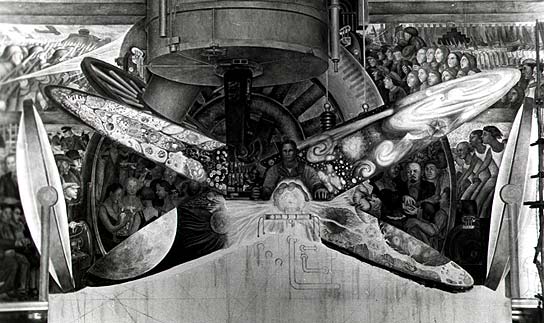
By 1930 muralist and communist Diego Rivera was achieving international recognition, for his murals, known for their passion and folkloric roots, in Mexican culture and communist principles. One of his new patrons was Abby Aldrich Rockefeller, wife of Nelson Rockefeller. She convinced her husband Nelson, to allow him to paint a mural in the newly built Rockefeller Center, in New York City.
Rivera proposed a 63 foot mural "Man at the Crossroads. It was a portrayal of a worker in a crossroad with capitalism, socialism, science and industry. In view of Diego's friendship with the Rockefeller family, they wouldn't object to Vladimir Lenin's portrait be included. The anti-capitalist theme, provoked controversy. The building managers despised the mural, and had final say about the content. The artist was paid in full and banned from the site. As a compromise Rivera proposed adding Abraham Lincoln to the mural, and keeping Lenin's picture. Despite demonstrations by Rivera's supporters, and the possibility of transferring the mural to the Museum of Modern Art. The painting was destroyed by attendants carrying axes. With Rivera paid in full, he had no say to stop the desecration.
The painting was redone at the Palace of Fine Arts in Mexico City, with a picture added of Nelson Rockefeller in a nightclub.RENEGADE EYE
Saturday, August 26, 2006
The Siege on Lebanon Continues
For now, Lebanon has been under siege since July 15th when the Israeli war ships formulated a siege on its shore and destroyed most of its routes. Lebanon during the war was under seige and its people were held hostages to IDF aggression. The upper class lebanese with two nationalities succeeded in escaping through the UN sponsored evacuations while the rest were left to be killed. The whole Lebanon was bombed except Beirut's heartland (although East and West Beirut were bombed few times).
During the siege, Israeli plans kept dropping leaflets telling the Lebanese that it was Hassan Nasrallah who brought this on them, and then the leftlets would confirm that Lebanon is burning and will burn more. It is important to tell sometimes the boxes which carries those "leaflets of mercy" sometimes do not open and do almost the damage of a Katyosha when falling on the ground. Israel was not aware that Lebanon this time was united economically and socially against its aggression as people from all sects welcomed the 1.1 million refugees, who are mostly from the lower class. 1.1 million refugee means more than 25% of the Lebanese population, can you imagine 25% of your own nation living on the streets, schools, and religious locations? Two churches were bombed, the Red Cross was bombed (actually plenty of times the Red Cross was bombed live when carrying Korean and or BBC journalists).
Lebanon was held a hostage in this brutal siege, while only one route remained accessible to Syria for people seeking safety. Israel kept saying that they warned the people to flee while mistaking the infrastructure of Hezbollah for the Lebanese. Actually there is no infrastructure for a party organized in a para-military form. Israel knew that, but needed the excuse to bomb out Lebanon. For example, the people of Marwaheen were killed, and mostly children. After Israel bombed the village on the borders, destroyed all gas stations, attacked refugee buses, and many more, Israel issues a one hour warning for the people of Marwaheen to flee. The poor people of that village had no means, no routes, and no where to go, so they go to neighboring UNIFIL to seek assylum, but UNIFIL does not welcome them, and Israel bombs the refugees returning to their homes (picture of the martyrs carried by a kid link )
The United States administration argued that it wants to create peace while giving Israel all the time it needed to carry out its bombing and not only that, but gave it laser guided missiles and bunker busters. They argued that this way it avoided killing civilians, which is ironical, because next week of that event, the Qana massacre took place. Qana is probably the only massacre exposed out of the over 1000 Lebanese civilian deathtoll. Rice argued that what is happening now is the creating of a New Middle East. The question is on whose expense is it? The people always pay for it. The new Middle East has to fit 100% the United States's foreign policy.
The siege on Lebanon and as resistance to Israeli invasion was gaining more and more momentum, the current US forged Arab regimes appeared to be shakey. Egypt, Jordan, and Saudi Arabia were having demonstrations, and the situation was escalating as the IDF, which appeared undefeatable, were losing on the ground. The reactionary regimes focused on donating humanitarian aid to Lebanon in order to save their own regimes from chaos. The United States forgot that the people of the Middle East still express solidarity to Lebanon and Palestine. As Egypt and Jordan refuted to go against the flow of their people by kicking the Israeli ambassadors, pressure was building more and more on them. They desperately needed a UN resolution to calm the offensive on Lebanon.
As Round 1 (as the people of Lebanon are calling it since they are expecting Israel to bomb more) is over, the Israeli siege remains under of course "Israel has the right to defend itself." Lebanon is still not allowed to bring forth weaponry to defend itself, and Israel bombed plenty of Lebanese army locations as well which made it already weaker as it is. The latest fiasco is as follows: Israel would not lift the siege from Lebanon unless UNIFIL forces are on Syrian borders as well, and Syria would close its borders with Lebanon in case UNIFIL are present on those areas.
The United States stopped Israel from bombing heart of Beirut in order not to weaken the Anti-Syrian government in majority, but allowed Israel to bomb the rest of Lebanon (check the locations bombed over here: link), not to forget the Oil spill when Israel bombed the Jiyyeh region and did not allow anyone to clean at least contain the damage. The Anti-Syrian Government decided to agree today that the Syrian borders will not have UNIFIL soldiers without the consent of the Syrians. Bush wants to drive Lebanon to a civil war by formulating a UN law to disarm Hezbollah. He forgets that Hezbollah was the party that kicked out Israel out of Lebanon in 2000 after its land has been occupied since 1978. He seems to forget that it was Hezbollah that built hospitals and schools for the people of the South. I would like to make it clear, I am not pro-Hezbollah, I am for a secular resistance against the IDF or all forms of bourgoeisie. Yet, when Lebanon was under invasion, Hezbollah again proved that they are the only force to incurr loses on IDF. In 1982, when Israel invaded Lebanon, it took them 5 hours to make it to the Damascus - Beirut route (half way to Lebanon), now it them two weeks to occupy a single village. Bush has to be aware that the arms of Hezbollah can't be taken away except through national dialogue between the leaders (well I call it the business meetings of the elites on the expense of the Proletariat).
1187 Lebanese civilians have been killed in less than a month. One third of those killed are children. Anan himself said that this is the first war where children die more than combatants (special thanks to Israeli aggression). This link displays some horrifying numbers (link), excluding the fact that Israel used prohibited weaponry such as cluster bombs and phospohric bombs. Bush made sure the UN resolution gave Israel "the right to defend itself" even inside Lebanon, Israel already on 3 seperate occassions severely violated UN 1701 while the UN officials were crippled and only said: "Israel should not have done this"
Now Lebanon is a tiny spot trapped between racist bourgeoisie known as Zionist, and over there the engineer of the "Grapes of Wrath" Mr. Natanyaho is doing a come back against Olmert, so we wonder what is the differenc between each government when it is not secular and extremely Zionist. From the other side, el-Assad is capitalizing on Hezbollah's victory for his own bargaining chips, and the hope to bring forth Lebanon back to his dominion.
In the end, the bourgeoisie play their games, and divide the Proletariat according race, gender, religion nationality, and color. The United States, through its corporations in general, and media ones in specific dominate its people while keeps promoting the Nationalism under the banner of the American Dream (link) The people pay for the prices of their rulers. In the end, I do not see any solution for the problem except a very long one which would involve the unity of the Proletariat for all sects and backgrounds and get rid of their leaders. Tony cliff thought of that over here: (Link).
What the near future holds, time will tell, but till now not so good.
MFL
PS: Details of the war (minute by minute) can be seen over here Link
During the siege, Israeli plans kept dropping leaflets telling the Lebanese that it was Hassan Nasrallah who brought this on them, and then the leftlets would confirm that Lebanon is burning and will burn more. It is important to tell sometimes the boxes which carries those "leaflets of mercy" sometimes do not open and do almost the damage of a Katyosha when falling on the ground. Israel was not aware that Lebanon this time was united economically and socially against its aggression as people from all sects welcomed the 1.1 million refugees, who are mostly from the lower class. 1.1 million refugee means more than 25% of the Lebanese population, can you imagine 25% of your own nation living on the streets, schools, and religious locations? Two churches were bombed, the Red Cross was bombed (actually plenty of times the Red Cross was bombed live when carrying Korean and or BBC journalists).
Lebanon was held a hostage in this brutal siege, while only one route remained accessible to Syria for people seeking safety. Israel kept saying that they warned the people to flee while mistaking the infrastructure of Hezbollah for the Lebanese. Actually there is no infrastructure for a party organized in a para-military form. Israel knew that, but needed the excuse to bomb out Lebanon. For example, the people of Marwaheen were killed, and mostly children. After Israel bombed the village on the borders, destroyed all gas stations, attacked refugee buses, and many more, Israel issues a one hour warning for the people of Marwaheen to flee. The poor people of that village had no means, no routes, and no where to go, so they go to neighboring UNIFIL to seek assylum, but UNIFIL does not welcome them, and Israel bombs the refugees returning to their homes (picture of the martyrs carried by a kid link )

The United States administration argued that it wants to create peace while giving Israel all the time it needed to carry out its bombing and not only that, but gave it laser guided missiles and bunker busters. They argued that this way it avoided killing civilians, which is ironical, because next week of that event, the Qana massacre took place. Qana is probably the only massacre exposed out of the over 1000 Lebanese civilian deathtoll. Rice argued that what is happening now is the creating of a New Middle East. The question is on whose expense is it? The people always pay for it. The new Middle East has to fit 100% the United States's foreign policy.
The siege on Lebanon and as resistance to Israeli invasion was gaining more and more momentum, the current US forged Arab regimes appeared to be shakey. Egypt, Jordan, and Saudi Arabia were having demonstrations, and the situation was escalating as the IDF, which appeared undefeatable, were losing on the ground. The reactionary regimes focused on donating humanitarian aid to Lebanon in order to save their own regimes from chaos. The United States forgot that the people of the Middle East still express solidarity to Lebanon and Palestine. As Egypt and Jordan refuted to go against the flow of their people by kicking the Israeli ambassadors, pressure was building more and more on them. They desperately needed a UN resolution to calm the offensive on Lebanon.
As Round 1 (as the people of Lebanon are calling it since they are expecting Israel to bomb more) is over, the Israeli siege remains under of course "Israel has the right to defend itself." Lebanon is still not allowed to bring forth weaponry to defend itself, and Israel bombed plenty of Lebanese army locations as well which made it already weaker as it is. The latest fiasco is as follows: Israel would not lift the siege from Lebanon unless UNIFIL forces are on Syrian borders as well, and Syria would close its borders with Lebanon in case UNIFIL are present on those areas.
The United States stopped Israel from bombing heart of Beirut in order not to weaken the Anti-Syrian government in majority, but allowed Israel to bomb the rest of Lebanon (check the locations bombed over here: link), not to forget the Oil spill when Israel bombed the Jiyyeh region and did not allow anyone to clean at least contain the damage. The Anti-Syrian Government decided to agree today that the Syrian borders will not have UNIFIL soldiers without the consent of the Syrians. Bush wants to drive Lebanon to a civil war by formulating a UN law to disarm Hezbollah. He forgets that Hezbollah was the party that kicked out Israel out of Lebanon in 2000 after its land has been occupied since 1978. He seems to forget that it was Hezbollah that built hospitals and schools for the people of the South. I would like to make it clear, I am not pro-Hezbollah, I am for a secular resistance against the IDF or all forms of bourgoeisie. Yet, when Lebanon was under invasion, Hezbollah again proved that they are the only force to incurr loses on IDF. In 1982, when Israel invaded Lebanon, it took them 5 hours to make it to the Damascus - Beirut route (half way to Lebanon), now it them two weeks to occupy a single village. Bush has to be aware that the arms of Hezbollah can't be taken away except through national dialogue between the leaders (well I call it the business meetings of the elites on the expense of the Proletariat).
1187 Lebanese civilians have been killed in less than a month. One third of those killed are children. Anan himself said that this is the first war where children die more than combatants (special thanks to Israeli aggression). This link displays some horrifying numbers (link), excluding the fact that Israel used prohibited weaponry such as cluster bombs and phospohric bombs. Bush made sure the UN resolution gave Israel "the right to defend itself" even inside Lebanon, Israel already on 3 seperate occassions severely violated UN 1701 while the UN officials were crippled and only said: "Israel should not have done this"
Now Lebanon is a tiny spot trapped between racist bourgeoisie known as Zionist, and over there the engineer of the "Grapes of Wrath" Mr. Natanyaho is doing a come back against Olmert, so we wonder what is the differenc between each government when it is not secular and extremely Zionist. From the other side, el-Assad is capitalizing on Hezbollah's victory for his own bargaining chips, and the hope to bring forth Lebanon back to his dominion.
In the end, the bourgeoisie play their games, and divide the Proletariat according race, gender, religion nationality, and color. The United States, through its corporations in general, and media ones in specific dominate its people while keeps promoting the Nationalism under the banner of the American Dream (link) The people pay for the prices of their rulers. In the end, I do not see any solution for the problem except a very long one which would involve the unity of the Proletariat for all sects and backgrounds and get rid of their leaders. Tony cliff thought of that over here: (Link).
What the near future holds, time will tell, but till now not so good.
MFL
PS: Details of the war (minute by minute) can be seen over here Link
Wednesday, August 23, 2006
On Blogging: New Team Member Added To Renegade Eye
A new team member will be joining this blog MarxistFromLebanon. He is a secular Trotskyist from Lebanon. His being on the team, will sharpen the discussion here. Marxist from Lebanon supports the relief group in Lebanon called SAMIDOUN, a diverse group of all nationalities, and sexual orientations. He is joining Maryam Namazie, an Iranian feminist, secular leader and communist as a team member.
My blog is called Renegade Eye, because the good names were all taken. Renegade is a reference to Trotsky.
I think bloggers often write too much. What can you leave in comments, if everything is said.
The comments on a blog, when an issue is discussed with passion, have more importance than we realize sometime. The dialectic works, and people change or modify positions. RENEGADE EYE
My blog is called Renegade Eye, because the good names were all taken. Renegade is a reference to Trotsky.
I think bloggers often write too much. What can you leave in comments, if everything is said.
The comments on a blog, when an issue is discussed with passion, have more importance than we realize sometime. The dialectic works, and people change or modify positions. RENEGADE EYE
Monday, August 21, 2006
Free Detainees from Jails of the Patriotic Union of Kurdistan
The PUK security forces (Asayesh), launched a campaign against activists in Kurdistan. The PUK controls half of the autonomous zone in Iraq's north.
Following mass protests against poverty, miserable conditions and corruption, arrests occured at Sulaimaniyah, Kalaar, Kifri, Darbandikhaan, Chamchamaal, Rania, and other towns and villages. The Kurd forces, are still searching door to door, often arresting people at night, according to KurdishMedia.com.
Tahir Tofiq a journalist for Shaqam Weekly, was arrested in a protest at Derbendixan, while doing his job as a journalist. He is on a hunger strike at Kani-Gome Prison, protesting for freedom of speech. Despite attempts by the Lawyers’ Association of Kurdistan to secure his release, the PUK Asayish refused to release him.
Aryan Mahmood was killed in the protest at Kalaar. In addition 13 strikers in the Tasluja cement factory in Sulaimaniyah, were injured.
The PUK chose to release Saleh Ahmed Sharif, a killer and kidnapper of women, in a deal negotiated by tribal leaders, with the PUK. Such backwards and anti-women practises, into the existing justice system, will only pave the way for more killings and kidnappings.
The Left Worker-Communist Party of Iraq, call upon all workers, socialist, and humanitarian organizations and individuals, to protest the oppressive campaign of the PUK against the people, and to demand the immediate release of all detainees from the prisons of the PUK. See: Left Worker-Communist Party of Iraq.
RENEGADE EYE
Following mass protests against poverty, miserable conditions and corruption, arrests occured at Sulaimaniyah, Kalaar, Kifri, Darbandikhaan, Chamchamaal, Rania, and other towns and villages. The Kurd forces, are still searching door to door, often arresting people at night, according to KurdishMedia.com.
Tahir Tofiq a journalist for Shaqam Weekly, was arrested in a protest at Derbendixan, while doing his job as a journalist. He is on a hunger strike at Kani-Gome Prison, protesting for freedom of speech. Despite attempts by the Lawyers’ Association of Kurdistan to secure his release, the PUK Asayish refused to release him.
Aryan Mahmood was killed in the protest at Kalaar. In addition 13 strikers in the Tasluja cement factory in Sulaimaniyah, were injured.
The PUK chose to release Saleh Ahmed Sharif, a killer and kidnapper of women, in a deal negotiated by tribal leaders, with the PUK. Such backwards and anti-women practises, into the existing justice system, will only pave the way for more killings and kidnappings.
The Left Worker-Communist Party of Iraq, call upon all workers, socialist, and humanitarian organizations and individuals, to protest the oppressive campaign of the PUK against the people, and to demand the immediate release of all detainees from the prisons of the PUK. See: Left Worker-Communist Party of Iraq.
RENEGADE EYE
Wednesday, August 16, 2006
Lebanon as a test run for Iran
This reprinted from an intelligent, well written blog I discovered called the human province.
Sy Hersh has a new piece on Lebanon in The New Yorker. He says that this conflict had been planned by Israel and approved by the US for several months. The idea was that Israel's attacks on Hizbollah and Lebanon's infrastructure would serve as a trial run for a future American attack on Iran.
The Bush Administration, however, was closely involved in the planning of Israel's retaliatory attacks. President Bush and Vice-President Dick Cheney were convinced, current and former intelligence and diplomatic officials told me, that a successful Israeli Air Force bombing campaign against Hezbollah's heavily fortified underground-missile and command-and-control complexes in Lebanon could ease Israel?s security concerns and also serve as a prelude to a potential American preëmptive attack to destroy Iran's nuclear installations, some of which are also buried deep underground. ...
According to a Middle East expert with knowledge of the current thinking of both the Israeli and the U.S. governments, Israel had devised a plan for attacking Hezbollah -- and shared it with Bush Administration officials -- well before the July 12th kidnappings. "It's not that the Israelis had a trap that Hezbollah walked into," he said, "but there was a strong feeling in the White House that sooner or later the Israelis were going to do it."
The Middle East expert said that the Administration had several reasons for supporting the Israeli bombing campaign. Within the State Department, it was seen as a way to strengthen the Lebanese government so that it could assert its authority over the south of the country, much of which is controlled by Hezbollah. He went on, "The White House was more focussed on stripping Hezbollah of its missiles, because, if there was to be a military option against Iran's nuclear facilities, it had to get rid of the weapons that Hezbollah could use in a potential retaliation at Israel. Bush wanted both. Bush was going after Iran, as part of the Axis of Evil, and its nuclear sites, and he was interested in going after Hezbollah as part of his interest in democratization, with Lebanon as one of the crown jewels of Middle East democracy."
Of course this attack has not gone as smoothly as the Israelis would have liked it to. The results have so far been unclear, with both sides claiming victory. This war seems to have been sold to the US by Israel, but so far, notes Richard Armitage it has been less than convincing and should serve as a warning against attacking Iran:
"The Israelis told us it would be a cheap war with many benefits," a U.S. government consultant with close ties to Israel said. "Why oppose it? We'll be able to hunt down and bomb missiles, tunnels, and bunkers from the air. It would be a demo for Iran."
A Pentagon consultant said that the Bush White House "has been agitating for some time to find a reason for a preëmptive blow against Hezbollah." He added, "It was our intent to have Hezbollah diminished, and now we have someone else doing it." (As this article went to press, the United Nations Security Council passed a ceasefire resolution, although it was unclear if it would change the situation on the ground).
According to Richard Armitage, who served as Deputy Secretary of State in Bush's first term -- and who, in 2002, said that Hezbollah "may be the A team of terrorists" -- Israel's campaign in Lebanon, which has faced unexpected difficulties and widespread criticism, may, in the end, serve as a warning to the White House about Iran. "If the most dominant military force in the region -- the Israel Defense Forces -- can't pacify a country like Lebanon, with a population of four million, you should think carefully about taking that template to Iran, with strategic depth and a population of seventy million," Armitage said. "The only thing that the bombing has achieved so far is to unite the population against the Israelis."
Sy Hersh has a new piece on Lebanon in The New Yorker. He says that this conflict had been planned by Israel and approved by the US for several months. The idea was that Israel's attacks on Hizbollah and Lebanon's infrastructure would serve as a trial run for a future American attack on Iran.
The Bush Administration, however, was closely involved in the planning of Israel's retaliatory attacks. President Bush and Vice-President Dick Cheney were convinced, current and former intelligence and diplomatic officials told me, that a successful Israeli Air Force bombing campaign against Hezbollah's heavily fortified underground-missile and command-and-control complexes in Lebanon could ease Israel?s security concerns and also serve as a prelude to a potential American preëmptive attack to destroy Iran's nuclear installations, some of which are also buried deep underground. ...
According to a Middle East expert with knowledge of the current thinking of both the Israeli and the U.S. governments, Israel had devised a plan for attacking Hezbollah -- and shared it with Bush Administration officials -- well before the July 12th kidnappings. "It's not that the Israelis had a trap that Hezbollah walked into," he said, "but there was a strong feeling in the White House that sooner or later the Israelis were going to do it."
The Middle East expert said that the Administration had several reasons for supporting the Israeli bombing campaign. Within the State Department, it was seen as a way to strengthen the Lebanese government so that it could assert its authority over the south of the country, much of which is controlled by Hezbollah. He went on, "The White House was more focussed on stripping Hezbollah of its missiles, because, if there was to be a military option against Iran's nuclear facilities, it had to get rid of the weapons that Hezbollah could use in a potential retaliation at Israel. Bush wanted both. Bush was going after Iran, as part of the Axis of Evil, and its nuclear sites, and he was interested in going after Hezbollah as part of his interest in democratization, with Lebanon as one of the crown jewels of Middle East democracy."
Of course this attack has not gone as smoothly as the Israelis would have liked it to. The results have so far been unclear, with both sides claiming victory. This war seems to have been sold to the US by Israel, but so far, notes Richard Armitage it has been less than convincing and should serve as a warning against attacking Iran:
"The Israelis told us it would be a cheap war with many benefits," a U.S. government consultant with close ties to Israel said. "Why oppose it? We'll be able to hunt down and bomb missiles, tunnels, and bunkers from the air. It would be a demo for Iran."
A Pentagon consultant said that the Bush White House "has been agitating for some time to find a reason for a preëmptive blow against Hezbollah." He added, "It was our intent to have Hezbollah diminished, and now we have someone else doing it." (As this article went to press, the United Nations Security Council passed a ceasefire resolution, although it was unclear if it would change the situation on the ground).
According to Richard Armitage, who served as Deputy Secretary of State in Bush's first term -- and who, in 2002, said that Hezbollah "may be the A team of terrorists" -- Israel's campaign in Lebanon, which has faced unexpected difficulties and widespread criticism, may, in the end, serve as a warning to the White House about Iran. "If the most dominant military force in the region -- the Israel Defense Forces -- can't pacify a country like Lebanon, with a population of four million, you should think carefully about taking that template to Iran, with strategic depth and a population of seventy million," Armitage said. "The only thing that the bombing has achieved so far is to unite the population against the Israelis."
Sunday, August 13, 2006
"World Trade Center" Oliver Stone's Apolitical Movie?
This is reprinted from World Socialist Web Site, the most widely read socialist website.
World Trade Center, directed by Oliver Stone, screenplay by Andrea Berloff
Five years after the fact, the September 11, 2001, terrorist attacks on New York City and Washington, DC, remain largely uninvestigated. The most critical questions surrounding events that supposedly “changed everything” continue to go unanswered and even unaddressed.
Oliver Stone’s World Trade Center, following in the wake of United 93 (directed by Paul Greenglass), does not deign to approach any of the troubling issues surrounding September 11. On the contrary, Stone’s work is artistically crude and politically dishonest.
The film follows two Port Authority policemen, John McLoughlin (played by Nicolas Cage) and Will Jimeno (Michael Peña), who are ordered on the morning of September 11 to help with the evacuation of the first World Trade Center tower to be struck and end up buried in rubble themselves. For the greater portion of the film we see McLoughlin and Jimeno, in pain and speaking to one another, stuck in the tons of wreckage of the massive skyscrapers.
At one point in Stone’s film, President George W. Bush shows up on a television screen. “The resolve of our great nation is being tested, but make no mistake,” he asserts, “we will show the world we will pass the test.” New York City’s Mayor Rudolph Giuliani makes a brief appearance. Horrified television viewers around the world watch the event.
Much of the film cuts between the two trapped men and their distraught wives and families in suburban New York and New Jersey. Donna McLoughlin (Maria Bello), the wife of the 21-year veteran of the police force, has four children, one of whom accuses her of indifference because the family sits at home and waits for news. Eventually, Donna heads into Manhattan to find out her husband’s fate.
Jimeno’s wife, the younger Allison (Maggie Gyllenhaal), is five months pregnant. With her family and in-laws, she waits anxiously across the river in New Jersey. Given false information that her husband has been rescued, Allison and other family members rush to lower Manhattan, only to be told that Jimeno remains trapped in the ruins.
An ex-marine from Connecticut, Dave Karnes (Michael Shannon), changes into his old uniform and unofficially reports for duty at Ground Zero. Patrolling the site at night, he makes contact with Jimeno and McLoughlin, who are eventually brought to the surface by emergency workers risking their own lives in the process.
The real McLoughlin and Jimeno survived the ordeal, and the screenplay, by Andrea Berloff, is based on their accounts of the experience.
Stone has never been a serious artist. His “good” films (Salvador, Platoon, Born on the Fourth of July, JFK) were not very good, unsubtle and bombastic, and his bad films (The Doors, Natural Born Killers, Any Given Sunday, Alexander) have simply been awful.
About Any Given Sunday, six years ago, I wrote: “In any event, the final result is at once clichéd, impersonal and hysterical. Nearly everyone acts detestably throughout.” About Alexander, in 2005: “Alexander tells us little about its central figure or the sort of society he emerged from or envisioned. Its goings-on are rather silly. It’s not at all clear what Stone is getting at, other than suggesting that conquering the world is exhausting and psychologically damaging work. He wants us to admire youth and heroism, but a sensibility that finds it difficult to distinguish between the exploits of Jim Morrison of The Doors and Alexander of Macedon may be lacking some fundamental ingredient.”
Berloff’s screenplay for World Trade Center, although based on facts, is cliché-ridden and contrived, and the direction follows suit. Even the opening banter among the Port Authority cops feels false. Certain moments are objectively moving, and the performers do their best, but the film is emotionally manipulative and maudlin. “Is Daddy coming home?” asks Allison’s daughter at one point. “They did what they had to do,” we are sternly told at another. Although no expense or theatrics have been spared, the condition of McLoughlin and Jimeno is never genuinely communicated—because the film, at its core, is deeply evasive and untruthful and this finds expression at every dramatic turning point.
Stone and his colleagues assert that World Trade Center is “not a political film.” In a variety of interviews, the director has sounded this theme. “The beauty of my original premise was to take you inside the lives of these two men,” Stone told the Chicago Sun-Times. “I wanted to narrow it down to two men and feel their fear, their strength and their courage. I thought this was a fresh way to purge our systems of this tragedy.”
In comments to the New York Times, the filmmaker went farther: “It’s not about the World Trade Center, really. It’s about any man or woman faced with the end of their lives, and how they survive.”
The notion that this is merely a tribute to the courage and strength of individuals on a tragic day is absurd, and it’s doubtful that Stone believes it. If the work is simply about individual heroics, or how men and women face the end of their lives, why spend $63 million in recreating the rubble of the World Trade Center?
The filmmaker’s own view, which comes out from time to time, seems to be that September 11 was an extraordinary opportunity for national unity, which was hijacked by a crowd of neo-conservatives in the Bush administration: “All I can say is that we had the sympathy of the world on that day. The rest of the world was with us. We had a right to pursue those murderers. We should have closed the circle. We didn’t need more and more terror, Constitutional breakdowns and more pain.” Iraq, he argues, like numerous leading Democrats, is the “wrong war.”
In the immediate aftermath of the terrorist attacks, Stone had a more “left” take on the events. On October 6, 2001, at a New York Film Festival forum, he denounced the “new world order” and asserted that “the revolt of September 11th was about ‘Fuck you! Fuck your order—’” He suggested that those in the Arab world who celebrated the downing of the World Trade Center were reacting like those who had responded joyfully to the French and Russian revolutions. Stone also apparently drew a link between the attacks and the hijacking of the 2000 elections by the Bush camp, which he described as a confirmation of the demise of democracy.
To ascribe any degree of political legitimacy to the heinous attacks of September 11, in which 2,700 innocent human beings horribly lost their lives, was wrong and disoriented. Stone’s transformation into a manufacturer of patriotic myths is not an improvement. He asserts, “Don’t pigeon-hole me; I change.” We feel that a lack of principles and any sense of political responsibility, however, are constants.
In any event, Stone, with whatever degree of consciousness, has made a highly political film. Granted, this takes a peculiar form. In World Trade Center, no effort has been made to provide the slightest historical or political context for the 9/11 attacks; on the contrary, Stone’s film is devoted to the principle of explaining nothing. The viewer, it is made clear, will know only what McLoughlin and Jimeno knew that day. Why is that an advantage? What is the point of art in that case? This was the premise of United 93, and it failed in that instance, too.
If sticking to the bare empirical facts, or claiming to do so, is a poor guideline for a historian or a journalist, it is nearly always fatal for an artist. Art exists to illuminate, to expand, to magnify. It lives or dies by the degree to which its imaginative and recreative powers are exercised, even in non-fiction or documentary—in those cases, the conscious intervention of the artist to arrange his or her material is perhaps all the more essential.
It is impossible to understand the smallest incidents of September 11 apart from their broader context. The film, of course, does not take this up, but the very unpreparedness of the city for such an attack led to the high death toll among firefighters in particular. The latter were unable to communicate with each other or the police. Firefighters in the World Trade Center’s north tower, for example, 121 of whom died, were never able to hear the order to evacuate because of faulty equipment—at a time when all the civilians who could possible have been reached were already out of the building.
Meanwhile, Rudolph Giuliani treated September 11 as one extended photo opportunity. As the WSWS has noted, the mayor “did little other than appear repeatedly before the television cameras.” At the national commission hearings in May 2004, Giuliani was heckled by a number of relatives of those killed in the attack. (In a new book, as noted by the New York Times August 6, commission heads Thomas Kean and Lee Hamilton admit that they failed to “ask tough questions” of Giuliani out of fear of “public anger”—i.e., the right-wing media.)
The general social and socio-psychological situation is a fundamental fact for cinema; it has to saturate a given work. Stone’s film, however, portrays an American society without sharp contradictions. The better Hollywood films about World War II never painted such a false picture. Even the titles of some of the works, They Were Expendable, the ironic The Best Years of Our Lives, acknowledged difficulties and social discontent. In World Trade Center the myth of a nationally unified, harmonious America filters into the images and falsifies critical moments, including intimate ones.
Explicitly political elements are not missing either in this “non-political” film. A Sheboygan, Wisconsin, policeman, focused upon for some reason, calls the terrorists “bastards.” The images of the ex-marine, Karnes, in his uniform, determinedly searching the smoking ruins are particularly loaded. Having come upon the trapped men, in the company of another marine, he shouts down to them, “We are marines. We’re not leaving you. You are our mission.” Later in the film, Karnes looks straight ahead and menacingly avers, “They’re gonna need some good men out there to avenge this.”
Stone’s work is thoroughly conformist and encourages various forms of backwardness. One shot stands out in particular: one of Allison’s in-laws on her knees, tearfully praying. The camera lingers on the woman, in Stone’s inimitable style, which consists of hitting the spectator over the head until he or she cries “Uncle!” We are also treated twice to a vision of Jesus Christ, which apparently came to Jimeno in his obviously desperate circumstances.
Patriotism, militarism, religion, Bush and Giuliani: this is nothing for Stone to be proud of. The extreme right, however, thinks highly of World Trade Center. Reactionary columnist Cal Thomas termed the work “one of the greatest pro-American, pro-family, pro-faith, pro-male, flag-waving, God Bless America films you will ever see.” L. Brent Bozell III, president of the right-wing Media Research Center and founder of the Parents Television Council, described World Trade Center as “a masterpiece.” These comments strike one as a clutching at straws. It’s dubious, in fact, whether such an insincere film will have a significant impact on those who see it.
Parenthetically, the effort by Paramount on behalf of World Trade Center is a further repugnant instance of the Hollywood studios’ knuckling under to the ultra-right. The Los Angeles Times reports that Paramount “was so worried about Stone’s bomb-thrower reputation that the studio hired a media firm [Creative Response Concepts] that played a prominent role in various conservative causes, notably the Swift Boat Veterans for Truth group that attacked Sen. John F. Kerry’s Vietnam record during the 2004 presidential campaign, to do outreach in the conservative community. Paramount also tried to avert a backlash in Washington by having screenings of the film and its trailer for members of Congress.”
Why has Stone made this film? As he says, he “changes,” and it may very well be that his own confused, disoriented views are drifting generally to the right. The atmosphere of intimidation that followed the September 11 attacks and which has never dissipated has clearly had an impact on an entire social layer, in Hollywood in particular. How many leading film figures have denounced the Bush administration for its criminal activities?
There is another issue, however, perhaps an even more troubling one, and not only associated with Stone’s evolution (although he may be particularly susceptible): the obsession with celebrity in the US, the desire to be in the limelight, the fear of isolation and disapproval. As we noted seven years ago, at the time of informer Elia Kazan’s honoring by the Academy Awards—“In America, after all, if you are not an immense success, a star, you are nothing, a human zero.”
Stone has been wandering in the wilderness for a dozen years or more. Recent films, Alexander in particular, have not been successful in the US. Directing World Trade Center did not fall into his lap. As he admits, he campaigned for the job. Clearly, he felt, here was a chance to get back in the industry’s good graces, to return to the fold. And, by all appearances, the strategy has worked.
The filmmaker made a revealing comment in an interview with the New York Times, whose reporter noted that Paul Haggis (Crash) is directing an adaptation of former intelligence analyst Richard Clarke’s book, Against All Enemies, which took the Bush administration to task for its failings. “Asked if that weren’t the kind of film he might once have tried to tackle, Stone first scoffs: ‘I couldn’t do it. I’d be burned alive.’ Then he adds: ‘This [World Trade Center] is not a political film. That’s the mantra they handed me.’ ”
How can anything worthwhile emerge from this type of cowardice and cynicism?,
World Trade Center, directed by Oliver Stone, screenplay by Andrea Berloff
Five years after the fact, the September 11, 2001, terrorist attacks on New York City and Washington, DC, remain largely uninvestigated. The most critical questions surrounding events that supposedly “changed everything” continue to go unanswered and even unaddressed.
Oliver Stone’s World Trade Center, following in the wake of United 93 (directed by Paul Greenglass), does not deign to approach any of the troubling issues surrounding September 11. On the contrary, Stone’s work is artistically crude and politically dishonest.
The film follows two Port Authority policemen, John McLoughlin (played by Nicolas Cage) and Will Jimeno (Michael Peña), who are ordered on the morning of September 11 to help with the evacuation of the first World Trade Center tower to be struck and end up buried in rubble themselves. For the greater portion of the film we see McLoughlin and Jimeno, in pain and speaking to one another, stuck in the tons of wreckage of the massive skyscrapers.
At one point in Stone’s film, President George W. Bush shows up on a television screen. “The resolve of our great nation is being tested, but make no mistake,” he asserts, “we will show the world we will pass the test.” New York City’s Mayor Rudolph Giuliani makes a brief appearance. Horrified television viewers around the world watch the event.
Much of the film cuts between the two trapped men and their distraught wives and families in suburban New York and New Jersey. Donna McLoughlin (Maria Bello), the wife of the 21-year veteran of the police force, has four children, one of whom accuses her of indifference because the family sits at home and waits for news. Eventually, Donna heads into Manhattan to find out her husband’s fate.
Jimeno’s wife, the younger Allison (Maggie Gyllenhaal), is five months pregnant. With her family and in-laws, she waits anxiously across the river in New Jersey. Given false information that her husband has been rescued, Allison and other family members rush to lower Manhattan, only to be told that Jimeno remains trapped in the ruins.
An ex-marine from Connecticut, Dave Karnes (Michael Shannon), changes into his old uniform and unofficially reports for duty at Ground Zero. Patrolling the site at night, he makes contact with Jimeno and McLoughlin, who are eventually brought to the surface by emergency workers risking their own lives in the process.
The real McLoughlin and Jimeno survived the ordeal, and the screenplay, by Andrea Berloff, is based on their accounts of the experience.
Stone has never been a serious artist. His “good” films (Salvador, Platoon, Born on the Fourth of July, JFK) were not very good, unsubtle and bombastic, and his bad films (The Doors, Natural Born Killers, Any Given Sunday, Alexander) have simply been awful.
About Any Given Sunday, six years ago, I wrote: “In any event, the final result is at once clichéd, impersonal and hysterical. Nearly everyone acts detestably throughout.” About Alexander, in 2005: “Alexander tells us little about its central figure or the sort of society he emerged from or envisioned. Its goings-on are rather silly. It’s not at all clear what Stone is getting at, other than suggesting that conquering the world is exhausting and psychologically damaging work. He wants us to admire youth and heroism, but a sensibility that finds it difficult to distinguish between the exploits of Jim Morrison of The Doors and Alexander of Macedon may be lacking some fundamental ingredient.”
Berloff’s screenplay for World Trade Center, although based on facts, is cliché-ridden and contrived, and the direction follows suit. Even the opening banter among the Port Authority cops feels false. Certain moments are objectively moving, and the performers do their best, but the film is emotionally manipulative and maudlin. “Is Daddy coming home?” asks Allison’s daughter at one point. “They did what they had to do,” we are sternly told at another. Although no expense or theatrics have been spared, the condition of McLoughlin and Jimeno is never genuinely communicated—because the film, at its core, is deeply evasive and untruthful and this finds expression at every dramatic turning point.
Stone and his colleagues assert that World Trade Center is “not a political film.” In a variety of interviews, the director has sounded this theme. “The beauty of my original premise was to take you inside the lives of these two men,” Stone told the Chicago Sun-Times. “I wanted to narrow it down to two men and feel their fear, their strength and their courage. I thought this was a fresh way to purge our systems of this tragedy.”
In comments to the New York Times, the filmmaker went farther: “It’s not about the World Trade Center, really. It’s about any man or woman faced with the end of their lives, and how they survive.”
The notion that this is merely a tribute to the courage and strength of individuals on a tragic day is absurd, and it’s doubtful that Stone believes it. If the work is simply about individual heroics, or how men and women face the end of their lives, why spend $63 million in recreating the rubble of the World Trade Center?
The filmmaker’s own view, which comes out from time to time, seems to be that September 11 was an extraordinary opportunity for national unity, which was hijacked by a crowd of neo-conservatives in the Bush administration: “All I can say is that we had the sympathy of the world on that day. The rest of the world was with us. We had a right to pursue those murderers. We should have closed the circle. We didn’t need more and more terror, Constitutional breakdowns and more pain.” Iraq, he argues, like numerous leading Democrats, is the “wrong war.”
In the immediate aftermath of the terrorist attacks, Stone had a more “left” take on the events. On October 6, 2001, at a New York Film Festival forum, he denounced the “new world order” and asserted that “the revolt of September 11th was about ‘Fuck you! Fuck your order—’” He suggested that those in the Arab world who celebrated the downing of the World Trade Center were reacting like those who had responded joyfully to the French and Russian revolutions. Stone also apparently drew a link between the attacks and the hijacking of the 2000 elections by the Bush camp, which he described as a confirmation of the demise of democracy.
To ascribe any degree of political legitimacy to the heinous attacks of September 11, in which 2,700 innocent human beings horribly lost their lives, was wrong and disoriented. Stone’s transformation into a manufacturer of patriotic myths is not an improvement. He asserts, “Don’t pigeon-hole me; I change.” We feel that a lack of principles and any sense of political responsibility, however, are constants.
In any event, Stone, with whatever degree of consciousness, has made a highly political film. Granted, this takes a peculiar form. In World Trade Center, no effort has been made to provide the slightest historical or political context for the 9/11 attacks; on the contrary, Stone’s film is devoted to the principle of explaining nothing. The viewer, it is made clear, will know only what McLoughlin and Jimeno knew that day. Why is that an advantage? What is the point of art in that case? This was the premise of United 93, and it failed in that instance, too.
If sticking to the bare empirical facts, or claiming to do so, is a poor guideline for a historian or a journalist, it is nearly always fatal for an artist. Art exists to illuminate, to expand, to magnify. It lives or dies by the degree to which its imaginative and recreative powers are exercised, even in non-fiction or documentary—in those cases, the conscious intervention of the artist to arrange his or her material is perhaps all the more essential.
It is impossible to understand the smallest incidents of September 11 apart from their broader context. The film, of course, does not take this up, but the very unpreparedness of the city for such an attack led to the high death toll among firefighters in particular. The latter were unable to communicate with each other or the police. Firefighters in the World Trade Center’s north tower, for example, 121 of whom died, were never able to hear the order to evacuate because of faulty equipment—at a time when all the civilians who could possible have been reached were already out of the building.
Meanwhile, Rudolph Giuliani treated September 11 as one extended photo opportunity. As the WSWS has noted, the mayor “did little other than appear repeatedly before the television cameras.” At the national commission hearings in May 2004, Giuliani was heckled by a number of relatives of those killed in the attack. (In a new book, as noted by the New York Times August 6, commission heads Thomas Kean and Lee Hamilton admit that they failed to “ask tough questions” of Giuliani out of fear of “public anger”—i.e., the right-wing media.)
The general social and socio-psychological situation is a fundamental fact for cinema; it has to saturate a given work. Stone’s film, however, portrays an American society without sharp contradictions. The better Hollywood films about World War II never painted such a false picture. Even the titles of some of the works, They Were Expendable, the ironic The Best Years of Our Lives, acknowledged difficulties and social discontent. In World Trade Center the myth of a nationally unified, harmonious America filters into the images and falsifies critical moments, including intimate ones.
Explicitly political elements are not missing either in this “non-political” film. A Sheboygan, Wisconsin, policeman, focused upon for some reason, calls the terrorists “bastards.” The images of the ex-marine, Karnes, in his uniform, determinedly searching the smoking ruins are particularly loaded. Having come upon the trapped men, in the company of another marine, he shouts down to them, “We are marines. We’re not leaving you. You are our mission.” Later in the film, Karnes looks straight ahead and menacingly avers, “They’re gonna need some good men out there to avenge this.”
Stone’s work is thoroughly conformist and encourages various forms of backwardness. One shot stands out in particular: one of Allison’s in-laws on her knees, tearfully praying. The camera lingers on the woman, in Stone’s inimitable style, which consists of hitting the spectator over the head until he or she cries “Uncle!” We are also treated twice to a vision of Jesus Christ, which apparently came to Jimeno in his obviously desperate circumstances.
Patriotism, militarism, religion, Bush and Giuliani: this is nothing for Stone to be proud of. The extreme right, however, thinks highly of World Trade Center. Reactionary columnist Cal Thomas termed the work “one of the greatest pro-American, pro-family, pro-faith, pro-male, flag-waving, God Bless America films you will ever see.” L. Brent Bozell III, president of the right-wing Media Research Center and founder of the Parents Television Council, described World Trade Center as “a masterpiece.” These comments strike one as a clutching at straws. It’s dubious, in fact, whether such an insincere film will have a significant impact on those who see it.
Parenthetically, the effort by Paramount on behalf of World Trade Center is a further repugnant instance of the Hollywood studios’ knuckling under to the ultra-right. The Los Angeles Times reports that Paramount “was so worried about Stone’s bomb-thrower reputation that the studio hired a media firm [Creative Response Concepts] that played a prominent role in various conservative causes, notably the Swift Boat Veterans for Truth group that attacked Sen. John F. Kerry’s Vietnam record during the 2004 presidential campaign, to do outreach in the conservative community. Paramount also tried to avert a backlash in Washington by having screenings of the film and its trailer for members of Congress.”
Why has Stone made this film? As he says, he “changes,” and it may very well be that his own confused, disoriented views are drifting generally to the right. The atmosphere of intimidation that followed the September 11 attacks and which has never dissipated has clearly had an impact on an entire social layer, in Hollywood in particular. How many leading film figures have denounced the Bush administration for its criminal activities?
There is another issue, however, perhaps an even more troubling one, and not only associated with Stone’s evolution (although he may be particularly susceptible): the obsession with celebrity in the US, the desire to be in the limelight, the fear of isolation and disapproval. As we noted seven years ago, at the time of informer Elia Kazan’s honoring by the Academy Awards—“In America, after all, if you are not an immense success, a star, you are nothing, a human zero.”
Stone has been wandering in the wilderness for a dozen years or more. Recent films, Alexander in particular, have not been successful in the US. Directing World Trade Center did not fall into his lap. As he admits, he campaigned for the job. Clearly, he felt, here was a chance to get back in the industry’s good graces, to return to the fold. And, by all appearances, the strategy has worked.
The filmmaker made a revealing comment in an interview with the New York Times, whose reporter noted that Paul Haggis (Crash) is directing an adaptation of former intelligence analyst Richard Clarke’s book, Against All Enemies, which took the Bush administration to task for its failings. “Asked if that weren’t the kind of film he might once have tried to tackle, Stone first scoffs: ‘I couldn’t do it. I’d be burned alive.’ Then he adds: ‘This [World Trade Center] is not a political film. That’s the mantra they handed me.’ ”
How can anything worthwhile emerge from this type of cowardice and cynicism?,
Monday, August 07, 2006
JOIN THE THIRD CAMP IN OPPOSITION TO THE TWO POLES OF TERRORISM
War, or murder, rather, has once again rendered it an urgent necessity for the humanist and freedom loving people of the world to rally around the banner of a third camp - the camp of freedom, equality, and humanity. The two poles of terrorism have shed the blood of innocent people and destroyed their lives in Iraq, Afghanistan, New York, Beslan, Madrid and London… and today in Lebanon and Palestine.
The current savage attacks of the Israeli government on the people of Lebanon, carried out with the overt support of the United States and Britain, and accompanied by the consensual silence of many Western governments, has left hundreds of people dead, thousands injured, and hundreds of thousands displaced and/or homeless. On the other side of the conflict stands Hezbollah, or political Islam at large, which, directly backed by the Islamic regime in Iran, envisages the annihilation of the State of Israel through expanding its terrorizing of the innocent citizens of Israel.
The Israeli government has officially declared that it is implementing the goals of the USA in the region. However, what we are in fact confronted with is a state that has never stopped, even for one single day, suppressing the most basic rights of the Palestinian people, and whose leaders must be brought to justice as war criminals, now posturing as the standard bearers of fighting terrorism! Today, the Israeli government is, indeed carrying out the exact same policies as the US is following in Iraq. And tomorrow it will be the Iranian people’s turn. So far the outcome of such policies has not only been the mass killing and total destruction of the lives of innocent people, but also the growth of Hamas and Hezbollah, and that of political Islam at large, the expansion of insecurity for the people of the region, increasing loss of rights for women, and increasing loss of civil rights for people in Palestine and Lebanon. Moreover, such circumstances have increasingly overshadowed the just demand for the establishment of an independent, secular Palestinian State on an equal footing with all other internationally recognized states. And, finally, such circumstances have paved the way for Hezbollah to let out increasingly louder howls in the streets of the West, to raise the posters of such murderers as Khomeini, Moqtada al-Sadr, and Hasan Nasrollah, and even to verbally assault “unveiled” women at rallies and demonstrations in the heart of Europe.
Civilized humanity must stand up and free the world from the claws of these two murderous camps of terror. The banner of the Third Camp must be raised and fly at full mast everywhere. The world is in urgent need of such a camp and its humane, radical policies against the other two. The Third Camp is the camp of hundreds of millions of people with a thirst for freedom and justice all over the globe who have no common interests with either of the other two camps of reaction and terror.
Join us, and take this initiative across the world.
We, the undersigned, demand the following:
immediate cessation of war against the innocent people in Lebanon, Palestine, and Israel;
conviction of the Israeli government as a war criminal;
establishment and international recognition of an independent, equal Palestinian State;
payment of compensation to the people of Lebanon and Palestine;
condemnation of the governments of United States, Britain, and other state supporters of the State of Israel in the current war against innocent people;
condemnation of the terrorist policies of Hezbollah, the Islamic Republic of Iran, and political Islam in its entirety.
We call on all progressive organizations, personalities, and individuals defending freedom and equality, human rights, secularism, women’s rights, and so on, to support the above-mentioned demands, and to join The Third Camp in order to oppose the other two, and to help bring about freedom and welfare for the people throughout the world.
Asqar Karimi
To sign on, go to www.thirdcamp.com.
Asqar Karimi/Maryam Namazie
The current savage attacks of the Israeli government on the people of Lebanon, carried out with the overt support of the United States and Britain, and accompanied by the consensual silence of many Western governments, has left hundreds of people dead, thousands injured, and hundreds of thousands displaced and/or homeless. On the other side of the conflict stands Hezbollah, or political Islam at large, which, directly backed by the Islamic regime in Iran, envisages the annihilation of the State of Israel through expanding its terrorizing of the innocent citizens of Israel.
The Israeli government has officially declared that it is implementing the goals of the USA in the region. However, what we are in fact confronted with is a state that has never stopped, even for one single day, suppressing the most basic rights of the Palestinian people, and whose leaders must be brought to justice as war criminals, now posturing as the standard bearers of fighting terrorism! Today, the Israeli government is, indeed carrying out the exact same policies as the US is following in Iraq. And tomorrow it will be the Iranian people’s turn. So far the outcome of such policies has not only been the mass killing and total destruction of the lives of innocent people, but also the growth of Hamas and Hezbollah, and that of political Islam at large, the expansion of insecurity for the people of the region, increasing loss of rights for women, and increasing loss of civil rights for people in Palestine and Lebanon. Moreover, such circumstances have increasingly overshadowed the just demand for the establishment of an independent, secular Palestinian State on an equal footing with all other internationally recognized states. And, finally, such circumstances have paved the way for Hezbollah to let out increasingly louder howls in the streets of the West, to raise the posters of such murderers as Khomeini, Moqtada al-Sadr, and Hasan Nasrollah, and even to verbally assault “unveiled” women at rallies and demonstrations in the heart of Europe.
Civilized humanity must stand up and free the world from the claws of these two murderous camps of terror. The banner of the Third Camp must be raised and fly at full mast everywhere. The world is in urgent need of such a camp and its humane, radical policies against the other two. The Third Camp is the camp of hundreds of millions of people with a thirst for freedom and justice all over the globe who have no common interests with either of the other two camps of reaction and terror.
Join us, and take this initiative across the world.
We, the undersigned, demand the following:
immediate cessation of war against the innocent people in Lebanon, Palestine, and Israel;
conviction of the Israeli government as a war criminal;
establishment and international recognition of an independent, equal Palestinian State;
payment of compensation to the people of Lebanon and Palestine;
condemnation of the governments of United States, Britain, and other state supporters of the State of Israel in the current war against innocent people;
condemnation of the terrorist policies of Hezbollah, the Islamic Republic of Iran, and political Islam in its entirety.
We call on all progressive organizations, personalities, and individuals defending freedom and equality, human rights, secularism, women’s rights, and so on, to support the above-mentioned demands, and to join The Third Camp in order to oppose the other two, and to help bring about freedom and welfare for the people throughout the world.
Asqar Karimi
To sign on, go to www.thirdcamp.com.
Asqar Karimi/Maryam Namazie
Tuesday, August 01, 2006
Dinner Party Game 3
My first dinner party post, brought me more and varied readers, than anything I did before. The original rules were, you could invite any four people, living or dead, from any time in history. In the second game, the rule was added not to repeat yourself.
Dinner Party Three Rules
1) Again four people.
2) Only Bloggers.
This game gives you a chance to plug blogs, that may not be noticed by others.
I'll start:
1) Histologion Taros from Greece, is a
great left journalist. He doesn't visit other blogs often.
2) KiskeyAcity Just look at her smile.
3) Unrepentant Marxist I'd like to
pick his brain. Our politics are close yet far.
4) Une Femme Libérée My first blog
friend.
Some predictions: sonia-belle will be popular, and invite leftists as MikeB. celticfire will not invite any Maoists. the beetroot will invite Redwine.
RENEGADE EYE
Dinner Party Three Rules
1) Again four people.
2) Only Bloggers.
This game gives you a chance to plug blogs, that may not be noticed by others.
I'll start:
1) Histologion Taros from Greece, is a
great left journalist. He doesn't visit other blogs often.
2) KiskeyAcity Just look at her smile.
3) Unrepentant Marxist I'd like to
pick his brain. Our politics are close yet far.
4) Une Femme Libérée My first blog
friend.
Some predictions: sonia-belle will be popular, and invite leftists as MikeB. celticfire will not invite any Maoists. the beetroot will invite Redwine.
RENEGADE EYE
Tuesday, July 25, 2006
World War III???
This is reprinted from one of my favorite blogs Louis Proyect: The Unrepentant Marxist.
Newt Gingrich: Look what you’ve been covering: North Korea firing missiles. We say there’ll be consequences, there are none. The North Koreans fire seven missiles on our Fourth of July; bombs going off in Mumbai, India; a war in Afghanistan with sanctuaries in Pakistan. As I said a minute ago, the, the Iran/Syria/Hamas/Hezbollah alliance. A war in Iraq funded largely from Saudi Arabia and supplied largely from Syria and Iran. The British home secretary saying that there are 20 terrorist groups with 1200 terrorists in Britain. Seven people in Miami videotaped pledging allegiance to al-Qaeda, and 18 people in Canada being picked up with twice the explosives that were used in Oklahoma City, with an explicit threat to bomb the Canadian parliament, and saying they’d like to behead the Canadian prime minister. And finally, in New York City, reports that in three different countries people were plotting to destroy the tunnels of New York.
I mean, we, we are in the early stages of what I would describe as the third world war….
Tim Russert: This is World War III?
Newt Gingrich: I, I believe if you take all the countries I just listed, that you’ve been covering, put them on a map, look at all the different connectivity, you’d have to say to yourself this is, in fact, World War III.
—-
Although this is probably just an exercise in hyperbole, it does tend to concentrate one’s attention on the dynamics of a third world war, if did occur some time in the future. As was the case in WWI, events tend to spiral out of control very rapidly. Of course, unlike WWI, a new war that is truly global in character will very likely involve the use of nuclear weapons and destroy civilization as we know it.
There is a tendency to downplay such dangers because the threat of “mutually assured destruction” during the Cold War meant that using nuclear weapons was virtually unimaginable. With the capitalist transformation of the USSR, however, there is no longer a counter-balance to the U.S. and the world’s number one super-power surely must feel the temptation to use its advantage against weaker adversaries.
The Pentagon began reviewing its options in 2001 and decided that the old rules no longer applied. A white paper signed by Rumsfeld said, “nuclear weapons could be employed against targets able to withstand nonnuclear attack (for example, deep underground bunkers or bioweapon facilities).” There was a genuine worry that such weapons might have been used against the Iraqi military in the run-up to the invasion.
One wonders if the top brass in the Israeli army might be thinking along similar lines in light of the fact that a 20 tons of explosives was not sufficient to penetrate Hezbollah’s bunkers in south Beirut and kill its leader Hassan Nasrallah, who commented after the abortive strike: “I can confirm, without exaggerating or using psychological warfare, that we have not been harmed.” If anything, the Hezbollah missiles might even be harder to destroy based on the conclusions of a former Lebanese army officer cited in a July 21 FT report. He said the longest range rockets were buried in the south and in the eastern Bekaa valley, “so deep that bombs cannot reach them and guarded by suicide commandos”.
If Hezbollah can withstand 20 tons of explosives, perhaps they can be destroyed with a tactical nuclear weapon rated at 100 tons. Nuclear weapons experts define such bombs as having a range between 100 tons and one million tons. Hiroshima was destroyed by a 120,000 ton device. But that would be overkill. A nicely placed junior bomb of a mere 100 tons would be more than up to the task.
The Israel nuclear program grew out of a conviction that anything was justified to guarantee its survival, including nuclear weapons. It is of course ironic that the term nuclear holocaust gained currency in the 1950s. As is frequently the case with the Zionist state, threats and outright demonstrations of inhumanity are legitimized by past injustices.
The Federation of Atomic Scientists estimates that Israel has between 100 and 200 nuclear weapons. Israel developed the bomb over 30 years ago but never referred to it publicly until the year 2000 when Knesset member Issam Mahoul–a member of the predominantly Arab communist party Hadash–filed a motion to debate the nuclear issue. The motion was prompted by selections from the first-ever publication of the transcript of the trial of Mordechai Vanunu, imprisoned in 1986 for revealing the existence of Israel’s bomb program.
Vanunu, as opposed to the gangsters running Israel, demonstrates a commitment to true Jewish values as these remarks to a 2005 press conference after his release from prison demonstrate:
“I have no more secrets to tell and have not set foot in Dimona for more than 18 years. I have been out of prison, although not free, for one year. Despite the illegal restrictions on my speech, I have again and again spoken out against the use of nuclear weapons anywhere and by any nation. I have given away no sensitive secrets because I have none. I have not acted against the interests of Israel nor do I wish to. I have been investigated by the police again and again, and re-arrested twice, but they have found nothing. I have done nothing but speak for peace and world safety from a nuclear disaster… I did not seek to harm Israel, but rather to warn of an enormous danger. I do not seek to harm Israel now. I want to work for world peace and the abolition of nuclear weapons. I want the human race to survive.”
From http://www.vanunu.freeserve.co.uk/
In 1959, Hollywood released “On the Beach,” a film about WWIII based on Neville Shute’s best-seller. It was a memorable film that detailed the last days on earth of a group of survivors who are driven to the Arctic Circle to escape the radiation that has engulfed the planet. All of them die. The war began after Egypt bombed Great Britain using Russian-made planes, which the British interpreted as a Soviet attack. It was surely plausible then, as it is now, that the Middle East would spawn a nuclear war.
In the year 70 AD, there was a Jewish revolt against the Roman Empire led by the “Zealots” who objected to Roman rule just as Palestinians in Gaza and the West Bank object to Jewish rule today. Under the leadership of Elazar ben Ya’ir, the Zealots seized control of Masada from the Roman garrison stationed there.
In the fight to defend Masada from Roman assault, the Jews decided to kill themselves rather than relinquish control. Today Masada is used by the Israel Defense Forces and youth movements for swearing-in ceremonies, where participants swear the oath that “Masada shall never fall again.”
Newt Gingrich: Look what you’ve been covering: North Korea firing missiles. We say there’ll be consequences, there are none. The North Koreans fire seven missiles on our Fourth of July; bombs going off in Mumbai, India; a war in Afghanistan with sanctuaries in Pakistan. As I said a minute ago, the, the Iran/Syria/Hamas/Hezbollah alliance. A war in Iraq funded largely from Saudi Arabia and supplied largely from Syria and Iran. The British home secretary saying that there are 20 terrorist groups with 1200 terrorists in Britain. Seven people in Miami videotaped pledging allegiance to al-Qaeda, and 18 people in Canada being picked up with twice the explosives that were used in Oklahoma City, with an explicit threat to bomb the Canadian parliament, and saying they’d like to behead the Canadian prime minister. And finally, in New York City, reports that in three different countries people were plotting to destroy the tunnels of New York.
I mean, we, we are in the early stages of what I would describe as the third world war….
Tim Russert: This is World War III?
Newt Gingrich: I, I believe if you take all the countries I just listed, that you’ve been covering, put them on a map, look at all the different connectivity, you’d have to say to yourself this is, in fact, World War III.
—-
Although this is probably just an exercise in hyperbole, it does tend to concentrate one’s attention on the dynamics of a third world war, if did occur some time in the future. As was the case in WWI, events tend to spiral out of control very rapidly. Of course, unlike WWI, a new war that is truly global in character will very likely involve the use of nuclear weapons and destroy civilization as we know it.
There is a tendency to downplay such dangers because the threat of “mutually assured destruction” during the Cold War meant that using nuclear weapons was virtually unimaginable. With the capitalist transformation of the USSR, however, there is no longer a counter-balance to the U.S. and the world’s number one super-power surely must feel the temptation to use its advantage against weaker adversaries.
The Pentagon began reviewing its options in 2001 and decided that the old rules no longer applied. A white paper signed by Rumsfeld said, “nuclear weapons could be employed against targets able to withstand nonnuclear attack (for example, deep underground bunkers or bioweapon facilities).” There was a genuine worry that such weapons might have been used against the Iraqi military in the run-up to the invasion.
One wonders if the top brass in the Israeli army might be thinking along similar lines in light of the fact that a 20 tons of explosives was not sufficient to penetrate Hezbollah’s bunkers in south Beirut and kill its leader Hassan Nasrallah, who commented after the abortive strike: “I can confirm, without exaggerating or using psychological warfare, that we have not been harmed.” If anything, the Hezbollah missiles might even be harder to destroy based on the conclusions of a former Lebanese army officer cited in a July 21 FT report. He said the longest range rockets were buried in the south and in the eastern Bekaa valley, “so deep that bombs cannot reach them and guarded by suicide commandos”.
If Hezbollah can withstand 20 tons of explosives, perhaps they can be destroyed with a tactical nuclear weapon rated at 100 tons. Nuclear weapons experts define such bombs as having a range between 100 tons and one million tons. Hiroshima was destroyed by a 120,000 ton device. But that would be overkill. A nicely placed junior bomb of a mere 100 tons would be more than up to the task.
The Israel nuclear program grew out of a conviction that anything was justified to guarantee its survival, including nuclear weapons. It is of course ironic that the term nuclear holocaust gained currency in the 1950s. As is frequently the case with the Zionist state, threats and outright demonstrations of inhumanity are legitimized by past injustices.
The Federation of Atomic Scientists estimates that Israel has between 100 and 200 nuclear weapons. Israel developed the bomb over 30 years ago but never referred to it publicly until the year 2000 when Knesset member Issam Mahoul–a member of the predominantly Arab communist party Hadash–filed a motion to debate the nuclear issue. The motion was prompted by selections from the first-ever publication of the transcript of the trial of Mordechai Vanunu, imprisoned in 1986 for revealing the existence of Israel’s bomb program.
Vanunu, as opposed to the gangsters running Israel, demonstrates a commitment to true Jewish values as these remarks to a 2005 press conference after his release from prison demonstrate:
“I have no more secrets to tell and have not set foot in Dimona for more than 18 years. I have been out of prison, although not free, for one year. Despite the illegal restrictions on my speech, I have again and again spoken out against the use of nuclear weapons anywhere and by any nation. I have given away no sensitive secrets because I have none. I have not acted against the interests of Israel nor do I wish to. I have been investigated by the police again and again, and re-arrested twice, but they have found nothing. I have done nothing but speak for peace and world safety from a nuclear disaster… I did not seek to harm Israel, but rather to warn of an enormous danger. I do not seek to harm Israel now. I want to work for world peace and the abolition of nuclear weapons. I want the human race to survive.”
From http://www.vanunu.freeserve.co.uk/
In 1959, Hollywood released “On the Beach,” a film about WWIII based on Neville Shute’s best-seller. It was a memorable film that detailed the last days on earth of a group of survivors who are driven to the Arctic Circle to escape the radiation that has engulfed the planet. All of them die. The war began after Egypt bombed Great Britain using Russian-made planes, which the British interpreted as a Soviet attack. It was surely plausible then, as it is now, that the Middle East would spawn a nuclear war.
In the year 70 AD, there was a Jewish revolt against the Roman Empire led by the “Zealots” who objected to Roman rule just as Palestinians in Gaza and the West Bank object to Jewish rule today. Under the leadership of Elazar ben Ya’ir, the Zealots seized control of Masada from the Roman garrison stationed there.
In the fight to defend Masada from Roman assault, the Jews decided to kill themselves rather than relinquish control. Today Masada is used by the Israel Defense Forces and youth movements for swearing-in ceremonies, where participants swear the oath that “Masada shall never fall again.”
Tuesday, July 18, 2006
Lebanon: G8, Arab States Fail Lebanon's Civilian Population

The Arab governments, and the G8, are turning their back, on Lebanon, giving Israel, a green light to continue its policy of collective punishment, toward Lebanon. The infrastructure is being decimated. Every important port, highway and airport was destroyed. Much of the infrastructure was built ironically by the Saudis. The Lebanese government is doing a great job evacuating Europeans and Americans, while Lebanese are living in shelters for safety.
What makes it different, than before; is that Hizbollah does what it says it will do. Nasrallah, the leader of Hizbollah warned he would show what he can do, and an Israeli ship was hit. It was at first denied by Israel's media. It was later unable to be hidden, because four sailors died, and the ship was towed in. His next threat is to bomb, the industrial sector of Haifa, where chemicals are stored. Hizbollah claims it has rockets, that can hit Tel Aviv. The Israeli army confirmed that.
Hizbollah is supported in Southern Lebanon. It has clearly a reactionary perspective, of gaining reforms from Israel, by hurting its population. Unfortunately it doesn't understand,any concept of class struggle, and appeal to Israeli opinion. Zionism is much the same, with bigger weapons.
Will Syria and Iran intervene? Syria was weakened after it left Lebanon. It doesn't want an influx of refugees, particularly from a country it disrespects. Hizbollah's weapons are made in Iran, Israel's are made in Seattle and Duluth.
Nobody knows how long, the siege will continue. Israel may be able to drive Hizbollah, a few kilometers inland, and claim victory. The actual solution lies with Palestinians, given land and rights, in a socialist secular Israel, surrounded by a federation of socialist states. As for peace, neither the Zionist or Hizbollah leadership want it. In the USA, the Evangelical Zionists are not going to stop the rapture. This is a wet dream to them. Bill Clinton called for support to Israel.
Not all Israelis support the government's policy. The latest adventure, caused a split in Ashkenazi Jewry. A leadership like Hizbollah's has no understanding of taking advantage of it.
This is a good blog covering Lebanon minute by minute: Updates on the aggression against lebanon .RENEGADE EYE
Friday, July 14, 2006
The Destroyed Republic of Congo
This story about events in Republic of Congo, was written by Greek Blogger Talos for Histoligan. He also wrote it for The European Tribune. At his blog, there is a follow-up post. This post is longer than most of my posts, but I thought it is well written, and worth posting.
/ death and destruction / outside the visible media universe /
"I am convinced now, that the lives of Congolese people no longer mean anything to anybody. Not to those who kill us like flies, our brothers who help kill us or those you call the international community. Even God does not listen to our prayers any more and abandons us."
Salvatore Bulamuzi, a member of the Lendu community whose parents, two wives and five children were all killed in recent attacks on the town of Bunia, north-eastern DRC. - from an Amnesty International 2003 report.
If there was ever any real doubt that Africans are simply not considered important by the rest of the world - and particularly by the rest of the world's media - the sheer fact that the little news item, linked to from this post's title, was indeed, a little news item, should put it to rest. I quote:
Some 1,200 people in the DRC die daily from conflict-related causes. More than 20 per cent of the children die before their fifth birthday and one in 10 die in the first year of life. The refugee agency’s appeal last year for the repatriation and reintegration of Congolese refugees received only 14 per cent of the needed funding, or $10.6 million out of the $75 million required.
Meanwhile, of $14.7 million requested for UNHCR's programme for internally displaced people (IDPs) in a country the size of Western Europe, only $3.2 million had come in.
Now this is not the result of war - this is just the aftermath of a war: the deadliest war after WWII, whose victims direct and indirect numbered by 2004, a year after the peace accord was signed, around 4 million people. These were butchered, fell ill, starved or wasted away in the period of just five years. If the 1,200 figure is any guide we're talking about an extra ~0.8 million dead since the official ceasefire.
No wonder then that the UN has listed the Congo disaster as one of the "10 Stories the World Should Hear More About" or that Reuters had it at the top of its "forgotten" disasters list.
The sheer numbers are so huge as to be almost inconceivable. Yet it turns out that the per capita foreign aid that Congo receives is minimal, when it gets there at all. Why is that? Why is Congo receiving, per capita, 25 times less foreign aid than Kosovo for example? How are the needs prioritized? After all as dire as the situation in Kosovo might be, there certainly aren't any plague epidemics and reports of little girls being boiled alive, so by all indications one would expect a similar level of news exposure and humanitarian aid.
An interesting answer comes from Larry Thompson, Director of Advocacy for Refugees International, in an article posted in the International Council of Voluntary Agencies' website, he suggests: Why do some humanitarian emergencies receive more attention than others?
Answers to this question usually focus on three topics. First, media coverage of the emergency; secondly, the national interests of the aid donors, and third, the influence of aid organizations.
* Media coverage. This is what is often called "the CNN factor" Humanitarian emergencies which receive extensive publicity, such as Kosovo and, recently, Afghanistan are believed to get more attention and assistance from donors. Thus, humanitarian emergencies which are unpublicized, such as the Congo, may receive less assistance. The theory behind the "CNN factor" is that people and governments respond to the needs of people they see on their television screens.
* National Interests of the AID donors. Humanitarian assistance is perceived by the big donors as an arm of their foreign policy. Afghanistan is a recent example in which the United States and its allies perceived that providing humanitarian aid to Afghan civilians was important to achieving political and military objectives.
Humanitarian aid in Kosovo in 1999 had an even closer link to the interests of the large powers, especially the Europeans. Certainly, one reason why large amounts of aid was provided to Kosovar refugees in Macedonia and Albania was to prevent the refugees from trying to immigrate to other countries in Europe. "Keep the refugees comfortable in Macedonia - and they won't try to go to Paris" was how one relief worker described to me a factor underlying the generosity of European aid donors. U.S. humanitarian aid to Haiti in the mid 1990s had much the same purpose: keep the Haitians at home.
* Influence of aid organizations. Another factor influencing the level of humanitarian aid is the lobbying and influence of aid and citizen's organizations for a particular cause. Southern Sudan, for example, is cited as one area in which donors have provided humanitarian assistance over a long period of time primarily because aid agencies and non-governmental organizations have maintained pressure on donor countries to provide assistance.
An even better example might be the cause of the Tibetans versus that of the Uighers [note: that's Uighurs properly]. The plight of the Tibetans, whose culture is being overrun by the Han Chinese, is familiar to most of us. But how many have ever heard of the Uighers - a people in western China who have a similar cause? Why? Some observers have said the difference is that the Tibetans have a support structure of foreigners and foreign organizations plus a charismatic leader - and the Uighers do not.
So, what is the answer to the question as to why Kosovar refugees received $207 each in UN assistance in 1999 and Congolese refugees and displaced persons received only $8? The Kosovars had on their side at least two of the above three factors: their plight had the attention of the media and they were important to the national interests of the large donors of international assistance. The Congo had none of the three factors listed above operating in its favor.
The author then goes on to add such factors as racial and ethnic kinship, traditional ties and accessibility of stricken area to humanitarian organizations...
Yet there are other sides to this: who's arming the conflict, what's fueling it and who profits?
On the first question the answer is "a lot of people": from the US military aid that helped arm the warring parties in the first place, to the fact that 17% of all weapons in the DRC were found to be made in China, to "arms dealers, brokers and transporters from many countries including Albania, Bosnia and Herzegovina, Croatia, Czech Republic, Israel, Russia, Serbia, South Africa, the UK and USA", there is certainly money to be made selling weapons - and its very easy to smuggle them in through porous borders - with countries that were themselves embroiled in the war. It seems that the ban on arms exports to any of the warring factions is more or less moot: AK-47's are jokingly referred to as Congolese credit cards...
As for the root cause of the fighting, it suffices to note that in the DRC:
"...The Congo River system has 10 percent to 12 percent of the world's hydroelectric capacity. More than 50 percent of all the tropical hardwoods in Africa are inside the Congo. It has been in the top 10 in terms of production of five or six major minerals: gold, industrial diamonds, copper, cobalt and coltan - the material from which cellular telephones are made..."
So while it is a given that all sorts of local and neighbouring military units and armed groups were struggling to gain control of and riches from Congo's fabulous mineral and forest wealth, at great pain and cost to the local population, it is worth remembering a UN report on plunder in the DRC, that pointed to quite less marginal figures as culprits in the wartime pillage. In fact as Keith Harmon Snow and David Barouski write on Znet: ...Some people are aware that war in the Congo is driven by the desire to extract raw materials, including diamonds, gold, columbium tantalite (coltan), niobium, cobalt, copper, uranium and petroleum. Mining in the Congo by western companies proceeds at an unprecedented rate, and it is reported that some $6 million in raw cobalt alone: an element of superalloys essential for nuclear, chemical, aerospace and defense industries exits DRC daily. Any analysis of the geopolitics in the Congo requires an understanding of the organized crime perpetrated through multinational businesses, in order to understand the reasons why the Congolese people have suffered a virtually unending war since 1996...
he UN has 17000 troops in the area and all sorts of diplomats and mediators, doing what they can (and a few implicated in a major scandal as well), but to limited effect - though one has to give the UN credit for brokering the peace process in the Congo - whatever the shortfalls of this peace may be. They are quite proud - and justifiably so - of the fact that they are about to oversee elections in the DRC and of the general progress achieved:
Look at where the country was even three years ago, at the time the [peace] agreements were signed, and look now, with most of the country pacified and the [armed groups in the] east increasingly being put under pressure.
The great hope here is the determination of the Congolese people. There are an estimated 28 million voters here. [Of them,] 25.6 million went out and registered. That's not like driving up to the shopping centre and going to register. These people have had to walk 20km or 30km, stand in line for seven or eight hours, perhaps come back the next day in order to get that voting card.
Then these same people went out - two-thirds of them, 15 million - in December to vote for a constitution that most had never seen and very few had ever read, because they saw this as the next ticket to be punched on the way to elect their own leaders.
Locals seem to be less optimistic about the elections:
...There are hardly any colours flying for any of the other candidates contesting the election. It looks as if Oriental Province is a sure thing for the young and incumbent president. Almost every observer IRIN encountered said the same thing: "Kabila has the money, so he will win."
At Yasira market, a vendor sells unlicensed drugs; others offer smoked fish, bananas and cassava cake wrapped in leaves. Aside from petty trade, the economy is at a virtual standstill. The electorate here, as in other villages throughout the impoverished heart of the Congo, is needy: "We want money, beer or T-shirts," one voter said.
In Kisangani, people walked around in T-shirts emblazoned with the images and names of candidates a month before the official start of campaigning.
"In all this misery, you can buy a poor man with a piece of soap," said Sister Marie Madeleine Bofoe, head of the Catholic NGO Caritas in Isangi.
This also illustrates a paradox: an election to end despotism is making an entire society gamble with its future. "We don't know any of the candidates, and we have no idea who to vote for," said Bebale Bombole, a fish vendor.
With more than 9,600 parliamentary candidates and a campaign period limited to one month, many voters will not be able to make an informed decision...
Meanwhile the opposition isn't really impressed by the process either:
We have said to everybody that the electoral process imposed on the Congolese people is not a good one. The impression we have gotten is that our [international] partners don't want to organise [proper] elections. We can't understand why our partners are just pushing us to go to elections without asking the question, "But what about after the elections?"
With all this as background, the EU is about to embark on a military mission to the DRC to help with the elections. The mission will "support MONUC in its peacekeeping efforts where necessary; the EU is responsible for protecting and -- if necessary -- evacuating election personnel, election observers and U.N. personnel. They will also protect and remove civilians out of danger zones, if such form, and provide MONUC with information from the EU's military intelligence services." The mission will consist of 2000 troops and be under German command. There are serious misgivings about this deployment in Germany however. Deutsche Welle notes:
"..how serious can Europe really be about this mission, when Central Africa's big hope rests on the shoulders of just 2,000 European soldiers, many of whom will never actually be stationed in the country? And what are they supposed to secure in this country saddled with unrest? A poorly prepared election in which former warlords will surrender to the ballot?
If the observers are right, then interim President Joseph Kabila will profit more than anyone else from the presence of European soldiers in DR Congo. As far as security goes, he prefers to rely on his private army. Kabila is friendly with the French, who are involved in power politics in the region and therefore play a decisive role in the conflict. Paris is only concerned with stability and the status quo in Africa, regardless of whether dictators or democrats come out on top. Since no one wants to hear about that in Berlin, France was able to lure the Germans into DR Congo by assuring them that the mission would strengthen the European Union's position as a global security power...
...That all sounds very nice, but DR Congo is a poor choice for improving the EU's reputation. As soon as the situation escalates, the European mini-force will have to make a run for it -- and leave a lot of disappointed people behind.
It seems that the main motive for this expedition is less the protection of the (already flawed) Congolese elections and more a grand opening for the European Security an Defense Policy and, possibly, the protection of French interests in the country. Already the opposition is calling EU Envoys in the country "public enemies":
...According to Bomanza the International Electoral Commission (IEC) has been instructed to organize the polls to convert them into a plebiscite for Kabila. For this the European Development Commissioner, Louis Michel bears a large responsibility. His support for Kabila can be traced back to January 2002, when he managed to convince Congolese participants at a round-table meeting in Brussels to accept Kabila as the president of the future transitional government, said Bomanza.
"The Congolese people consider the EU's Special Envoy in the Great Lakes, Aldo Ajello, and Louis Michel as its public enemies", he added.
While the sentiment on the street in Kinshasha isn't exactly always pro-european:
Tyres were burning on Kinshasa's main boulevard, tear gas hung in the air and the whole angry mob was screaming at once.
But one voice eventually rose above the rest: "The Belgians and the rest of their European friends will have to watch out," shouted Jean Bosco Muaka.
"This place is no longer their colony and, if they aren't careful, we may have to burn a few of them," the lawyer and parliamentary candidate added as some fellow protestors ran their fingers across their necks in a menacing gesture.
Just weeks ahead of Democratic Republic of Congo's first free elections in 40 years, visiting U.N. Security Council delegates this week told politicians to tone down election rhetoric and avoid inflaming ethnic tensions.
But Monday's protests, called by opposition parties unhappy with preparations for the July 30 polls which are meant to draw a line under years of war and chaos, demonstrated mounting hostility to foreign involvement in Congo.
"There is a clear 'anti-international community' sentiment growing out there," a U.N. official told Reuters.
"They see us as having already decided who will be elected," said the official, who asked not to be named. "They are totally frustrated with the process and could start taking it out on soft targets, which is worrying."
The scope, the circumstances and the timing of this EU unit is troubling: rather than being sent there under UN command with some tangible humanitarian goal, the EU's presence is seen as legitimizing rather suspicious elections - in a country in which at least one of its member states has both interests and clients. Having said that, this mission is indeed at the UN's request and is thus surely legitimate. Whether it is wise, relevant or disinterested, is another matter.
Meanwhile, from another point of view, this operation is described as "cosmetic" by those that wish to see a more "militarily involved" EU. Jean-Yves Haine and Bastian Giegerich write in the IHT that:
...The mission's rationale has more to do with French-German cohesion and with the EU's desire to bolster the credibility of the European Security and Defense Policy after the fiasco over the European constitutional treaty's rejection in referendums in France and the Netherlands. The actual reality on the ground in Congo is only a secondary factor...
To sum it up the two facts that are making me suspicious of whether anybody has a clear and acceptable goal in mind is that a. the EU force will be there to safeguard against "bad losers" and oversee the elections which b. most consider very one-sided and the opposition is renouncing as rigged - so if the elections are "flawed" the EU force will be using force against people who will rightfully demonstrate. So are "we" (in the EU) helping in setting up another de facto dictator by lending him credibility or are "we" doing whatever the UN tells us with no agenda of our own...? I'd love to read some local perspective on this - so I would be grateful for any suggested sources (or your personal views if you are from the DRC or the region).
Anyway, the story developing in the DRC needs some drastically more serious exposure - and since the Real Media aren't doing that job, I wonder if bloggers can step up and try to publicize the extent and urgency of the DRC's ongoing humanitarian catastrophe, that is currently claiming one Bosnia every three months...
/ death and destruction / outside the visible media universe /
"I am convinced now, that the lives of Congolese people no longer mean anything to anybody. Not to those who kill us like flies, our brothers who help kill us or those you call the international community. Even God does not listen to our prayers any more and abandons us."
Salvatore Bulamuzi, a member of the Lendu community whose parents, two wives and five children were all killed in recent attacks on the town of Bunia, north-eastern DRC. - from an Amnesty International 2003 report.
If there was ever any real doubt that Africans are simply not considered important by the rest of the world - and particularly by the rest of the world's media - the sheer fact that the little news item, linked to from this post's title, was indeed, a little news item, should put it to rest. I quote:
Some 1,200 people in the DRC die daily from conflict-related causes. More than 20 per cent of the children die before their fifth birthday and one in 10 die in the first year of life. The refugee agency’s appeal last year for the repatriation and reintegration of Congolese refugees received only 14 per cent of the needed funding, or $10.6 million out of the $75 million required.
Meanwhile, of $14.7 million requested for UNHCR's programme for internally displaced people (IDPs) in a country the size of Western Europe, only $3.2 million had come in.
Now this is not the result of war - this is just the aftermath of a war: the deadliest war after WWII, whose victims direct and indirect numbered by 2004, a year after the peace accord was signed, around 4 million people. These were butchered, fell ill, starved or wasted away in the period of just five years. If the 1,200 figure is any guide we're talking about an extra ~0.8 million dead since the official ceasefire.
No wonder then that the UN has listed the Congo disaster as one of the "10 Stories the World Should Hear More About" or that Reuters had it at the top of its "forgotten" disasters list.
The sheer numbers are so huge as to be almost inconceivable. Yet it turns out that the per capita foreign aid that Congo receives is minimal, when it gets there at all. Why is that? Why is Congo receiving, per capita, 25 times less foreign aid than Kosovo for example? How are the needs prioritized? After all as dire as the situation in Kosovo might be, there certainly aren't any plague epidemics and reports of little girls being boiled alive, so by all indications one would expect a similar level of news exposure and humanitarian aid.
An interesting answer comes from Larry Thompson, Director of Advocacy for Refugees International, in an article posted in the International Council of Voluntary Agencies' website, he suggests: Why do some humanitarian emergencies receive more attention than others?
Answers to this question usually focus on three topics. First, media coverage of the emergency; secondly, the national interests of the aid donors, and third, the influence of aid organizations.
* Media coverage. This is what is often called "the CNN factor" Humanitarian emergencies which receive extensive publicity, such as Kosovo and, recently, Afghanistan are believed to get more attention and assistance from donors. Thus, humanitarian emergencies which are unpublicized, such as the Congo, may receive less assistance. The theory behind the "CNN factor" is that people and governments respond to the needs of people they see on their television screens.
* National Interests of the AID donors. Humanitarian assistance is perceived by the big donors as an arm of their foreign policy. Afghanistan is a recent example in which the United States and its allies perceived that providing humanitarian aid to Afghan civilians was important to achieving political and military objectives.
Humanitarian aid in Kosovo in 1999 had an even closer link to the interests of the large powers, especially the Europeans. Certainly, one reason why large amounts of aid was provided to Kosovar refugees in Macedonia and Albania was to prevent the refugees from trying to immigrate to other countries in Europe. "Keep the refugees comfortable in Macedonia - and they won't try to go to Paris" was how one relief worker described to me a factor underlying the generosity of European aid donors. U.S. humanitarian aid to Haiti in the mid 1990s had much the same purpose: keep the Haitians at home.
* Influence of aid organizations. Another factor influencing the level of humanitarian aid is the lobbying and influence of aid and citizen's organizations for a particular cause. Southern Sudan, for example, is cited as one area in which donors have provided humanitarian assistance over a long period of time primarily because aid agencies and non-governmental organizations have maintained pressure on donor countries to provide assistance.
An even better example might be the cause of the Tibetans versus that of the Uighers [note: that's Uighurs properly]. The plight of the Tibetans, whose culture is being overrun by the Han Chinese, is familiar to most of us. But how many have ever heard of the Uighers - a people in western China who have a similar cause? Why? Some observers have said the difference is that the Tibetans have a support structure of foreigners and foreign organizations plus a charismatic leader - and the Uighers do not.
So, what is the answer to the question as to why Kosovar refugees received $207 each in UN assistance in 1999 and Congolese refugees and displaced persons received only $8? The Kosovars had on their side at least two of the above three factors: their plight had the attention of the media and they were important to the national interests of the large donors of international assistance. The Congo had none of the three factors listed above operating in its favor.
The author then goes on to add such factors as racial and ethnic kinship, traditional ties and accessibility of stricken area to humanitarian organizations...
Yet there are other sides to this: who's arming the conflict, what's fueling it and who profits?
On the first question the answer is "a lot of people": from the US military aid that helped arm the warring parties in the first place, to the fact that 17% of all weapons in the DRC were found to be made in China, to "arms dealers, brokers and transporters from many countries including Albania, Bosnia and Herzegovina, Croatia, Czech Republic, Israel, Russia, Serbia, South Africa, the UK and USA", there is certainly money to be made selling weapons - and its very easy to smuggle them in through porous borders - with countries that were themselves embroiled in the war. It seems that the ban on arms exports to any of the warring factions is more or less moot: AK-47's are jokingly referred to as Congolese credit cards...
As for the root cause of the fighting, it suffices to note that in the DRC:
"...The Congo River system has 10 percent to 12 percent of the world's hydroelectric capacity. More than 50 percent of all the tropical hardwoods in Africa are inside the Congo. It has been in the top 10 in terms of production of five or six major minerals: gold, industrial diamonds, copper, cobalt and coltan - the material from which cellular telephones are made..."
So while it is a given that all sorts of local and neighbouring military units and armed groups were struggling to gain control of and riches from Congo's fabulous mineral and forest wealth, at great pain and cost to the local population, it is worth remembering a UN report on plunder in the DRC, that pointed to quite less marginal figures as culprits in the wartime pillage. In fact as Keith Harmon Snow and David Barouski write on Znet: ...Some people are aware that war in the Congo is driven by the desire to extract raw materials, including diamonds, gold, columbium tantalite (coltan), niobium, cobalt, copper, uranium and petroleum. Mining in the Congo by western companies proceeds at an unprecedented rate, and it is reported that some $6 million in raw cobalt alone: an element of superalloys essential for nuclear, chemical, aerospace and defense industries exits DRC daily. Any analysis of the geopolitics in the Congo requires an understanding of the organized crime perpetrated through multinational businesses, in order to understand the reasons why the Congolese people have suffered a virtually unending war since 1996...
he UN has 17000 troops in the area and all sorts of diplomats and mediators, doing what they can (and a few implicated in a major scandal as well), but to limited effect - though one has to give the UN credit for brokering the peace process in the Congo - whatever the shortfalls of this peace may be. They are quite proud - and justifiably so - of the fact that they are about to oversee elections in the DRC and of the general progress achieved:
Look at where the country was even three years ago, at the time the [peace] agreements were signed, and look now, with most of the country pacified and the [armed groups in the] east increasingly being put under pressure.
The great hope here is the determination of the Congolese people. There are an estimated 28 million voters here. [Of them,] 25.6 million went out and registered. That's not like driving up to the shopping centre and going to register. These people have had to walk 20km or 30km, stand in line for seven or eight hours, perhaps come back the next day in order to get that voting card.
Then these same people went out - two-thirds of them, 15 million - in December to vote for a constitution that most had never seen and very few had ever read, because they saw this as the next ticket to be punched on the way to elect their own leaders.
Locals seem to be less optimistic about the elections:
...There are hardly any colours flying for any of the other candidates contesting the election. It looks as if Oriental Province is a sure thing for the young and incumbent president. Almost every observer IRIN encountered said the same thing: "Kabila has the money, so he will win."
At Yasira market, a vendor sells unlicensed drugs; others offer smoked fish, bananas and cassava cake wrapped in leaves. Aside from petty trade, the economy is at a virtual standstill. The electorate here, as in other villages throughout the impoverished heart of the Congo, is needy: "We want money, beer or T-shirts," one voter said.
In Kisangani, people walked around in T-shirts emblazoned with the images and names of candidates a month before the official start of campaigning.
"In all this misery, you can buy a poor man with a piece of soap," said Sister Marie Madeleine Bofoe, head of the Catholic NGO Caritas in Isangi.
This also illustrates a paradox: an election to end despotism is making an entire society gamble with its future. "We don't know any of the candidates, and we have no idea who to vote for," said Bebale Bombole, a fish vendor.
With more than 9,600 parliamentary candidates and a campaign period limited to one month, many voters will not be able to make an informed decision...
Meanwhile the opposition isn't really impressed by the process either:
We have said to everybody that the electoral process imposed on the Congolese people is not a good one. The impression we have gotten is that our [international] partners don't want to organise [proper] elections. We can't understand why our partners are just pushing us to go to elections without asking the question, "But what about after the elections?"
With all this as background, the EU is about to embark on a military mission to the DRC to help with the elections. The mission will "support MONUC in its peacekeeping efforts where necessary; the EU is responsible for protecting and -- if necessary -- evacuating election personnel, election observers and U.N. personnel. They will also protect and remove civilians out of danger zones, if such form, and provide MONUC with information from the EU's military intelligence services." The mission will consist of 2000 troops and be under German command. There are serious misgivings about this deployment in Germany however. Deutsche Welle notes:
"..how serious can Europe really be about this mission, when Central Africa's big hope rests on the shoulders of just 2,000 European soldiers, many of whom will never actually be stationed in the country? And what are they supposed to secure in this country saddled with unrest? A poorly prepared election in which former warlords will surrender to the ballot?
If the observers are right, then interim President Joseph Kabila will profit more than anyone else from the presence of European soldiers in DR Congo. As far as security goes, he prefers to rely on his private army. Kabila is friendly with the French, who are involved in power politics in the region and therefore play a decisive role in the conflict. Paris is only concerned with stability and the status quo in Africa, regardless of whether dictators or democrats come out on top. Since no one wants to hear about that in Berlin, France was able to lure the Germans into DR Congo by assuring them that the mission would strengthen the European Union's position as a global security power...
...That all sounds very nice, but DR Congo is a poor choice for improving the EU's reputation. As soon as the situation escalates, the European mini-force will have to make a run for it -- and leave a lot of disappointed people behind.
It seems that the main motive for this expedition is less the protection of the (already flawed) Congolese elections and more a grand opening for the European Security an Defense Policy and, possibly, the protection of French interests in the country. Already the opposition is calling EU Envoys in the country "public enemies":
...According to Bomanza the International Electoral Commission (IEC) has been instructed to organize the polls to convert them into a plebiscite for Kabila. For this the European Development Commissioner, Louis Michel bears a large responsibility. His support for Kabila can be traced back to January 2002, when he managed to convince Congolese participants at a round-table meeting in Brussels to accept Kabila as the president of the future transitional government, said Bomanza.
"The Congolese people consider the EU's Special Envoy in the Great Lakes, Aldo Ajello, and Louis Michel as its public enemies", he added.
While the sentiment on the street in Kinshasha isn't exactly always pro-european:
Tyres were burning on Kinshasa's main boulevard, tear gas hung in the air and the whole angry mob was screaming at once.
But one voice eventually rose above the rest: "The Belgians and the rest of their European friends will have to watch out," shouted Jean Bosco Muaka.
"This place is no longer their colony and, if they aren't careful, we may have to burn a few of them," the lawyer and parliamentary candidate added as some fellow protestors ran their fingers across their necks in a menacing gesture.
Just weeks ahead of Democratic Republic of Congo's first free elections in 40 years, visiting U.N. Security Council delegates this week told politicians to tone down election rhetoric and avoid inflaming ethnic tensions.
But Monday's protests, called by opposition parties unhappy with preparations for the July 30 polls which are meant to draw a line under years of war and chaos, demonstrated mounting hostility to foreign involvement in Congo.
"There is a clear 'anti-international community' sentiment growing out there," a U.N. official told Reuters.
"They see us as having already decided who will be elected," said the official, who asked not to be named. "They are totally frustrated with the process and could start taking it out on soft targets, which is worrying."
The scope, the circumstances and the timing of this EU unit is troubling: rather than being sent there under UN command with some tangible humanitarian goal, the EU's presence is seen as legitimizing rather suspicious elections - in a country in which at least one of its member states has both interests and clients. Having said that, this mission is indeed at the UN's request and is thus surely legitimate. Whether it is wise, relevant or disinterested, is another matter.
Meanwhile, from another point of view, this operation is described as "cosmetic" by those that wish to see a more "militarily involved" EU. Jean-Yves Haine and Bastian Giegerich write in the IHT that:
...The mission's rationale has more to do with French-German cohesion and with the EU's desire to bolster the credibility of the European Security and Defense Policy after the fiasco over the European constitutional treaty's rejection in referendums in France and the Netherlands. The actual reality on the ground in Congo is only a secondary factor...
To sum it up the two facts that are making me suspicious of whether anybody has a clear and acceptable goal in mind is that a. the EU force will be there to safeguard against "bad losers" and oversee the elections which b. most consider very one-sided and the opposition is renouncing as rigged - so if the elections are "flawed" the EU force will be using force against people who will rightfully demonstrate. So are "we" (in the EU) helping in setting up another de facto dictator by lending him credibility or are "we" doing whatever the UN tells us with no agenda of our own...? I'd love to read some local perspective on this - so I would be grateful for any suggested sources (or your personal views if you are from the DRC or the region).
Anyway, the story developing in the DRC needs some drastically more serious exposure - and since the Real Media aren't doing that job, I wonder if bloggers can step up and try to publicize the extent and urgency of the DRC's ongoing humanitarian catastrophe, that is currently claiming one Bosnia every three months...
Monday, July 10, 2006
The Guggenheim Abu Dhabi: No Nudes

See: No Nudes. I reprinted this article from an ABC Arts and Entertainment blog. It shows Guggenheim, engaged in self censorship, not to offend Islamists.
No nudes in world's biggest Guggenheim?
By Cristen Tilley. Posted: Sunday, July 9 2006
Frank Gehry has been asked to design the world's largest Guggenheim (Photo: Reuters)
For those of us whose favourite holidays combine shopping and a bit of culture, there's another destination jostling for your leisure dollars: the United Arab Emirates.
Dubai is well known for indulging consumerist desires, but now the Guggenheim Foundation's announced it intends to build its largest art museum on Saadiyat Island (which apparently means island of happiness) in the capital, Abu Dhabi.
The Guggenheim Abu Dhabi, or GAD as it's known to its mates, will be designed by US architect Frank Gehry, who also drew up plans for the foundation's Bilbao museum (and is the subject of a Sydney Pollack doco).
Actor Dennis Hopper, fresh from a Guggenheim-sponsored motorcycle ride around the UAE, reckons the 30,000sq metre space will make Abu Dhabi a cultural capital.
But the latest addition could present a headache for curators - how to balance artistic expression and Islamic cultural sensitivities. Guggenheim Foundation director Thomas Krens says Muslim traditions will be respected:
Our objective is not to be confrontational, but to be engaged in a cultural exchange. There are things that we don't do in New York because we feel that it is not appropriate to do them in this city.
But a Guggenheim source has gone further, saying there will be no nudes or works with a religious theme. Krens says the touchy topic hasn't yet been discussed.
An art museum with no nudity? I won't be booking my ticket just yet.
See: No Nudes.
Wednesday, July 05, 2006
Nepalese Maoists Join New Government and Disarm
The Communist Party of Nepal (Maoist) reached an eight-point agreement to join the new government of Nepal. The Maoists signed an agreement with Prime Minister Girija Prasad Koirala, under the plan, the current parliament will be dissolved to make way for an interim administration that will include the CPN (M) and will operate under an interim constitution, which is currently being drafted. By May next year, elections will take place for a “constituent assembly” that will establish a new permanent constitution.
During an interview last week for state-run television, CPN (M) leader Prachanda declared that he would stand aside as supreme commander of his army once a new interim government was formed. “We are ready to put our army under the new prime minister. Then the guerrilla army would become the national army and no longer remain the Maoist army,” he said. No mechanisms have been spelt out, however.
Prime Minister Koirala said he wants the new government, to be a constitutional monarchy. That remark sparked protests, including of the Maoists. They hinted they will accept, whatever comes from the referendum.
India played a role, in calling on King Gyanendra, to step down. They see the incorporation of the Maoists into the government, as a model for how to handle Naxalites, their Maoist guerilla movement.
I sent a copy of the article, to Vidrohi at My Red Diary. His response: What Crap!
Maoists have joined the government because the government has agreed to call elections to the constituent assembly. Maoists want, and correctly so, to be a part of the processes that would lead up to the formation of the constituent assembly. Once the constituent assembly is called, if the Maoists are in majority, and there are chances that they would be because of their massive political support, they would be able to force their constitutional framework, which may be socialist.
CPN(m) have made very wise decisions.
Denouncement of CPN(m) is the most expected behavior from the Trotskyite circles, who have always opposed all revolutionary changes, except for one.
For the cause,
Vidrohi
Be sure to read: World Socialist Web Site Article About Nepal.RENEGADE EYE
During an interview last week for state-run television, CPN (M) leader Prachanda declared that he would stand aside as supreme commander of his army once a new interim government was formed. “We are ready to put our army under the new prime minister. Then the guerrilla army would become the national army and no longer remain the Maoist army,” he said. No mechanisms have been spelt out, however.
Prime Minister Koirala said he wants the new government, to be a constitutional monarchy. That remark sparked protests, including of the Maoists. They hinted they will accept, whatever comes from the referendum.
India played a role, in calling on King Gyanendra, to step down. They see the incorporation of the Maoists into the government, as a model for how to handle Naxalites, their Maoist guerilla movement.
I sent a copy of the article, to Vidrohi at My Red Diary. His response: What Crap!
Maoists have joined the government because the government has agreed to call elections to the constituent assembly. Maoists want, and correctly so, to be a part of the processes that would lead up to the formation of the constituent assembly. Once the constituent assembly is called, if the Maoists are in majority, and there are chances that they would be because of their massive political support, they would be able to force their constitutional framework, which may be socialist.
CPN(m) have made very wise decisions.
Denouncement of CPN(m) is the most expected behavior from the Trotskyite circles, who have always opposed all revolutionary changes, except for one.
For the cause,
Vidrohi
Be sure to read: World Socialist Web Site Article About Nepal.RENEGADE EYE
Subscribe to:
Posts (Atom)