Showing posts with label Argentina. Show all posts

Thursday, June 11, 2009

Charlie abandoned his factory: Arrufat chocolate without a boss

Znet
We all know the childhood tale of Charley and the Chocolate Factory best
emulated in the psychedelic inspired 1971 film. Charley a poor, well intentioned boy wins the Willy Wonka chocolate factory in a stroke of good fortune - every child's fantasy and utopia. But would what happen if Charley grew older and greedy against the advice of Willy Wonka? If he ran the chocolate factory into ruins, throwing out the workers and closing up shop? And what if the oompa loompas would take over the plant to demand their unpaid salaries and severance pay? What if they would decide to start up production without Charley, collectively running the plant and relating to other worker occupied factories? Well, this alternate version of the childhood story is becoming a reality for workers in Argentina.

In Argentina, Charley did abandon his factory. But in this case, Charley is Diana Arrufat, heiress to the Arrufat chocolate factory in Buenos Aires. She closed the factory's doors on January 5, 2009. The workers, who are not the imagined oompa
loompa refugees in the film, but real workers decided to occupy the plant. And now the workers are producing deliciously sweet delicacies without the supervision and exploitive practices of Charley.

Factory closure

On January 5, the workers got the news that they were fired. Diana Arrufat left a poster on the gate of the factory to inform the workers they no longer had jobs. The 50 workers still employed hadn't been paid their salaries for much of 2008. "They fired us without having to look at our faces. They abandoned us," says Alberto Cavrico a worker who has worked at the plant for more than 20 years. That they same day they to open the factory gate and remain inside the factory.

Within hours owner went to the police accusing the workers for "usurpation" and trespassing of the plant. Meanwhile, she has been unwilling to meet with the workers and labor ministry to discuss how to normalize the situation.

Arrufat, founded in 1931 had been a national leader in chocolate. The family run business was finally inherited by the original owner's granddaughter, Diana Arrufat in the late 90's. Since she took over the company, the factory took a turn for the worse. Workers describe how the owner would cut corners sacrificing product quality - using hydrogenated oil instead of cocoa butter and imitation cocoa instead of the real beans imported from Ecuador or Brazil. In its heyday, when the company produced high quality chocolate, it employed more than 300 workers. By 2008, the chocolate manufacturer only had 66 employees.

Throughout 2008, the owner was not paying workers their full salary, with the promise that they would be paid at a later date. The workers sent a report to the labor ministry in May 2008 that the owner owed them nearly 6 months in back salaries, was emptying out the plant and hadn't paid the workers' retirement funds for 10 years. By the end of 2008, on Christmas Day the owners gave the workers 50 pesos (less than 20 dollars) and then five days before firing them paid them 50 pesos again on New Year's.

Many of the workers had heard about factory occupations but never thought that they would face a factory closure. "I never thought that I'd have to sleep inside the factory on top of a machine to defend my job post," says Marta Laurino, a stead fast woman with over 30 years working at the plant. Concluding that the owners weren't coming back, at least to open up shop again - the workers decided in an assembly to continue to occupy the plant and form a cooperative.

Chocolate without a boss

Just 30 days after occupying the plant, the workers of Arrufat had already formed a cooperative and sought out the advice from other occupied factories operating since the 2001 financial crisis. They have successfully begun producing, although sporadically because the electricity in the plant has been turned off since Diana Arrufat ran up a $15,000 dollar debt with the privatized electric company Edesur. And the electric company won't turn the lights back on until the debt is paid.

Meanwhile, the workers have invented alternatives in order to produce. For Easter, the cooperative produced more than 10,000 chocolate Easter eggs. They got a loan of $5,000 dollars from the NGO La Base that provides low interest loans to occupied factories and worker cooperatives. They used this money to rent an industrial generator and buy raw materials - cocoa beans, cocoa butter, liquor and sugar needed to make high-quality chocolate. They decided to re-open the store front on the side of the factory. The day that they started producing the government health inspector came to the plant, the same inspector's office which hadn't visited the factory in probably 20 years according to the workers. The police also came because the workers opened the store front.

All of the eggs were sold out of the factory's store front before the end of the Easter season. The workers were able to pay back the loan within a week, sell the entire stock of Easter eggs and each take home around $1,000, no small feat after not getting a full salary for more than a year. With the remaining capital, rented a generator and bought more raw materials.

During much of the occupation before getting the loan and afterward, the workers were producing small quantities of chocolate by hand, unable to use the machinery because the electricity was shut off. A neighbor, a niece of Diana Arrufat, let the workers connect an electric line that way they would at least have lights and a refrigerator in the factory. And in a small space, with a domestic freezer, the workers began producing small batches of bonbons, chocolate bars and chocolate covered delicacies.

Production has helped the workers transform their subjectivity, seeing that they have more power to fight against the owner, judges, private companies and police constantly throwing monkey wrenches at their dreams. "The worker occupied factories insisted that we get back to work giving us the advice that we won't gain anything by sitting around. They're right producing without a boss does change your outlook and ability to believe in yourself," said Marta Laurino.

Now the cooperative hopes that they can gain enough momentum in the market to continue production with regularity. But they are fighting an eviction notice, criminal charges and bureaucratic offices preventing them from accessing a tax number for their cooperative, which they consequentially need to get an account with the electric company. Looking at the business model other worker recuperated enterprises have established, the workers at Arrufat make all their decisions collectively in a weekly assembly. All workers are paid the same wage. And they want to continue to reinvent social relations inside the plant.

New wave of occupations

Arrufat isn't the only factory that has been occupied since the global recession crept up. Since late 2008 there have been several new factory takeovers in Argentina. For example, the owners of Indugraf printing press shut down operations in a similar manner to Arrufat in November 2008. The printing house workers in Buenos Aires occupied their plant on December 5, the same week that workers in Chicago decided to occupy the Republic and Windows Doors Plant - to demand severance pay and benefits after being abruptly fired. Currently, they are fighting to form a cooperative and start up production without a boss. Other occupations include Disco de Oro, a plant producing the pastry dough to make empanadas, a meat filled pastry common in Argentina. Febatex, a textile plant producing thread and Lidercar, a meat packing plant are two more examples of recent worker occupations. These workers have had to collectively fight violent eviction threats and are still struggling to start up production as worker cooperatives.

Many workers from the newly occupied factories say that their bosses saw the crisis as the perfect opportunity to clear their debts by closing up shop, fraudulently liquidate assets, fire workers and later re-start production under a new firm. This was the case in Arrufat, and seems to be a global trend with many companies hoping for a bailout plan to re-open shop.

All of these newly formed cooperatives have said that they were influenced and inspired by the previous experiences of worker self-management in the nation. "The other worker occupied factories bring us hope that we can win this fight," says Mirta Solis, a long time chocolatier. Essentially, the worker run BAUEN Hotel in downtown Buenos Aires, has become the landing place or you could say launch pad for many of these factory takeovers. Workers, who decided to take over their plant, come to the BAUEN Hotel occupied since 2003 to get legal advice and political support.

FACTA or the Federation of Worker Self-managed Cooperatives has played an important role in supporting the cooperatives. FACTA, founded in 2007, is made up of more than 70 worker self-managed coops, many worker occupied others worker owned inspired by the recuperated enterprise phenomenon. FACTA's objective is to group cooperatives together so they can collectively negotiate institutional, political, legal and market challenges together; the idea being that 70 cooperative united can better negotiate with state representatives, institutional offices and other businesses. FACTA also brings identity. For Adrian Cerrano, from Arrufat FACTA's work has helped the new occupied factories to organize legally and as cooperatives. "We were occupying not knowing what to do and workers from the BAUEN, which forms part of FACTA and provided a lot of support. We decided to ask FACTA's lawyer to represent us legally."

Utopia tale

Arrufat is not yet a utopia, but at least workers are fulfilling the dream of fighting for their rights. "I worked at this factory for 25 years. I lost part of my body inside this factory because I lost my hand while working in this plant. This is what makes me make the sacrifices and work towards forming the cooperative and produce." They are setting an example for workers all around the world that through direct action and occupations they can prevent companies from using the crisis as an excuse to further exploit workers and make unnecessary cut-backs in hopes of getting a bailout plan. The government should support these experiences of worker-self-management, provide them with the same benefits and subsidies that capitalist business receive.

And if Charley, or any other boss, wants to leave his or her factory, let them! But the workers have the right to continue their work with dignity. "Maybe one day our story will be included in a chapter on the working class history that a group of workers occupy a plant and begin producing," said Adrian after lamenting the loss of his hand in the factory under capitalist supervision. And the occupied factories in Argentina are doing just that; writing a new chapter in working class history sending the message that workers can do what capitalists aren't interested in doing creating jobs and dignity for workers.

Marie Trigona is a writer, radio producer and filmmaker based in Argentina. She is currently writing a book on Worker Self-Management in Latin America forthcoming by AK Press. She can be reached at mtrigona@msn.com

RENEGADE EYE

Thursday, September 27, 2007

Human Rights in Argentina: A year without Julio Lopez

by Marie Trigona

Human Rights groups in Argentina rallied September 18 to mark the one year disappearance of a key witness who helped convict a former police officer for life in 2006. Rights representatives have expressed immediate concerns over missing witness Julio Lopez; a new name that has been inscribed on the doleful roll call of Argentina's disappeared. From the final courtroom proceedings to the search for the disappeared witness, a look at the events of the past year.


“The Federal Criminal Court number 1 in
La Plata, orders the following sentence. The court sentences Miguel Osvaldo Etchecolatz to life in prison.” As judge Carlos Rozanski read the sentence, Etchecolatz kissed a crucifix. Several spectators threw red paint on him as he was escorted out of the courtroom. Human rights activists and relatives of the disappeared celebrated the verdict while embracing each other inside and outside the court room in La Plata,


Julio Lopez, went missing exactly a year ago, on the eve of the land mark conviction of Miguel Etchecolatz, the first military officer to be sentenced to life in prison for crimes against humanity and genocide committed during the 1976-1983 military dictatorship. Lopez was last seen walking near his home in
La Plata, about 40 miles from Buenos Aires.


Lopez's testimony of his detention as a political prisoner from 1976-1979 in clandestine detention centers was key in the conviction of Etchecolatz. Testifying before a court in
La Plata, Lopez described the prolonged bouts of torture under Etchecolatz's direct supervision. “That day they electrocuted me with the electric prod using a lower voltage. The electric prod had a battery, so I couldn't feel it as much. ‘Now you're going to feel it,’ he said to me. He gave an order to the others: ‘Hook the electric prod up directly to the street line,’ he said. Etchecolatz said this. Mr. Etchecolatz.”


Since Lopez's disappearance, little headway has been made in the investigation of his whereabouts. Much of the evidence recently released has been tracked to the federal pr
ison where Etchecolatz and another 100 military officers are imprisoned. Phone calls from the prison and note’s from Etchecolatz’s personal agenda lead to a clear trail that Lopez was under surveillance in the days leading up to his kidnapping.


At a press conference, Myriam Bergman, human rights lawyer handling the case of Lopez's disappearance, says she worries that much of the evidence has been filtered to protect the kidnappers. “A year has gone by since Julio was kidnapped and the disappearance of th
e comrade and there's still no one under investigation in the case. Human rights organizations have given the only serious tip offs being investigated. The investigators have waited months to investigate them. They allowed the suspects under investigation to know they were being investigated.”

Human rights groups are pointing to Etchecolatz and other military officers currently jailed in the V.I.P. Marcos Paz Federal prison while facing trial for human rights crimes. For Margarita Cruz, a torture survivor from the northern province of Tucuman, Julio Lopez's disappearance is a sign of the long standing impunity for military personnel who killed an estimated 30,000 people during the military junta's reign of terror. “A year since Julio was disappeared, it's certain that impunity in the country is alive and well. All of the work of human rights organizations on each of the anniversaries, each month since Julio's disappearance, is going to bring change. That's what we hope, we are calling for a massive march, to demand real answers to the whereabouts of Julio Lopez.”

In total, 256 former military personnel and members of the military government have been accused of human rights crimes and are now awaiting trial. But only three trials have been held since Argentina's Supreme Court struck down amnesty laws in 2005 protecting military personnel who served during the seven-year dictatorship. Human rights groups in Argentina report that the trials to convict former members of the military dictatorship for abuses have advanced at a snails pace, if advancing at all. Victims blame an inefficient court system filled with structural roadblocks and uncooperative judges.

To listen to this radio story visit, www.fsrn.org. For videos on human rights in Argentina visit, www.agoratv.org

http://mujereslibres.blogspot.com/ Marie Trigona


Renegade Eye Addendum: Mr. James Reiss wrote this very thoughtful review of a radio story produced for Free Speech Radio News on the one year anniversary of the disappearance of Julio Lopez.

Last week marked an important first anniversary. The Argentine human rights activist, Julio Lopez, disappeared on September 18, 2006, the very day that the Director of Investigations of the Buenos Aires Police, Miguel Etchecolatz, was imprisoned for human rights abuses, including the torture of Lopez.

Free Speech Radio News reporter Marie Trigona has been tireless in exposing military and police brutality in Argentina, reminiscent of much worse abuses during the "dirty war" military government years from 1976 to 1983. Under the current civilian Nestor Kirchner administration, 256 "bad cops," former military personnel and members of the military government, have been accused. So far, however, only 3 have been tried.

The situation in Buenos Aires may not be as bad as in, say, Yangon, Myanmar (Burma), where an ultra-repressive military junta is now facing a standoff of thousands of protesting Buddhist monks. But Trigona's lone voice in the wilderness is a wakeup call for American listeners, distracted by huge headlines, who yawn at news stories relegated to the back pages of "The New York Times." Right now the kidnapped septuagenarian construction worker Julio Lopez may possibly be the equivalent of Myanmar's Nobel-Prize winning dissident, Aung San Suu Kyi -- if Lopez is alive. My guess is that he isn't. As to his whereabouts, the most we know is nada. The plot stagnates.

Back when he was on the scene, in his court testimony, Lopez's description of undergoing prolonged bouts of torture with electric prods in La Plata during 1976 makes for graphic radio. Otherwise, Trigona's matter-of-fact "Letter from Buenos Aires" passionately underscores her view that -- forget about Hamlet's Denmark -- something is rotten in Argentina.

(Reviewer) james reiss
Oxford, OH
September 24, 2007

Saturday, August 18, 2007

Argentina: Hotel Bauen's Workers Without Bosses Face Eviction

Written by Marie Trigona
Wednesday, 15 August 2007
ImageArgentina’s worker occupied factory movement is rallying across the country for a national expropriation law in the face of eviction orders and legal uncertainty. At the forefront of the worker recuperated enterprise movement is the BAUEN Hotel, just one of the 180 worker-run businesses up and running in Argentina.

After four years of successful worker management, a federal court issued a 30 day eviction notice to the workers of the hotel on July 20. If the workers do not successfully block the eviction order legally or through political actions the hotel could be lost and 154 workers out of a job.

A network of worker run factories and worker organizations are mobilizing not only against the possible eviction of the cooperative from the BAUEN Hotel, but also for a long-term legal solution for the 10,000 workers currently employed at Argentina’s recovered factories and businesses. At worker assemblies and rallies, hundreds of workers without bosses are using the slogan: si tocan a uno, nos tocan a todos! (if they touch one of us, they touch all of us!)

Working without bosses

Image
Recent Bauen Press Conference
After the hotel’s 2001 closure, on March 21, 2003 the workers decided to take over the hotel to safeguard their livelihood and defend their jobs. Since 2003, workers have operated the BAUEN cooperative hotel, a 20 story building in the very heart of Buenos Aires. The BAUEN cooperative, like many of the recuperated enterprises was forced to start up production without any legal backing whatsoever.

Just a week before the eviction notice was delivered workers could be heard in the comedor (cafeteria) talking about how to improve services for hotel guests. Over a lunch of roast beef and potatoes, reception workers discussed strategies for checking hotel guests in quickly to avoid back ups at the front desk during their busiest time of year, winter vacation in Buenos Aires.. These aren’t hotel managers strategizing how to make employees improve services in order to get a promotion. They are simply rank and file workers taking pride in their jobs and working to improve services for the benefit of the entire cooperative. Such conversations are common in the break room, an informal space where the workers can discuss administrative and personal issues that need to be resolved. Since the eviction notice, there was a dramatic shift in what is being discussed in the break room. Workers are now talking about how to defend their jobs and hotel by keeping services up and running, while focusing energy on the political fight to prevent the cooperative from being evicted from the hotel.

ImageAt a time when Argentina is just recovering from its 2001 economic crisis, during which thousands of factories closed down and millions of jobs were lost, the recuperated enterprises have created jobs. Gabriel Quevedo, president of the BAUEN cooperative says that the workers created jobs when investors and industrialists were fleeing the country. “The workers took on responsibility when the country was in full crisis and unemployment over 20 percent, where workers couldn’t find work. The workers formed a cooperative and created jobs, when no one believed that it was possible.”

Along with the other worker-run recuperated enterprises throughout Argentina, the BAUEN Hotel has redefined the basis of production and management: without workers, bosses are unable to run a business; without bosses, workers can do it better. This is the message of Pino Solanas, world renowned filmmaker. “BAUEN is a symbol of resistance and an example of creativity in society. At the BAUEN they have invented a way of managing a business successfully. This proves that a non-capitalist form of management is viable, in a society that has been in crisis.”


READ THE ARTICLE

RENEGADE EYE

Monday, July 16, 2007

Trial Against Accused Catholic Priest Torturer Begins in Argentina

A much awaited human rights abuse trial is underway in Argentina. The accused is a catholic priest charged with carrying out human rights abuses while working in several clandestine detention centers during the nation's 1976 to 1983 military dictatorship. The priest has been under arrest for 4 years ago while living under a false alias in Chile. This is the latest human rights trial of accused torturer since the landmark conviction of a former police officer for genocide in 2006.

Former Chaplin Christian Von Wernich wore a priest's collar and bullet proof vest as he sat behind reinforced glass in a federal court. The court clerk read charges accusing him of collaborating with state security agents and covering up crimes in seven deaths, 31 cases of torture and 42 cases of illegal imprisonment. He answered basic court questions but refused to testify in the case, “Following the advice of Dr. Jerollini who is my lawyer. I am not going to declare. And I am not going to accept questions.”

At least 120 witnesses are slated to testify against Von Wernich and the court has taken precautions to protect their safety, putting up police fences around the court house and installing metal detectors. In the front row of the court room's audience, representatives from the human rights organization Mothers of Plaza de Mayo sat with their white headscarves listening to the court's accusations.

According to Nora Cortinas, president of the Mothers of Plaza de Mayo – Linea Fundadora, the Catholic Church supported the crimes committed during the dictatorship.

“The heads of the Catholic Church participated in the dictatorship. Many priests were chaplains inside the barracks of the concentration camps. We want to point out that there is a sector from the church that didn't have anything to do with the dictatorship, on the contrary they supported us and reported the crimes committed at the time. But most of the representatives from the church participated in the celebration of death and torture.”

Journalist Horacio Verbisky recently published a book on the Catholic Church's involvement with the military dictatorship. Outside the courthouse, hundreds of human rights advocates rallied, demanding a severe sentence for the Catholic Priest. At one point, Von Wernich interrupted head judge Carlos Rozanski, saying he couldn't hear the accusations against him because protestors could be heard yelling 'Assassin' from outside the courtroom.

Christina Valdez's, whose husband was kidnapped and disappeared in La Plata in 1976, describes how she felt seeing Von Wernich on trial. “Looking at Von Wernich is looking at the face of a murderer. I suppose that all the relatives of the disappeared must feel a similar sensation: a certain impunity because one has to sit and swallow down everything that he or she feels in that moment. You can't yell at the murderer, you can't scream assassin.”

This is only the third human rights trial since Argentina's supreme court struck down amnesty laws in 2005 protecting military personnel who served during the 7-year dictatorship. Human rights organizations worry that judicial roadblocks and an atmosphere of fear may provide former members of the military dictatorship a window to escape conviction.

Nora Cortinas says that Argentines do not wish to live with a justice system of impunity. “What we want is for the trials to speed up a little bit and not be tried on a case by case basis. And that the government takes responsibility to help end the threats against witnesses, judges, and lawyers. So that we can really say that there's justice in this country.”

Von Wernich's trial is expected to go on for two months. Human rights groups are preparing events to demand the safe return Julio Lopez, a key witness who helped convict a former officer for life, but who disappeared nearly a year ago.

Listen to interview on Uprising Radio: Clergyman on trial for human rights crimes

Marie Trigona
http://mujereslibres.blogspot.com/

RENEGADE EYE

Saturday, May 19, 2007

News from Argentina

This past month in Argentina has been anything but dull. Here’s a run through of recent events and personal reflections on where things are going. Check out videos on these news events at www.agoratv.org Also, feel free to visit my blog for further updates: http://mujereslibres.blogspot.com/

Train Riot breaks out

Enraged train commuters rioted in a major rail station in Buenos Aires on May 16. Delays in railway services sparked violent riots in Buenos Aires, when commuters set fire to parts of a train station during rush hour.

Angry passengers lobbed rocks at ticket booths, and set fire to automated ticket dispensers and police offices inside the Constitucion train station, the largest station in Buenos Aires with more than 300,000 users daily. About an hour after the violence erupted, riot police clashed with protesting passengers; shooting tear gas, rubber bullets and arresting 16 people.

Overcrowding has plagued the railway, leading from Constitucion station in downtown Buenos Aires to the capital's poor southern suburbs, since services were privatized in the 1990's.

Mothers of Plaza de Mayo Commemorate 30th Anniversary

The Mothers of Plaza de Mayo commemorated the 30th anniversary of their movement on April 30 in Argentina with a celebration of art and music. Thousands joined the mothers in the Plaza in the heart of Buenos Aires to thank them for their three decade long struggle for human rights and justice. After thirty years of fighting, they continue to face legal roadblocks preventing courts from putting ex-military behind bars for their human rights crimes while a key witness in these trials was disappeared in 2006.

In 1977, out of desperation and love for their children, a group of mothers began a protest to demand information about the whereabouts of their children. These youth were among the 30,000 people who were forcefully disappeared during the so-called dirty war carried out by Argentina’s military dictatorship between 1976 and 1983.

Juana Pargament, now 92-years-old, said that the Mothers of Plaza de Mayo have always gathered the strength to fight from their children. “30 years of struggle! Of course we are older now, we started out when we were younger. When they took our children away, it was painful, we suffered. But we had a strength that I can't put into words. It was also a difficult lesson, because we mothers had to learn to defend our children.”

Impunity and escrache popular

Following the Mothers of Plaza de Mayo’s example the group H.I.J.O.S. (Children for Identity Justice and Against Forget and Silence) formed in 1996 using the escrache as a tool for popular justice for their parents and against impunity.

H.I.J.O.S. (Children for Identity Justice and Against Forget and Silence) held an “escrache” protest outside the home of Alfredo Bisordi, the Magistrate Council president who is accused of deliberately obstructing the cases to convict ex-military leaders for state supported terrorism. Alvaro Piedra, a son of a disappeared, human rights lawyer and member of HIJOS says that after 30 years victims still await justice. “The escrache is a method to send a message and bring light to the situation that Bisordi supports impunity, throughout his career as a magistrate he has supported the military.”

Bisordi first incorporated into the judicial system during the military dictatorship and was the secretary for Judge Norberto Giletta, who became infamous for rejecting the missing persons reports that the Mothers of Plaza de Mayo and other parents presented to the courts. Bisordi has openly supported the dictatorship and has even gone so far as to pardon skin heads accused of racist physical attacks and call torture survivors “subversive terrorists.”

Human rights groups want Bisordi and the other three council members to be removed from their positions and for the trials to make progress. Piedras said that if the trials are delayed military may escape prosecution. “We’re trying the criminals 30 years after their crimes were committed, so the presentation of evidence is more difficult.”

Marie Trigona
http://mujereslibres.blogspot.com/
RENEGADE EYE

Monday, April 02, 2007

Argentina: Thirty-One Years After Coup, Disappearances and Terror Back on the Streets

Toward Freedom
Written by Marie Trigona
Thursday, 29 March 2007
ImageArgentina marked the 31st anniversary of the nation's 1976 military coup on March 24 with a series of marches to commemorate 30,000 disappeared during the so-called dirty war. As the perpetrators face trial 31 years on, key witnesses are disappearing and terror is back on the streets. In the face of threats and attacks, demonstrators demanded an end to impunity for military personnel who served in the 1976-1983 dictatorship.

Rights representatives have expressed immediate concerns over Julio Lopez; a new name that has been inscribed on the doleful roll call of Argentina's disappeared. Human rights groups in Argentina report that the trials to convict former members of the military dictatorship for human rights abuses have been put on hold and that the wave of threats against witnesses continues.

Legacy of fighting for human rights

The Mothers of Plaza de Mayo held their weekly Thursday vigil in the plaza where they have met for 30 years to demand information on the whereabouts of their children who were kidnapped and later murdered, but whose bodies have never been found.

Mercedes Meroño, whose daughter was disappeared in 1978 said that the Mothers of Plaza de Mayo have gathered the strength to fight from their children. "After 30 years of struggle in the plaza and 31 after the dictatorship, we defeated the dictators with a struggle that we never abandoned, because we support the revolutionary struggle of our children. We continue to say that we were born out of our children’s fight, because before we didn’t know anything about this. For love we went out into the streets."

ImageDuring the Mothers’ 29 years of struggle they have endured physical attacks and endless threats. Three of the founding members were disappeared and murdered following the infiltration by Adolfo Astiz, a military officer, in 1977. Astiz, like many other former military leaders have been charged with human rights abuses, but has never been sentenced for his crimes. Astiz is facing trial for the 1977 disappearances of French nuns Alice Domon and Léonie Duque and a dozen other people, including Azucena Villaflor, the founder of Mothers of Plaza de Mayo.

Meroño, now 82 years old, says that the Mothers will continue to fight until ex-military leaders are convicted and put behind bars for human rights crimes "At 31 years since Argentina's worst military coup, what we want is peace, love and solidarity. And those of us who fight for those words are triumphant. The evil people, the murderers, those who threw young people alive into the sea, tortured and raped: all of them are hidden in their homes like cowards. We want for them to be put in jail just like any other murderer and to be placed in common jails."

Today’s terror and impunity

Right across from the Plaza de Mayo on March 22, a delegation from the group called Space for Memory, Truth and Justice presented a report of over 200 cases of recent attacks and threats against human rights activists. Police barricades blocked the delegation two blocks from the Interior Ministry.

Carlos Leiva is an activist from an unemployed workers organization Frente Dario Santillan. Speaking at the Interior Ministry, Leiva describes his kidnapping that occurred earlier this month. "On Friday, March 2, I was on my way to a movement meeting. A car stopped in front of me and two people who came from behind forced me into the car. They took me to an abandoned warehouse. I was held there for 6 or 7 hours while they threatened me a lot and asked personal questions and questions about our movement. The moment came when they had orders from a superior and they simulated shooting me."

ImageLeiva has identified his perpetrators as civil police who harassed him at a previous protest and says that authorities haven’t carried out an investigation since his kidnapping. "Every year the point is to go out and say we don't forget. During the dictatorship they disappeared an entire generation that thought, that could speak out. Today we are trying to fight for a better future in our organizations and the police are trying to fill organizations with fear. The clearest case is they disappeared Julio Lopez and he hasn’t turned up."

Human rights trials paralyzed

Argentina’s federal courts have virtually paralyzed upcoming human rights trials six months after the disappearance of Julio Lopez — a key witness who helped convict a former police officer for life. Lopez went missing September 18, the eve of the landmark conviction of Miguel Etchecolatz, the first military officer to be tried for crimes against humanity and genocide.

ImageIn his testimony, Lopez said that Etchecolatz tortured him during his detention from 1976-1979. Testifying before a court in La Plata, Lopez described the prolonged bouts of interrogation under Etchecolatz’s supervision. "I even thought that one day I find Etchecolatz, I am going to kill him. And then I thought, well, if I kill him I’ll just be killing a piece of garbage, a serial killer who didn’t have compassion." He said that the police chief would personally kick detainees until they were unconscious and oversee torture sessions.

Etchecolatz's sentence for crimes against humanity, genocide, and the murder and torture of political dissidents during the dictatorship represents the first time in the nation's history that the courts have sentenced a military officer to life for crimes against humanity.

This is only the second conviction of a former military officer charged with human rights abuses since 2005 when Argentina's Supreme Court struck down immunity laws for former officers of the military dictatorship as unconstitutional. Etchecolatz was arrested and sentenced to 23 years in 1986, but was later freed when the "full stop" and "due obedience" laws implemented in the early '90s made successful prosecution of ex-military leaders for human rights abuses virtually impossible.

In total, 256 former military personnel and members of the military government have been accused of human rights crimes and are now awaiting trial. However, this adds up to less than one ex-military officer for each of the country’s 375 clandestine detention centers that were used to torture and forcefully disappear 30,000 people. Aside from numbers, human rights representatives report that the trials are advancing at a snails pace, if advancing at all. Victims blame an inefficient court system filled with structural bureaucratic roadblocks and uncooperative judges.

Some trials have been delayed more than three years. President Nestor Kirchner, under pressure from human rights groups, addressed the issue publicly at the government’s official rally to commemorate March 24. He pleaded with the judicial system to speed up the trials but did not sanction any order or take any other action. Recently, 61 plaintiffs (mostly torture survivors) publicly accused four Magistrate Council members for deliberately obstructing the cases to try ex-military leaders for state supported terrorism. The council president, Alfredo Bisordi, has been investigated by the Magistrates Association for openly supporting the dictatorship and amnesty for human rights abusers. Human rights groups want Bisordi and the other three council members to be removed from their positions.

ImageGroups worry that judicial roadblocks and an atmosphere of fear may provide former members of the military dictatorship a window to escape conviction. Patricia Isasa, a former political prisoner and torture survivor is leading a case against 9 of her perpetrators in the province of Santa Fe. Currently, she is in a witness protection program after receiving threatening phone calls.

She says that many of the witnesses have dropped out of the trials since the wave of threats began: "The cases are clearly paralyzed. Before the kidnapping of Lopez I had a set date for the trial. The trial has been moved forward to no less than a year from now." Several judges have been threatened and are in police protection programs. In other cases, victims have reported that judges have ties to the military dictatorship. Isasa has made public complaints that her court case is being held up by a court with ties to one of her perpetrators, Victor Brusa, an interrogator in the concentration camps that later became a federal judge. Brusa served as a judge until he was put under house arrest thanks to Isasa’s efforts.

For Isasa, survivors deserve a quota of justice after 31 years of injustice and impunity. "The court delay means a year of impunity, a year of shame, a year of being a witness whose life is in danger. When can I have a sense of peace? When these people have a firm sentence in jail and deactivated as much as possible. Now, please don't put them in the same place!"

In recent months Human rights organizations have faced unrelenting threats in phone calls and emails defending crimes committed during the dictatorship. HIJOS, - an organization of children of the disappeared is one of those groups. Ramiro Gonzalez, son of a woman who was disappeared and member of HIJOS, was forced into an unmarked car by four men on October 4, who beat him while showing him pictures of activists and asking for their names.

ImageAccording to Gonzalez, many of the phone calls have been tracked to the federal prison where Etchecolatz and another 100 military officers are imprisoned. "We are continuing to receive phone calls from the federal penitentiary," says Gonzalez. "Everything is on hold, now that there are trials being held nationwide. Many of the witnesses don't want to take part in the prosecution out of fear, because the threats continue."
He adds that although HIJOS is on alert, they are continuing to fight for justice for their parent’s deaths during the military dictatorship. "We at HIJOS are particularly worried because we feel that we are an easy target. Many of our comrades are getting psychological help for the threats and some of us are truly afraid. But we are clear that we aren't going to abandon the struggle!"

With Julio Lopez missing for more than six months, it is almost certain that he is dead. His capturers are using his body as a negotiating tool to protect military personnel from any further criminal charges or trials. The political implications of Lopez’s disappearance has led to a virtual paralysis in the upcoming trials that human rights groups were promised when the Supreme Court overturned the amnesty laws that protected former military officers who served during the dictatorship.

Marie Trigona is a journalist and radio producer based in Buenos Aires. She can be reached at mtrigona@msn.com Visit http://mujereslibres.blogspot.com/ for more information on the human rights trials.

Friday, March 16, 2007

Venezuela Squeezes Out the International Monetary Fund

Thursday, Mar 15, 2007

By: Marie Trigona - Venezuelanalysis.com

Buenos Aires, Argentina, March 14, 2007--President Bush wrapped up his 5 nation-tour today dodging criticisms on immigration policy and opposition to the war in Iraq in Meridia, Mexico where protestors lobbed concrete rocks at his hotel. Venezuelan president Hugo Chavez dogged Bush during his own whirlwind tour of Latin America, signing trade accords to promote regional integration. Part of Chavez’s agenda is to squeeze the International Monetary Fund out of Latin America and replace it with a regionally based institution.

Speaking in front of thousands of supporters in Buenos Aires, Chavez announced plans to create Banco del Sur or Bank of the South, a socialist alternative to the Washington based IMF lending institution. Argentina has already agreed to transfer 10 percent of the nation's reserves to boost the Bank of the South, a financial institution that could serve as an alternative to the IMF.

Chavez said that the Bank of the South can break the vicious cycles of foreign debt. "We have paid a countless amount of resources to pay back foreign debt. In the past 20 or 25 years we have paid more than 2.2 billion dollars in debt. We have paid back the loans more than three times over.”

He also announced that Argentina and Bolivia have eagerly adhered to the development fund. “Seven years ago I was alone in South America with a proposal for the Bank of the South, a bank that is ours to replace the international financing system, the International Monetary Fund and the World Bank. 15 days ago with Argentina we signed an agreement and today we have agreed to move forward to outline the Bank of the South. Tomorrow, Bolivia will adhere to the Bank of the South. They are building a bank that is ours."

Leaders in the Southern Cone, so far from Venezuela, Argentina and Bolivia, have joined the bank project with hopes that such a bank would allow Latin American nations to avoid the policy conditions that generally come with IMF loans.

According to Alan Cibils, an Argentine economist specializing in foreign lending institutions, the Bank of the South is still in its early stages but could develop into a concrete alternative to the IMF and World Bank. “It could be that part of the function of this bank is to act as a lender of last resort for countries in crisis that need funds and instead of going to the IMF they would go to the Banco del Sur, so that's a possibility. The other possibility or the other alternative is that it acts as a development bank for development projects of the different countries. I think either way it's a good idea to have both of these functions.”

The IMF’s current crisis has further compelled leaders to look for regional alternatives for financing. “I think that it points to a very clear failure of the northern institutions specifically the IMF and also the World Bank and the effects of the policies they have promoted in Latin Ameirca and throughout the world,” says Cibils. He adds, “so having an alternative institution that is local and really obeys more to local needs than to the
need of northern finance I think is a good thing and is desirable.”

Despite enthusiasm, Cibils warns that the fund will have to overcome corruption and stay wary of draining economic reserves in the respective Latin American countries. “Now how this will be implemented and whether it will be able to act outside of the clientalism and corruption that you sometimes have in governments like Argentina for example is an open question.”

Carlos Aznarez international journalist with Resumen Latinoamericano says that Argentina and Brazil joined the Bank of the South project to keep up with competition with one another in the global market and in leadership of Mercosur. “Not all the countries think the same about the Bank of the South. The idea that is pushing Chavez is the idea to precisely use the funds and federal reserves from each country to promote economic growth in Latin America’s poorest countries.” Although he says he is skeptical over Brazil’s and Argentina’s intentions to adhere to the regional fund. “The direction this project is going to take depends on the ideological influence of Venezuela. Bolivia is the country that is going to receive substantial support because it doesn’t have a lot of economic alliances. And Brazil and Argentina are going to flirt with the Bank of the South.”

The Bank of the South is set to begin operations within four months with international reserves from all participating nations. Venezuela hopes that Nicaragua and Ecuador will soon join the fund, whose initial capital will be 10 percent of Caracas and Buenos Aires international reserves, or roughly seven billion dollars.

Marie Trigona is an independent journalist based in Buenos Aires. She can be reached at mtrigona@msn.com

Marie's Blog, Latin America Activism

RENEGADE EYE

Wednesday, February 07, 2007

Argentina's social movements

After a major move, a few weeks of vacation and enduring Buenos Aires' heat (it's summer time here), I'm getting back into the swing of things. Which means writing, filming and working. I'd like to make a few announcements about new videos and articles out and about. First, Ágora TV has featured a new section to videos with English subtitles online. Videos Click here to check them out There are several videos on Argentina's factory takeovers such as Zanon and BAUEN, as well as videos on the School of The Americas. This section is growing, so check in from time to time. I've gotten many questions for an analysis or review of Argentina's social movements. I have several articles out in publications that give a review of social movements. There's a lot going on, but many of the struggles have become disarticulated due to President Nestor Kirchner's policy to coopt social organizations. There are some very exciting struggles ongoing, which will come back into momentum in the next coming weeks. Finally, I did a major overhaul on my blog, Latin America Activism. Previous posts and articles are now labelled into categories for easy access.

Northeastern Anarchist

Montpelier Downtown Workers’ Union
Zanon: Class Consciousness Through Self-Management
Resistance in Pyeongtaek
Anarchist Study of Iroquois
Solidarity with Six Nations
Workers, Management, and Worker-management
and more...

Northeastern Anarchist #12, Winter 2007

Zanon building class consciousness through self management

by Marie Trigona

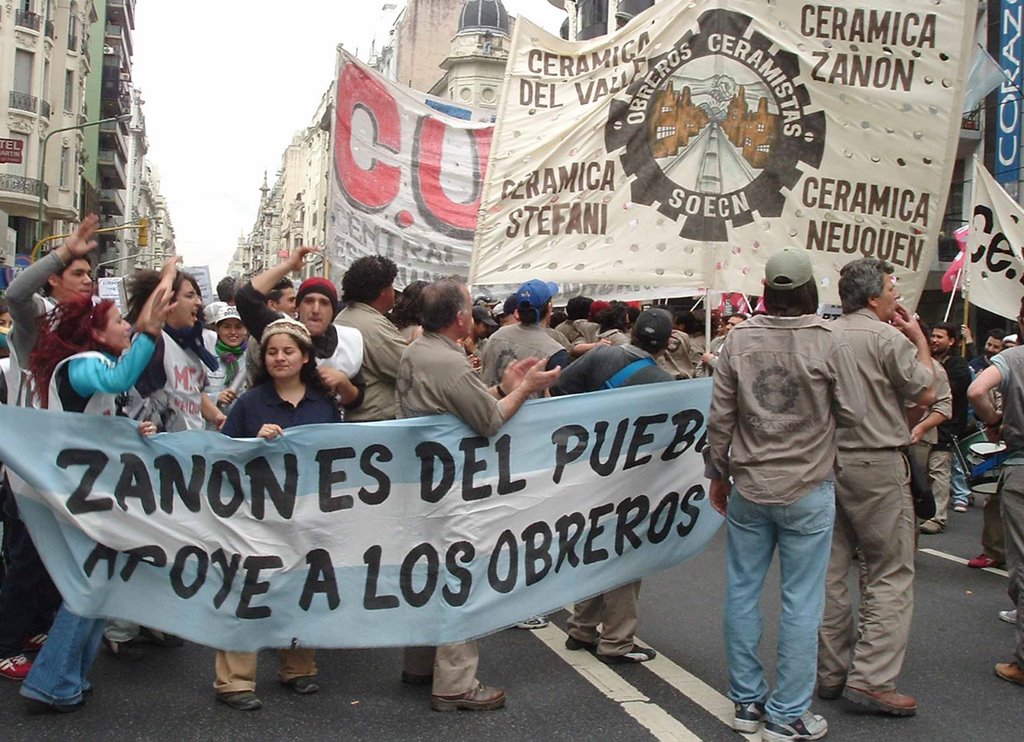
As the largest recuperated factory in Argentina, and occupied since 2001, the Zanon ceramics plant in the Patagonian province of Neuquén now employs 470 workers. Along with some 180 recuperated enterprises up and running, providing jobs for more than 10,000 Argentine workers, the Zanon experience has re-defined the basis of production: without workers, bosses are unable to run businesses; without bosses, workers can do it better. While these experiences are forced to co-exist within the capitalist market, they are forming new visions for a new working culture.

In October 2005, FASINPAT (Factory without a boss - Zanon's cooperative) won a legal dispute, pressuring federal courts to recognize it as a legal entity that has the right to run the cooperative for one year. With the October expiration date nearing, the worker assembly voted to step up actions and community efforts. On October 20, 2006, the workers won the longstanding legal battle for federal recognition of FASINPAT for three years.

Argentina’s working class has celebrated the Zanon workers’ temporary victory. With legal status, the FASINPAT can concentrate on planning production, improving working conditions, and doing community projects. As part of this celebration, the cooperative has invited other workers to visit Zanon to learn that they, too, can function without a boss or owner. The workers’ assembly has resolved that it is now in a position to teach others from its four and a half years of learning from self-management.

The workers at Zanon are rebuilding a national network of solidarity, which sustains the movement. Zanon workers regularly travel throughout the country to support a wide array of labor conflicts. As part of this initiative, several FASINPAT representatives toured the Greater Buenos Aires suburbs, hosting talks and special meetings with local worker organizations. Different from the usual political rallies, these meetings focused on building class consciousness and mutual solidarity among class-struggle-based organizations.

Affinities Journal
http://www.affinitiesjournal.org/index.php/affinities
Latin America’s Autonomous Organizing
MARIE TRIGONA
In February 2006 activists met in Uruguay for the fourth Latin American
Conference of Popular Autonomous Organizations. Over 300 delegates from
Brazil, Argentina, Bolivia, Chile and Uruguay organized this year's annual event as
a space to strategize autonomous organizing and coordinate direct actions. This
year's conference, held February 24-26 in Montevideo, focused on building
popular power in Latin America among organizations autonomous from the
state, political parties and Non-Governmental Organizations (NGOs).
Galpon de Corrales, a community center in a working class neighborhood in
Montevideo, coordinated the conference. The Galpon features a community
radio station, a community library and a large indoor space to hold cultural
activities. Activists from the community center take pride in the fact that the
Galpon is completely self-managed and sustaining, and several times a week
they organize a collective meal.
The participating organizations were generally oriented towards class struggle
and libertarian practices such as grass roots organizing, direct democracy and
mutual solidarity. Within the debate of how to build popular power, delegates
discussed strategies for communities to solve their own problems independently
of the state or other institutions.
The current context offered by Latin American state politics emerged as a focal
point during the two-day meeting. In each of the nations represented, social
organizations have faced new challenges due to the resurgence of "progressive"
social democratic governments. Take, for example, the case of Uruguay's social
movements, where many of these have demobilized after the inauguration of
Tabare Vazquez. At the conference all eyes were therefore on Bolivia due to the
recent victory of the Movement to Socialism’s (MAS) leader, Evo Morales. In all of
the workshops, participants discussed how to prevent the growing expectations
populations have of their social democratic governments from impeding the
accumulation of popular power.
Everything at the congress was auto-gestionado

Marie Trigona Latin America Activism

RENEGADE EYE