Monday, November 27, 2006

Introducing New Blog Team Member: Marie Trigona


I'm lucky having a strong team of writers on my blog; such as the nightmare to Islamism and capitalism from Iran originally Maryam Namazie, and the fighter against both Zionism and Arab reaction Marxist from Lebanon. Today I'm introducing from Buenos Aires, Argentina Marie Trigona.

The vanguard of the struggle against capitalism is now in Latin America. I was looking for a writer, to cover events there, when I discovered Marie Trigona's blog. The first post I read was about abortion in Argentina. I not only liked her post and writing, I also admired her bravery, to touch that subject there. Marie is also very knowledgeable about the recent occupations of factories in Latin America.

Marie is a journalist, videomaker and translator. This is her Blogspot profile; I have been working for a number of years as a writer. I regularly report for Free Speech Radio News, a radio news program broadcast in the U.S.. I form part of Grupo Alavío, an Argentine video collective. My main interests include labour struggle, social movements and popular communication. For a number of years, I've been writing about Argentina's recuperated enterprises. Hopefully, one day, I'll write a book. For now, I'm producing a lot of articles, radio stories and collaborating on video projects. I also translate from Spanish to English for paid work.

Besides her Blogspot blog, she writes as a blogger for ZNET. Marie's video work is at Agora TV.RENEGADE EYE

Saturday, November 25, 2006

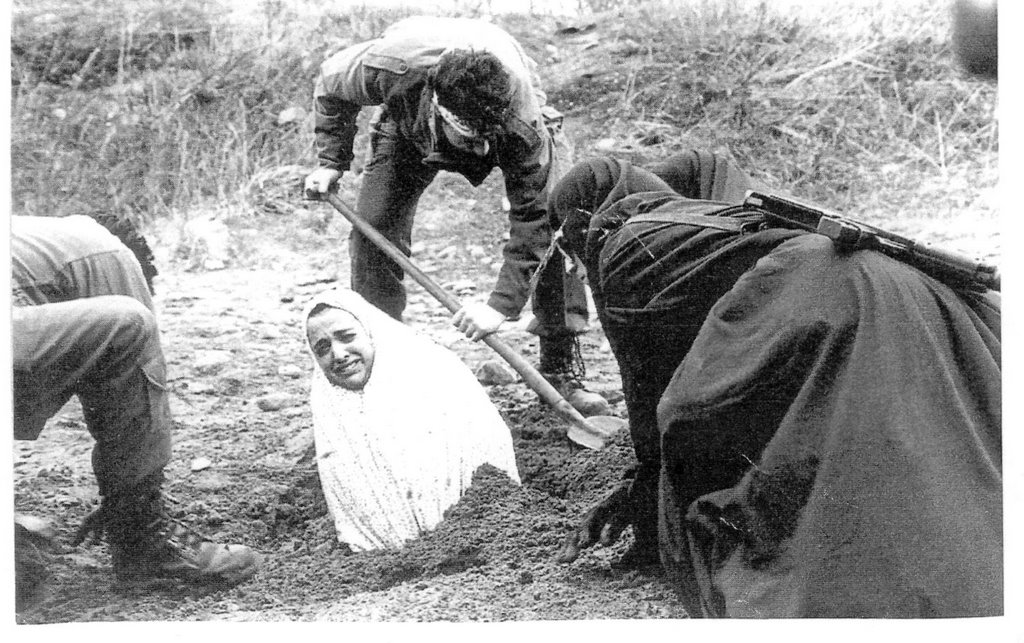
SEVEN WOMEN AT RISK FOR STONING


Seven women are at risk of imminent execution by stoning in Iran. Sign the petition against it by clicking here

This outrage has to be stopped now!

Maryam Namazie

Wednesday, November 22, 2006

‘Beyond the Veil: Perspectives on Muslim Women in a Western Secular Context’

Speech given by by blog team member Maryam Namazie at Goodenough College, on November 13, 2006.


It is crucial to speak about the rights of ‘Muslim’ women, go beyond the issue of the veil, and talk about secularism, particularly in light of the political Islamic movement’s assault on women and their rights, but restricting the debate in this way is seriously flawed.

Firstly, the so-called grouping of Muslim women is a constructed one. Out of the innumerable characteristics women have, why focus on their beliefs? Doing so, implies that religion informs the rights of all those labelled as Muslim (including very often people like myself - an atheist). This is not usually the case.

More importantly, why must women’s rights issues be discussed within the framework of religion or for that matter, with regard to the beliefs – real or imputed - of the woman whose rights are being discussed? Generally, this is not how rights are examined. For example, do we discuss domestic violence vis-à-vis Christian women or in the context of Christianity?

This seems to happen especially when it comes to Islam because of cultural relativism and a policy of minoritism. The British state prefers it to be so as it can ensure that these so-called Muslim women are forever alien to British society, ghettoized in regressive fragmented "minority" communities where they continue to face sexual apartheid and Islamic laws and customs. Their rights are not the highest standards available in society as one would expect but the most regressive and reactionary. To help ensure that it remains so, the state leaves the running of these Bantustans on the cheap to self-appointed ‘Muslim community’ leaders and ‘consultants on Muslim women’s affairs’ and continues with business as usual in wheeling and dealing with repressive Islamic states. The left, which is the traditional defender of women’s rights, shamelessly endorses the situation as it sees Islam and political Islam as ‘anti-imperialist’. As a result, no matter what happens - stonings and hangings in city squares in Iran or segregated Stop the War Coalition meetings in Birmingham and the manhandling of Iranian women’s rights activists in Manchester - they are quick to ignore violations of women’s rights. Hand in hand, they excuse and justify Islam and the political Islamic movement at the expense of women and their rights.

Clearly, a rights based discussion can’t begin with Islam but has to begin with the woman and her rights. In my opinion, you can either defend women or you must defend Islam. You can’t defend both because they are incompatible with and antithetical to each other.

In Islam a woman is sub-human, subservient, vilified and the property of men. To say that women have an elevated position under Islam is an insult to our intellect. Islam has wreaked more havoc, slaughtered more women, and committed more misogyny than can be denied, excused, re-interpreted, or covered up with such feeble defences.

According to the Koran, for example, those who are guilty of an 'indecency' must be 'confined until death takes them away or Allah opens some way for them.' (The Women, 4.15). 'Men are the maintainers of women' and 'good' women are obedient. Those that men fear 'desertion', can be admonished, confined and beaten' (The Women, 4.34). Wives are a 'tilth' for men, which they can go into their 'tilth' when they like (The Cow, 2.223) and on and on.

To say it is a problem of interpretation as some ‘Islamic feminists’ do is at best self-justification of one’s beliefs or at worst the justification of a right wing political Islamic movement, which targets women first and foremost.

Let me give you an example of the absurdity of re-interpretations. On the verse that allows women to be beaten, so-called Islamic feminists say ‘Islam only permits violence after admonishment and confinement and as a last resort. They say, since men would beat their wives mercilessly at that time, this is a restriction on men to beat women more mercifully’ (Women Living Under Muslim Laws, For Ourselves Women Reading the Koran, 1997). Or another says 'In extreme cases, and whenever greater harm, such as divorce, is a likely option, it allows for a husband to administer a gentle pat to his wife that causes no physical harm to the body nor leaves any sort of mark. It may serve, in some cases, to bring to the wife's attention the seriousness of her continued unreasonable behaviour' (Gender Equity in Islam Web Site).

Suffice it to say that misogyny cannot be interpreted to be pro-woman even if it is turned on its head.

Of course everyone has the right to believe anything they choose – however medieval and reactionary. Moreover, tolerance of the right to hold such beliefs is part and parcel of a civil society but that is very different to allowing beliefs to inform women’s rights or even tolerating the belief itself. Moreover, the question of choice is a questionable one when it comes to this situation. Of course an adult woman has the right to believe she must be veiled; must be beaten by her husband if she disobeys him; must be given the permission of her male guardian before she can travel or work; is not eligible for certain areas of study or work because of her ‘emotions’; should be stoned if she has sex outside of marriage and so on and so forth.

But if you remove all forms of intimidation and threats by Islamists, Islamic laws, racism, cultural relativism and ghetto-isation, the recruiting grounds for the political Islamic movement, etc., I can assure you that there will be very few women who will want to discuss their rights within the framework of Islam.

That rights are discussed in this way is more of an indication of the strength of the political Islamic movement in this country than anything else. Which is why ‘Islamic feminists’ or ‘consultants on Muslim Women’s affairs’ are more concerned about Islam than the woman and her rights.

Another example of this is their constant attempt at setting limits for who can and can’t discuss ‘Muslim women’s rights’. I thought the whole point of defending rights was to mobilise as much support as you can rather than establishing an exclusive club of the few who are allowed to say anything on the subject!
Anytime anyone discusses women’s status under Islam, s/he is labelled ‘Islamophobic’ and ‘racist’, a ‘white feminist’ supporter who ignores European and US imperialism’s battle over ‘Muslim women’s bodies’, a supporter of the USA’s threats and militarism, a ‘supporter of the war on terror’, and so on and so forth. Not to forget that s/he will be told that there are more important things in the world today – like poverty or US imperialism (this one crops up all the time), and of course that the crimes of the US government is much worse and must be the main and only focus…

What utter nonsense!

Criticising Islam (a belief) and political Islam (a right wing reactionary movement that has raised Islam as its banner) has nothing to do with racism no matter how many deceptively claim it to be so. Criticising the belief in and practice of Female Genital Mutilation does not mean you are vilifying or inciting hatred against girls and women who believe they should be or are mutilated.

Moreover, solidarity amongst people has nothing to do with their skin colour, place of residence or governments under which they were born or live under.

Also, saying a defence of women’s rights living under Islamic rules supports the war on terror or the USA’s militarism or colonialism and imperialism is like saying sex education promotes promiscuity. Saying so is more an attempt to defend religion than anything else.

And, why must a comparison be made with other outrages in the world. Yes the US government is one pole of international terrorism in the world today but what does that have to do with a defence of women’s rights living under the yoke of Islamic laws and rules?

Do we tell the environmentalist that children’s rights are more important because children are so vulnerable? Do we tell the anti-racist activist that poverty is more important than racism because you have to be fed to be alive? It is only when discussing women’s rights and those whose rights are deemed culturally relative that such arguments crop up.

And it only seems to come up with Islam and political Islam. No one says we shouldn’t condemn the Israeli occupation of Palestine or Tony Blair because US militarism is the main problem of our times.

And of course we keep hearing about how Jack Straw or the French government have mentioned the veil and our doing so puts us in the same boat as them. How so? I want a ban on the burka, neqab and child veiling. I think child veiling is a violation of children’s rights. I want the veil banned in all public institutions and the educational system. I will criticise the hejab as a tool for the repression of women even if some have the ‘right’ to ‘choose’ veiling. And I want much more done to religion, including an end to faith schools and the taxation of all these religious ‘charities’ and mosques…

Are we really supposed to stop speaking against the death penalty – for example - because Tony Blair is also against the death penalty in some way shape or form?

In this context, I think the defence of the veil as ‘a form of clothing’, ‘expression of faith’, ‘matter of choice’ and so on and so forth is more of the same. Saying we need to go beyond the veil implies that it is a superficial matter and that there are more important issues at stake. This is not the case.

The veil is a symbol like no other of what it means to be a woman under Islam - hidden from view, bound, and gagged. It is a tool for restricting and suppressing women. Of course there are some who choose to be veiled, but you cannot say it is a matter of choice because - socially speaking - the veil is anything but. There is no ‘choice’ for most women. In countries under Islamic rule, it is compulsory. Even here, in Britain, according to a joint statement about the veil from ‘Muslim groups, scholars and leaders’, including the Muslim Council of Britain, Hizb ut Tahrir and Islamic ‘Human Rights’ Commission, it is stated that the veil ‘is not open to debate’. The statement goes so far as to ‘advise all Muslims to exercise extreme caution in this issue since denying any part of Islam may lead to disbelief.’

And you know what they do disbelievers when they can – kill them.

As I have said before, take away all the pressure and intimidation and threats and you will see how many remain veiled.

In my opinion, debating the issue of women’s rights within an Islamic context is a prescription for inaction and passivity in the face of the oppression of millions of women struggling and resisting in Britain, the Middle East and elsewhere. Stripped bare it is a dishonest defence of Islam pure and simple and has nothing to do with women’s rights.

We must not allow the political Islamic movement to shift and redefine the debate on women’s rights. Anywhere they have power, to be a woman is a crime. In places like Britain, however, where they are vying for political power, they aim to control women relegated to their constructed regressive community via a deceptive discourse on ‘rights’ and ‘choice’ whilst defending Islamic law and repressive groups and states in the Middle East and elsewhere. They are an extension of the same movement that stones women to death and throws acid in their faces if they are improperly veiled. The stronger they become, the more repressed are women in the so-called Muslim community.

In the face of this onslaught, secularism, universalism and values worthy of 21st century humanity have to be defended and promoted unequivocally. We must hold the human being sacred. We must start first and foremost with the human being. We must stop sub-dividing people into a million categories beginning with religion and not even ending in Human. We must not allow concessions to religion at the expense of women; we must not allow the respect for and toleration of misogynist beliefs and practices. We have a duty to criticise and challenge Islam and its movement especially given what it is doing to women today.

At a minimum, we must demand the complete separation of religion from the state and educational system. Secularism is an important vehicle to protect society from religion's intervention in people's lives. A person's religion has to be a private affair.

Only an unequivocal defence of universal rights, secularism and the de-religionisation of rights and values will begin to defend women and their rights and challenge head on the outrage of this century.Maryam Namazie

Monday, November 20, 2006

December 03: 10,000,000 Votes for Hugo Chavez

Yesterday I attended the International Venezuela Solidarity conference, held at Macalester College, in St. Paul, MN. Several Venezuelan government members, and activists attended.

I'm reprinting the opening of the Statement of the International Marxist Tendency, on the Dec 03, 2006 Venezuelan elections. The Chavez supporters use the slogan, "10,000,000 Votes for Hugo Chavez". It is expected that Chavez will attain some 8 million votes. If they don't get 10,000,000, the more conservative Chavez supporters, are going to say he was too leftist. After the election, how revolutionary the government is, will be known.

The December presidential elections are an important turning point in the development of the Venezuelan Revolution. They reflect the struggle between the Venezuelan workers and peasants and the oligarchy and imperialism. Our attitude towards these elections is therefore a key question.

Marxism has nothing in common with anarchism. We have never denied the importance of the electoral struggle as part of the class struggle. For the masses the question is very clear: a vote for Chavez is a vote for the revolution. On the other hand, the oligarchy and imperialism are doing everything in their power to bring about the defeat of Chavez. At bottom this is a class question and we must take our place side by side with the revolutionary workers and peasants fighting against imperialism and the oligarchy.

The counterrevolutionary forces have already started a campaign to discredit the elections. They will use all the means at their disposal to undermine them: bribery, corruption, slander and lies and all kinds of sabotage. They will have at their disposal considerable resources: the wealth of the oligarchy, the technology of the CIA, the backing of the US embassy, the yellow press and the rest of the prostituted media.

On the other side we have the revolutionary spirit, courage and dedication of millions of Venezuelan workers, peasants and urban poor, the revolutionary youth, the revolutionary sections of the army and the progressive artists and intelligentsia - in short, all the live forces of Venezuelan society, backed by the exploited masses of Latin America and the working class of the entire world.

The workers and peasants are fighting to transform society. Great advances have been made, but the final goal has not been reached. The power of the oligarchy has not yet been broken. As long as this is the case, the revolution cannot be irreversible and will be constantly under threat.


When government representatives, at the conference, were asked about worker's control of industry, and worker's democracy, in general the question was ignored, or danced around. The politicians say that the revolution is based around the 1999 constitution. This document allows for private property rights. You hear from them, about the unique history of the struggle in Venezuela. They will say socialism in the 21st century, is different than anything before. This talk protects career politicians, some corrupt, and bureaucrats to be in the government, without a way for the workers and peasants, to oust them. The possibility of sabotage to the revolutionary path is real. Without an organizational form, similar to soviets at the time of the Russian revolution, the revolution can be curtailed.

One of the Chavez representatives, said the name of the country might be changed to the Bolivarian Socialist Republic of Venezuela. He didn't say anything about the telecommunications, food, and banking industry are in private hands, or what he thinks should be done about it.

It should be made clear, the elementary duty of a socialist or progressive person, is to support Venezuela if attacked from the outside. At the same time as a socialist, to warn the Chavez supporters, that they can lose the gains already made, without socialist revolution.RENEGADE EYE

Friday, November 17, 2006

HOTEL RWANDA -- Hollywood and the Holocaust in Central Africa -- by keith harmon snow


The blog CirqueMinime/Paris is a leftist blog of a theater group in Paris. I love reading it, for its unique view. Even when they make me cringe, with their support for Putin, Mugabe etc, they present good arguments, that will challenge your beliefs. I hope you'll visit their blog. In that spirit I present this post from their blog. Sorry for two long posts in a row.

HOTEL RWANDA
Hollywood and the Holocaust in Central Africa


keith harmon snow
www.allthingspass.com

First published: 04 July 2005;
Text modified: 05 November 2005;
Final version: 04 December 2005.
Revisited Final: 10 January 2006.


What happened in Rwanda in 1994? The standard line is that a calculated genocide occurred because of deep-seated tribal animosity between the majority Hutu tribe in power and the minority Tutsis. According to this story, at least 500,000 and perhaps 1.2 million Tutsis—and some ‘moderate’ Hutus—were ruthlessly eliminated in a few months, and most of them were killed with machetes. The killers in this story were Hutu hard-liners from the Forces Armees Rwandais, the Hutu army, backed by the more ominous and inhuman civilian militias—the Interahamwe—“those who kill together.”

“In three short, cruel months, between April and July 1994,” wrote genocide expert Samantha Power on the 10th anniversary of the genocide, “Rwanda experienced a genocide more efficient than that carried out by the Nazis in World War II. The killers were a varied bunch: drunk extremists chanting ‘Hutu power, Hutu power’; uniformed soldiers and militia men intent on wiping out the Tutsi Inyenzi, or ‘cockroaches’; ordinary villagers who had never themselves contemplated killing before but who decided to join the frenzy.” [1]

The award-winning film Hotel Rwanda offers a Hollywood version and the latest depiction of this cataclysm. Is the film accurate? It is billed as a true story. Did genocide occur in Rwanda as it is widely portrayed and universally imagined? With thousands of Hutus fleeing Rwanda in 2005, in fear of the Tutsi government and its now operational village genocide courts, is another reading of events needed? [2]

Is Samantha Power—a Pulitzer Prize winning journalist—telling it straight? [3]

Is it possible, as evidence confirms, that the now canonized United Nations peacekeeper Lt. General Roméo Dallaire was at the time an agent of the Tutsi army? Or that the funding for Hotel Rwanda came from a company with powerful mining interests in Congo—where access is insured by the Rwanda government?

Hundreds of thousands of people were killed, that’s clear. There was large-scale butchery of Tutsis. And Hutus. Children and old women were killed. There was mass rape. There were many acts of genocide. But was it genocide or civil war?

“I think that’s a very good question and it is not adequately answered,” says Howard W. French, former East Africa Bureau Chief for the New York Times and author of Africa: A Continent for the Taking. [4]

Howard W. French operated on the ground in Central Africa (1993-1999) and his reportage of the RPF Tutsi rebel army hunting down and massacring hundreds of thousands of Hutus in Congo is exceptional. [5]

“A minority of fifteen percent [RPF Tutsis] wages a determined effort to take over a country and rule in an ethnic way, by force of arms, and has been doing this for years. Two presidents are assassinated.” Howard W. French is adamant. “These are not excuses for butchery. But these are things that lead one in the direction of civil war, as a descriptor, as opposed to the one-sided tale that we have been given, of these sweet, innocent Tutsis who remind us of Israel, versus the savage Hutus who cold-heartedly butcher people hand-to-hand for three months.” [6]

From the very first words and frames, where the image has yet to appear and the screen is completely black, the film Hotel Rwanda sets up viewers to think a certain way about what happened in Rwanda in 1994. Here is a story about good versus evil. An ominous African voice is heard, clearly the announcer on a Rwandan radio program, and he is describing the Tutsis as ‘cockrrrRRROACHES.’ The voice is black and the cataclysm unfathomable, as anyone will tell you, and the black screen underscores the evil darkness of Africa. This voice of terror returns throughout the film to haunt the innocent but terrified Tutsis, on screen, and the viewers gripping their seats.

The good guys are the Tutsis, the victims of genocide. They are not killers in the movie: they are never killers. At the end of the film, when a well-attired guerrilla force is shown—the ‘rebels’ of the Rwandan Patriotic Front (RPF)—they are rescuers. They are disciplined, organized. They keep a tidy United Nations camp safely behind their lines. They don’t kill Red Cross nurses, or orphaned children, in the film: they reconnect children to their families.

The Hutus in the standard Rwanda genocide stories are always the bad guys, and they are all bad guys. Every Hutu is a genocidaire—to use the ominous French term deployed in English contexts to further underscore the horror, the horror (sic). The Hutus are the devil incarnate. The Tutsis are saintly. Indeed, they are beyond reproach, because they are the victims of genocide. The Hotel manager’s wife bears an obvious cross around her neck, to remind us that the Tutsis are the chosen people. When the now celebrated United Nations hero Lt. Gen. Roméo Dallaire shakes hands with the devil—as his own popular book and the subsequent film Shake Hands With the Devil concur—he is shaking hands with Hutu. [7]

That is the ideological framework of the Hotel Rwanda film. There is, today, an industry behind it.

The Tutsis are dehumanized by the Hutus and by the Hutu media, in the film, and there was plenty truth in this in real life. But the RPF pro-Tutsi media that operated in Rwanda after 1991, for example, was equally dehumanizing, and equally vicious, but the film does not tell us this. Tutsi guerrilla forces—prior to 1970—were the first to describe themselves as Inyenzi or cockroaches: they were not equated with the insects that everyone loathes, they were well trained, secretive and coordinated military forces who attacked at night and withdrew by day. [8]

The RPF would hit and run and kill with efficiency. It was not a pejorative usage, as it has been used in the film Hotel Rwanda, although it was bastardized and turned against the Tutsis by media outlets in Rwanda. Radio Mille Collines and the other anti-RPF media outlets of the President’s party, the National Republican Movement for Democracy and Development (MRND), [9] were not the only ones to incite hatred and murder. Indeed, RPF-controlled Radio Muhabura spread ethnic hatred and incited widespread killings, but this was—according to Hollywood—a war with only one army, the ruthless Hutus. [10]


The Pillars of Hotel Rwanda

When Human Rights Watch investigated the genocide, they sent Alison des Forges to tell the story, and the product of her long investigations was the fat treatise on genocide in Rwanda titled Leave None to Tell the Story. Irony is heaped upon irony when we consider that those who are left to tell the story are silenced by the authorized storytellers like Alison des Forges.

“Alison des Forges is a liar,” Cameroonian journalist Charles Onana, author of the book The Secrets of the Rwandan Genocide, Investigations on the Mysteries of a President, published in French in 2001, is adamant. “She is a LIAR.” [11]

Paul Kagame, RPF General and President of Rwanda, sued Charles Onana for defamation in a French court: Kagame lost. [12]

“Des Forges has written a book which has become the bible regarding Rwanda,” says Jean-Marie Higiro, former Director of the Rwandan Information Office (ORINFOR) who fled the killing, with his family, in early April 1994. “Everyone points to her book even though some of what she has produced is fiction. I don’t think she is an intentional liar, but I don’t know why she investigated Hutu human rights abuses but no RPF human rights abuses.”

Hotel Rwanda is built on the pillars of selective human rights reporting, but it really takes off from the celebrated text, We Regret To Inform You That Tomorrow We Will Be Killed With Our Families, by Philip Gourevitch, the New Yorker magazine’s premier Africa expert.

“Gourevitch's short book should be compulsory reading for Heads of State and Ministers of Defence all over Africa,” wrote Guardian reporter Victoria Brittain, “as well as for all UN officials involved in peacekeeping operations and humanitarian aid, from the Secretary General on down, and the heads of missionary orders in the US, France and Belgium.” Victoria Brittain is a Nation magazine contributor on genocide in Rwanda. [68]

The International human Rights Law Clinic at American University for several years (at least) asked students to read Philip Gourevitch on genocide in Rwanda, in preparation for legal work with the International Criminal Tribunal on Rwanda. Professor Melissa Crow, who worked with the Law Clinic, followed her term at Human Rights Watch (1994-1995) by working in Kigali, Rwanda, under the RPF government, working for the Office of the Prosecutor for the International Criminal Tribunal on Rwanda. Following this she joined Foley, Hoag and Elliot, the influential Washington D.C. law firm closely aligned with the U.S.-Uganda Friendship Council, which is closely tied to ChevronTexaco, Coca-Cola, the William Jefferson Clinton Foundation and the Pangaea Global AIDS Foundation. The latter foundations are also deeply involved in Rwanda [69].

Notably, a U.S. immigration judge in St. Paul Minnesota imposed Gourevitch’s book as compulsory reading for all attorneys dealing with Rwandan refugees requesting political asylum. But this is a dangerous and irresponsible precedent. [13]

Funding for Gourevitch’s book came from the United States Institute for Peace, a State Department offshoot (with an Orwellian name). [14]

What we never learn about Philip Gourevitch is that his brother-in-law, Jamie Rubin, was Madeleine Albright’s leading man and, through him, Gourevitch planted in the public mind a narrow perspective on Rwanda. [15]

Philip Gourevitch is an intimate pal of Rwandan President Paul Kagame. I regret to inform you that Philip Gourevitch is not an impartial journalist, regardless of how much you may have liked his book, or have been moved by it, because he has taken sides, and he has told only one side of the story, and he has told it badly, and he has been rewarded for his fine job in telling it badly. [16]

“Gourevitch begins the story with the Tutsi as these saintly victims,” the Times’ Howard W. French says. “And I don’t think Gourevitch is a stupid guy. I think that it’s just sheer intellectual dishonesty… Gourevitch was coming out in the New Yorker every other month with this very well written and—if you don’t know the facts—very compelling picture about Rwanda… as the Israel of Central Africa and the Tutsis as the Jews of Central Africa. That’s powerful stuff. But I’m on the ground in Central Africa seeing that the reality is very, very different.” [17]

The theme of genocide in Rwanda—whether true or false—has birthed an industry that revolves around a standard, simplified plot. The appearance of the film Hotel Rwanda marks the coup de grace in the long process whereby the facts, the ugly realities and dirty details of what really happened in Rwanda have been distilled into a neat and tidy story that proliferates in the media, in film, in literature, at seminars on genocide and workshops on reconciliation, and it is the predominant discourse in academia. Quebecois journalist Robin Philpot calls it “the right and proper tale.” [18]

The Falsification of Amerikan Consciousness

It has become a mythology: the Rwanda genocide mythology or, better, the Tutsi Holocaust mythology. But as African scholar Amos Wilson puts it so simply in The Falsification of Afrikan Consciousness, “you cannot understand the present unless you first understand the past.”

To understand the growth of the mythology on genocide in Rwanda, consider first the text of Hotel Rwanda—The Official Companion Book, which describes the process of “bringing the true story of an African hero to film.” [19]

The book deletes the most basic facts about the Rwandan Patriotic Front and its backers’ roles in the ongoing war for the Great Lakes region of Africa, war that has led to at least seven million people dead since the initial RPF invasion from Uganda in October 1990. [20]

Instead the book offers an abbreviated timeline of events that accentuate or exaggerate those points that serve the predominant Hotel Rwanda mythology, and it excludes those facts that would undermine this mythology: the entire framework of the brutal, bloody war for control of Rwanda is obscured.

October 1990: Guerrillas from the Rwandan Patriotic Front (RPF) invade Rwanda from Uganda; the RPF is mostly made up of Tutsis. A ceasefire is signed on March 29, 1991.

First: the above statement uses the definitive term for the RPF action: invaded. The Rwandan Patriotic Army invaded Rwanda from Uganda. However, the context of the RPF ascension to power is obliterated. RPF infiltration of Rwanda began around 1986 after Yoweri Museveni, with powerful western backers, shot his way to power in Uganda. Paul Kagame, current president of Rwanda, was head of Museveni’s Directorate of Military Intelligence, and later commanded the Rwandan Patriotic Front. But the RPF invasion was a gross violation of international law against a sovereign nation—a point the Hotel Rwanda industry ignores.

Never condemned by the international ‘community,’ the RPF ‘struggle’ was supported by powerful western agents and institutions, including the World Bank and the IMF, who shackled Rwanda with austerity programs in perfect synchronization with the RPF assault. This led to the heightened inculcation of structural violence throughout Rwanda. Combined with the crash of coffee prices on the world market, millions of Rwandans found it impossible to make ends meet as the 1990’s began. Suffering hit new lows not seen in Rwanda for decades.

The majority of people in Rwanda, besieged by the propaganda of competing factions—a spectrum of political interests aligned with or against the RPF or the Rwanda government of Juvenal Habyarimana—found scapegoats according to their positions in society. Economic interests predominated as a few elites increasingly controlled the life or death of the many. The rising insurgency and structural violence provoked hostility amongst and between groups, and elites controlling media outlets of all stripes began to use their venues to sow ethnic rivalry as the veneer for the deeper agenda: class warfare.

Hutus were dehumanized as often as Tutsis. “Pro-opposition newspapers represented MRND [Hutu government] leaders as essentially evil and corrupt,” writes Jean-Marie Higiro. They were “liars, idiots, animals, bloodthirsty murderers and warmongers. Some of these newspapers published drawings of President Habyarimana covered with blood.” [21]

The RPF and Rwandan Tutsi Diaspora had their own publications. The best known of these is Impuruza, published in the United States (1984-1994). Tutsi refugees joined Roger Winter, the Director of the United States Committee for Refugees, to help fund the publication. The editor, Alexander Kimenyi, is a Rwandan national and a professor at California State University. Like most RPF publications Impuruza circulated clandestinely in Rwanda amongst Hutu and Tutsi elite.

“A nation in exile, a people without leadership, ‘the Jews of Africa’, a stateless nation,” wrote Festo Habimana, the president of the Association of Banyarwanda in Diaspora USA, in the premier issue of Impuruza. Habimana called for the unity of Tutsi refugees. “But our success will depend entirely upon our own effort and unity, not through world community as some perceive… As long as we are scattered, with no leadership, business as usual on their part shall always be their policy. We are a very able and capable people with abundant blessings. What are we waiting for? Genocide?” [22]

The Association of Banyarwanda in Diaspora USA, assisted by Roger Winter, organized the International Conference on the Status of Banyarwanda [Tutsi] Refugees in Washington, DC in 1988, and this is where a military solution to the Tutsi problem was chosen. The US Committee for Refugees reportedly provided accommodation and transportation. [23]

Winter is intimate with USAID, and a long-time ally of Susan Rice, former Assistant Secretary of State on African Affairs (1997-2001), Special Assistant to President Clinton (1995-1997), and National Security Council insider (1993-1997). Roger Winter is also a staunch supporter of US. Rep. Donald Payne.

Winter acted as a spokesman for the RPF and their allies, and he appeared as a guest on major US television networks such as PBS and CNN. Philip Gourevitch and Roger Winter made contacts on behalf of the RPF with American media, particularly the Washington Post, New York Times and Time magazine. Roger Winter and US Rep. Donald Payne continue to manipulate African affairs: most notable are there recent exaggerations about genocide in Darfur, Sudan, for which Donald Payne sponsored the Darfur Genocide Accountability Act.

Second: the language of the above October 1990 timeline entry underscores the equally discrepant point that the RPF was “mostly made up of Tutsis.” According to the genocide mythology, the cataclysm in Rwanda was a tribal struggle between Hutus and Tutsis, with some involvement of France.

Who were the non-Tutsi elements of the ”mostly” Tutsi RPF? What is the implication? They were Hutus? How could Hutus be fighting alongside Tutsis if Hutus were exterminating all Tutsis based on an organized, premeditated plan? The term “moderate Hutu” invites a similar conundrum: what is a “moderate Hutu” in the international legal framework of genocide?

Jean-Marie Higiro says it best: “Academics and journalists divide Hutus into two categories: moderates and extremists following the myths of Hollywood. They never suggest that there were Hutu who did not belong to either category. There were those who were terrified by both sides and who just fled for their lives. Academics and journalists never do the same [segregating] for Tutsis and of course never for the RPF even though the RPF was a conglomerate of Tutsi supremacists, Republicans and monarchists. These supremacists are highly placed in the current government. Tito Rutaremara, one of the ideologues of the RPF is one of them, and General Ibingira, the butcher of Kibeho [is another] of them.”

The very definition of genocide would be called into question if it turned out that there were political, economic or class—as opposed to ethnic—motives behind the hundreds of thousands (or 1.2 million) of deaths that have been unequivocally attributed to Hutu genocidaires. A deeper examination of “genocide” in Rwanda raises just such inconvenient questions. The determination of what constitutes genocide is not so cut and dry as Hutus versus Tutsis, or lists of targeted Tutsis versus no lists, no matter the terror now invoked in one’s soul on hearing the word Interahamwe.

After the October 1990 entry, the timeline in the companion book omits any reference to the RPF until February 1993, as if the supposed ‘heroic’ Tutsi rebels were patiently sitting out the war from the Ugandan sidelines. But massacres occurred in northern Rwanda after the October 1990 invasion and after the 1991 ceasefire and they were committed by the RPF. Tens of thousands of refugees fled the border districts in fear of ongoing RPF atrocities.

(This author remembers well the traumatized tourist who disembarked from the bed of a small pick-up truck that crossed the border from Rwanda to Uganda in 1991. I was in Kasindi, in southwest Uganda. The Rwandan man sitting next to this western woman was shot by an RPF sniper as the truck drove down the road; the truck was then stopped, searched by the RPF, and the dead man taken.)

From 1990 on, RPF terror cells began infiltrating Kigali, the capital, and all other areas of Rwanda, and with them came atrocities that were frequently blamed on the Habyarimana government, including assassinations, massacres and disappearances. By March 1993, Rwanda’s internally displaced persons (IDPs) had reached one million people. The RPF practiced a scorched earth policy: they did not want to have to administer a territory or deal with local populations. The RPF displaced people, shelled the IDP camps, and marched on. They killed some captives, buried them in mass graves or burned corpses, and used survivors as porters to transport ammunition, dig trenches or cook their meals.

According to one Rwandan now in the US: prior to 1994, most Tutsis who had a job in Rwanda collected contributions for the RPF political and military program; people were afraid to refuse to pay the compulsory tax levied by a ruthless military institution, the RPF.

The Habyarimana government responded to terror with repression in kind, but the international human rights “community” had already taken sides in the war: the Hutu government of Habyarimana was accused of “genocide” against Tutsis as early as 1993; the RPF atrocities were ignored or explained away.

“There were many RPF killings in Rwanda between 1990 and 1994,” says Jean-Marie Higiro, “but these were not investigated; they were automatically attributed to Habyarimana’s [MRND] party by the international community. Even so, we know that the RPF used that kind of strategy to tarnish the image of their opponents.” [24]

Jean-Marie Higiro also cites the Tutsi newspaper Impuruza, the publication edited by Professor Alexandre Kimenyi, with accusing the Habyarimana government of committing genocide against the Tutsis, and this was prior to 1993.

February 1993: The RPF again invades Rwanda. Hutu extremists cite the invasion as proof the Tutsis aim to eliminate them, and begin calling for preemptive measures.

To begin with, the RPF never left Rwanda, and they never stopped killing. Following the reasonable questions by journalist Robin Philpot, how would US citizens respond if Canadian guerrillas—arguing that their parents were born or once lived in the US—invaded from Toronto? Would we call Americans who complained “extremists”? What if a few Islamic militants purportedly invading the US took out the World Trade Center? Would the US government call for preemptive measures? Would we call the invaders a “rebel army”? Extremists? Would we call them terrorists?

“Is it normal in the search for justice to condemn one side in a war for human rights violations,” writes Robin Philpot, “and not even question the morality of the aggressors, those who violated the principles of all the charters of rights humanity has ever drafted? Is it right to shout about how a government violates rights and turn a blind eye to the launching of an aggressive war?” [25]

Like the film, the Hotel Rwanda Companion Book offers a gross and distorted simplification of events in Rwanda.


Hotel Pentagon

Trained by the US Army at Fort Leavenworth, Kansas, USA, the RPF soldier and now President of Rwanda, Paul Kagame, is a regular visitor at the Pentagon, and he was not the only officer in Rwanda with ties to the US military.

Under the Pentagon’s International Military Education Training Program (IMET), some $769,000 trained 35 Rwandan officers at US military schools from 1980 to 1992, and $120,000 was earmarked for Rwanda for both 1994 and 1995. Further military assistance was provided by the US to 1994, while the bulk of the arms and logistical support came from US client states (France, South Africa, Egypt, Uganda and Zaire). The Pentagon has also trained large numbers of Rwandan soldiers in the Extended-IMET (E-IMET) and Joint Command Exchange and Training (JCET) programs. One of those trained was Bangladeshi Colonel Moen, the Chief Operations Officer for UNAMIR, another graduate of the U.S. Army Command and General Staff College in Leavenworth, Kansas (USA). [26]

From 1993 onwards the RPF continued to stick its bloody foot in the door of Rwanda, and the international community continued to tighten the screws on the Habyarimana government. Ever vigilant and inflammatory in advertising the governments’ human rights abuses—whether manufactured, exaggerated or real—the human rights community continued to close its eyes to RPF atrocities, terrorist infiltrations and bloodied land grabbing.

Backed by powerful factions from the United States, England and Belgium, the RPF maneuvered and manipulated its way to the very seat of power, in Kigali itself, where—under the Arusha Peace Accords negotiated in Arusha Tanzania in 1993—a battalion of RPF soldiers was based at a strategic site within the city center. The RPF immediately fortified its defenses under the watch of Lt. General Roméo Dallaire—now universally regarded as a hero—the Canadian Force Commander for the United Nations Assistance Mission for Rwanda (UNAMIR).

The Hotel Rwanda Companion Book offers only the following tidy summary which, as popular mythology now holds, credits the RPF with the imperative of ‘stopping the genocide’ against Tutsis.

Mid-July 1994: The Tutsi RPF forces capture Kigali and the genocide is over. Over a period of 100 days, almost 1,000,000 Rwandans were murdered.

While it is alleged that “almost 1,000,000 Rwandans were murdered” in those 100 days, a claim that is certainly exaggerated, it is also true that the RPF slaughtered, bombed, massacred, assassinated or tortured hundreds of thousands of people—including Hutu and Tutsi soldiers, politicians and government officials, and innocent civilians.

“All UN compounds were sheltering thousands of fearful Rwandans,” wrote the former UNAMIR commander, Lt. General Roméo Dallaire, “How could I possibly keep them safe?” Dallaire’s admission subsequent to the previous statement is very insightful, especially given his pro-RPF position: “We protected these citizens from certain death at the hands of the extremists or the RPF…” In this [previous] quote, Dallaire openly confirms the RPF’s role in killing, and his book repeatedly describes firefights he witnessed between the RPF and various government factions. [27]

There were no firefights shown in Hotel Rwanda, there was none of the ongoing warfare that rocked Kigali before and after 06 April 2004: there were only ruthless, savage, Hutu killers and rapists, and the dead bodies that—by inference and innuendo—the Hutus slaughtered with machetes, pangas, axes and hoes.

The RPF employed state-of-the-art information control and psychological operations tactics practiced by the US military: international reporters were embedded; access to battle zones was restricted; evidence of RPF massacres was erased, or massacres were blamed on Hutu extremists, Interahamwe militias or the government Forces Armee Rwandaise. British journalist Nick Gordon reported crematoriums where the RPF incinerated bodies.

After the April 6, 1994, double presidential assassination, the western press—including Joshua Hammer (Newsweek), and Raymond Bonner, James C. McKinley Jr. and Donatella Lorch (New York Times)—went out of their way to cite ‘professionalism’ and ‘discipline’ and ‘remarkable self-control’ exercised by the invading rebel RPF forces. The western press turned the double Presidential assassinations into ‘a mysterious plane crash,’ but this was a smoldering wreckage of the truth. [28]

“In conjunction with the military build-up by the RPF and its allies—including the infiltration into Kigali, the capital city, of up to 10,000 RPF soldiers,” writes ICTR barrister Chris Black, “western journalists and western intelligence services masquerading as “human rights” organizations began a concerted propaganda campaign against the [Habyarimana] Government and through it the Hutu people, accusing it of various human rights abuses, none of which were substantiated.” [29]

UN High Commission for Refugees investigator Robert Gersony reported in September 1994 on the RPF’s killing of more than 30,000 ethnic Hutus—in a period of two months—and gave a detailed account of locations, dates and nature of crimes, as well as the methods used to kill and to make the bodies disappear. Gersony also identified RPF leaders responsible for the killings. The classified UN report has never been released.

Interested moviegoers might want to hack through the perception management of Hotel Rwanda to get to United Artists parent company Metro Goldwyn Meyer. [30]

MGM directors, unsurprisingly, given what the film does not tell you about the true US role in Rwanda, include current United Technologies director and US General (Ret.) Alexander Haig. United Technologies is in the business of war and “I’m in charge here!” Al Haig served as secretary of state under a Hollywood actor named Ronald Reagan.

The other producers of Hotel Rwanda include an unknown company called Kigali Releasing Ltd., and another called the Industrial Development Corporation of South Africa Ltd. The latter is a major shareholder of, and mining partner with, Iscor Ltd., one of the companies named by the UN Panel of Experts Report (2002) for the illegal exploitation of resources from the Congo. [70].

US military involvement in Rwanda has included ‘counterinsurgency’ training, ‘psychological operations’ and tactical Special Forces: Special Operations Command oversees Navy Seals, Army Rangers and Delta Force: elite units deployed as special operatives in covert operations. [31]

The hotel in the film is not the real Hotel des Mille Collines. The Tutsi RPF rebels did not enter Kigali, Rwanda’s capital city, and save the day, they were in Kigali all along. The RPF gained a foothold in Kigali through their constant deceptions and manipulations of the “peace process,” and with the support of their international backers, especially the United States. The RPF ‘rebels’ were better trained, better equipped, better organized than any and all other combatants in Rwanda and, notably, numerous sources claim that the RPF had the capacity to stop the killings. Sources also report that the Forces Armees Rwandais—the Rwandan government army—didn’t have the resources to fight both the RPF and the Interahamwe.

Professors Christian Davenport (U. Maryland) and Allan Stam (Dartmouth) published research in 2004 that showed that the killings began with a small, dedicated cadre of Hutu militiamen, but quickly cascaded in an ever-widening circle, with Hutu and Tutsi playing the roles of both attackers and victims. Their team of researchers also found that only 250,000 people were killed, not the 800,000 plus advanced by the RPF, and that for every Tutsi killed two Hutus were killed. The research unleashed a firestorm: the media jumped on them for denying genocide.

“Our research suggests that many of the victims, possibly even a majority, were Hutus—there weren’t enough Tutsis in Rwanda at the time to account for all the reported deaths… When you add it all up it looks a lot more like politically motivated mass killing than genocide. A wide diversity of individuals, both Hutu and Tutsi, systematically used the mass killing to settle political, economic and personal scores.” [32]

“When you look at the motivations of the Interahamwe leadership and young people in the Interahamwe they were motivated by money,” notes former ORINFOR director Jean-Marie Higiro. Some Hutu businessmen were giving out loans, contributing to political parties of both the Rwandan government and the RPF rebels. “These guys wanted to do business: people were motivated by different interests.”

“Many Hutu and Tutsi businessmen prospered under the Habyarimana regime,” Jean-Marie Higiro notes. “They received government contracts and loans from government banks and suddenly became rich. During this period of uncertainty they contributed money to the RPF, MRND, and opposition parties—always speculating on the winner. That is why, after the war, very few Hutu businessmen who had contributed to the RPF reopened their business immediately. That is why some Tutsi businessmen who contributed to the RPF made an excellent calculation. After the war they reaped off the benefits.” [33]

Some facts in the film are true. To begin with, in every sense of the terms “human rights” and “humanitarianism,” the western powers betrayed the people of Rwanda. The whites were rapidly evacuated, the blacks abandoned, including the many African staffers of international agencies. The French armed the Hutu side, and they evacuated key Hutu elite at the first opportunity, but the United States, U.K. and Belgium armed the Tutsis. There was a Rwandan man named Paul Rusesabagina and he would, one day, be working at the Hotel des Mille Collines, but he was the manager of the Hotel des Diplomats. The Tutsi rebels were blamed for the assassination of the presidents of Rwanda and Burundi, but the film convinces us they didn’t do it, when everything suggests they did. And it is certainly true that hundreds of thousands of Rwandans died.

Hotel Rwanda is a work of fiction. As a cultural artifact produced by an affluent entertainment industry in the West, and for affluent western consumers, but focused on a distant and exoticized culture about which the affluent western consumers know very little, or nothing at all, it serves to consolidate the ideological pillars of disinformation that came before it, and upon which it was built.

According to many and varied knowledgeable sources, including hotel insiders: Rwanda was not abandoned by the western powers: Belgium, France, Canada, England and the United States were all militarily involved in the 1994 conflict. Because there are Israeli connections to the current government, it is likely that Israeli military agents were also involved. These were no bystanders to genocide, as Samantha Power and the Atlantic Monthly and others would like us to think, but active participants in a ruthless international military conflagration. Note that amongst Atlantic Monthly’s primary advertisers [read: sponsors] is Lockheed Martin [aerospace and defense] Corporation.

The hotel was not under a state of siege early on as the movie suggests—an elegant wedding took place there during the fray, and it married the sister of the Tutsi businessman Kamana Claver, who had contracts with the Hutu government. According to one guest, powerful Hutus and Tutsis regularly came and went. When the water to the hotel was shut off, forcing the ‘refugees’ to drink the water from the swimming pool, it was not shut off by the Hutu genocidaires, as implied in the film, but by the Tutsi RPF army, who cut power to the city.

General Bizimungu appears in the very first scenes of the film, prior to the double presidential assassination: yet when the plane was shot down on April 6, 1994, General Bizimungu was still a Colonel, and he was far from Kigali. According to one hotel guest, who remains unnamed for fear of retribution, Paul Rusesabagina, the film’s hero, in no way wielded the kind of influence as depicted throughout the film:

“Paul was a very simple man like me in front of the Interahamwe. If he succeeded to save some Tutsi from his home he was most probably helped by some influential Interahamwe friend, say Georges Rutaganda. He was as vulnerable as I was and could not oppose any action against the will of the militia and much less of the army. He lies when he feints to call General Bizimungu for help, because the Hotel des Mille Collines was under the jurisdiction of Colonel Renzaho. Bizimungu lived at the northern war front lines, and he only came to Kigali four days after the plane was shot down and I never saw him at the hotel.” [34]

“There is overwhelming evidence,” wrote Rutigita Macumu in an opinion piece titled “Paul Rusesabagina Not a Hero!” in Rwanda’s state-owned newspaper, The New Times, on November 5, 2005, “that Paul Rusesabagina did not particularly go out of his way to bring the people, who were being hunted, to the Mille Collines Hotel haven, to protect them once they were in the hotel, to procure them food or even water when they were unable to pay for them, or to devise any uncommon means to fend off the killer gangs outside the hotel. It is highly apparent that he only fulfilled his duty, as directed by his Sabena bosses, to run the hotel well and cater for all its occupants.” [35]

Georges Rutaganda, the devil beer salesman and erstwhile murderer of Tutsis in Hotel Rwanda, writes that Paul Rusesabagina was no disinterested, apolitical hotel manager, but an important activist member of a national political party. On 12 April 1994, Rusesabagina shifted to the Hôtel des Mille Collines where he acted as its new director because the other hotel had been evacuated by foreign troops.

Hotel Rwanda depicts Rusesabagina at the Hotel des Mille Collines prior to the double presidential assassinations of 6 April 1994. Rutaganda claims to have visited the hotel and seen guests from both Hutu and Tutsi ethnic groups, including: Rubangura Vedaste; Mutalikanwa Félicien; Dr. Gasasira Jean Baptiste; Kamana Claver; Kajuga Wicklif; Rwigema Celestin; Kamilindi Thomas; and others.

Rutaganda claims that very few UNAMIR soldiers were around, and they were incidental to security: the Hutu Gendarmes of the FAR army were manning a roadblock at the main entrance. He also claims that the “refugees” in the UN convoy that were turned back at a roadblock “were the real elite cream of Tutsi ethnic tribe. Had one been really spurred by bad intentions this would have been a great occasion to decapitate the Tutsi ethnic group. Families of former ministers, of doctors, of lawyers, of big business men, of highly educated men, of professors, etc, were among them.”

If the ‘genocide’ were so organized and calculated, and quick to strike, then Rutaganda has a very interesting point: how did it happen that the elite of the Tutsi tribe were protected and evacuated by UNAMIR troops and Hutu Gendarmes? Of course, all Hutus are killers, and no one will believe a genocidaire: Georges Rutaganda was sentenced to life in prison by the ICTR.

Can George Rutaganda’s claims be corroborated?

“Georges Rutaganda cooperated with the UN to save all those people.” ICTR investigator Phil Taylor offers a compelling portrait of the supposed devil himself: Rutaganda didn’t incite hate crimes, he called for calm and respect for the Red Cross; Rutaganda was never accused of the rape and sexual slavery depicted in the film; and Rutaganda never traded in machetes. Indeed, Human Rights Watch in January 1994 identified an English businessman who had imported tens of thousands of machetes into Rwanda. [36]

And rape was off the agenda at the ICTR until Hillary Clinton showed up in Arusha and pledged $600,000 to be paid after the first ICTR rape conviction: that’s when they decided to pin rape on Georges Rutaganda, and that’s where the Tutsi women collected in the fictitious Rutaganda compound in Hotel Rwanda come from.

The film offers a fictitious UN Colonel Oliver (Nick Nolte) as a substitute for the Canadian Lt. Gen. Roméo Dallaire, whose is absent from the film. (It is believed that Dallaire asked too much money from the filmmakers for the use of his name or character.) Roméo Dallaire allegedly worked not as an impartial United Nations commander, but as an agent for the invading RPF army. Dallaire reportedly approached Hutu military commanders to convince them to follow the winds of change and embrace the RPF program. Dallaire was rarely present at the hotel, according to witnesses, but his substitute (Nick Nolte) is always there.

Dallaire mentions in his book how he passed by the Hotel des Mille Collines, but in his own meticulously detailed recounting of the daily events and travels around Kigali from 6 April to 10 April, 1994, for example, Dallaire stops at the Hotel des Mille Collines only once. [37]

According to Chris Black, a lead counsel at the International Criminal Tribunal on Rwanda (ICTR) since 2000, UN documents brought into testimony at the ICTR in October 2005 clearly establish that UNAMIR’s Lt. Gen. Roméo Dallaire:

was an agent of the RPF; helped shoot down the plane in the double presidential assassination;

covered up the preparation of the final RPF offensive assisted by Uganda, the US and UK;

lied to his United Nations boss Jacques-Roger Booh-Booh about it.

Contrary to the caring, humanitarian character of Colonel Oliver—as presented by Nick Nolte in the film—in real-life General Dallaire allegedly arranged for the closure of the western approach to the Kigali airport at the request of the RPF. This made it easier for the RPF and others to track the presidential plane as it came in from the east. The Belgian contingent of the UN force was in control of the airport area and the area from which the missiles were fired, and a Belgian military unit (the “peacekeepers” killed later) were the only people caught by the Hutu army coming out of the firing area after the plane was shot down, after the army threw up a cordon to try to catch the culprits.

“All of Dallaire’s actions only make sense in this light,” lawyer Chris Black explains. “Dallaire admits in his book that he was close to Paul Kagame and admired him. He helped Kagame by covering up the RPF build-up for an offensive in violation of the Arusha Accords, while at the same time helping with the anti-government propaganda of the RPF. The Belgian’s actively engaged on the side of the RPF and once the plane was shot down they attacked FAR army and gendarme positions alongside the RPF. We have radio intercepts of the RPF talking about their help from the Belgians and others. By saying Dallaire was an RPF agent I am of course really saying he worked for the Americans under the orders of Ottawa.” [38]

Lt. General Roméo Dallaire was no peacekeeper: he was an active military strategist—a war-maker.

The Political Economy of Genocide

Prior to the cataclysm of 1994, the RPF set up its political base in Belgium. When Belgian “peacekeepers” are murdered by “Hutus” in Hotel Rwanda—the blue helmets are scattered on the ground in front of our horrified UN hero, Colonel Oliver (Nick Nolte)—the false inference is that the genocidaires’ calculated killing of the Belgians would provoke a UNAMIR withdrawal from Rwanda. This is a central pillar of the genocide theory: with the Belgian ‘peacekeepers’ out of the way, the Hutu killing machine had free reign to shift into high gear. In reality, the Belgians were immediately killed because they were the political accomplices of a ruthless bunch of terrorists, the invading RPF army.

Substantial evidence entered into public record in the ICTR’s so-called ‘Military I’ and ‘Military II’ trials (both began in 2005) contradicts the fundamental premise above—and the central theory of the ICTR prosecution—by showing that Hutu officers charged by the ICTR with complicity in the Belgians’ murder actually risked their lives trying to save the Belgian soldiers. The UN Force Commission—set up immediately after the attack on the Belgians by UN Force Commander General Dallaire—concluded the same. Eyewitness testimony by a UN Military Observer also states that there were not ten Belgian soldiers killed, but thirteen. “This is a point of some interest in Belgium,” writes Chris Black, “where the government claims to have lost only ten men.” [39]

So who were those three Belgian soldiers and what was their mission? Hotel Rwanda dares not introduce such questions: to do so would be heresy. But the United States knows, and the RPF knows and the legal ‘experts’ at the ICTR all know that the genocide theory would crumble under the admission of the truth.

According to ICTR lawyers, UN documents show that Lt. General Roméo Dallaire was aware, at least from December 1993, and probably before, that the RPF, with the support of the Ugandan Army, was daily violating the Arusha Accords by sending into Rwanda men, materiel, and light and heavy weapons. That is how the US, Belgians and Canadians assisted the RPF/A in preparing for the final solution in Rwanda—total military victory over the Hutus. [40]

“The RPF engaged in assassinations of officials, politicians and civilians, and attempted to cast the blame on the government,” writes Chris Black. “Dallaire assisted in this campaign by suppressing facts concerning these crimes and openly siding with the RPF propaganda statements.” [41]

It was not UNAMIR soldiers who guarded the Hotel but Gendarmes (paramilitary police) dispatched by the Hutu government. This fact flies in the face of the “genocide” mythology. If the hotel was full of Tutsis targeted for genocide, why was it being protected by the very same architects of that supposed genocide? The Hotel was not filled only with Tutsis (refugees from genocide): it was full of powerful Tutsis and Hutus (with Tutsis in the majority) with political and economic connections to powerful factions both inside and outside of Rwanda.

Questions about the composition of the ‘mostly Tutsi’ RPF invaders provoke questions about the ethnic composition of the Interahamwe militias and commercial relationships that transcended ethnicity. Such details are overlooked in the western reductionism on Rwanda—because they contradict the official and burgeoning Rwanda holocaust industry and the US State Department fictions. The following ethnic inconsistencies are very revealing:

Robert Kajuga, was the Tutsi President of the notorious “genocidal” Rwandan Interahamwe;

Kamana Claver was a Tutsi businessman and frequent recipient of large government-awarded contracts from the “genocidal” Hutu government;

Celestin Sebulikoko was a Tutsi businessman and strong supporter of the main Hutu political party (MRND)--he is believed to have been disappeared by the RPF;

A Tutsi named Mpangaza, who worked for the Rwandan government firm TRANSINTRA, reportedly manned a powerful machine gun at an Interahamwe roadblock in downtown Kigali in 1994--he was a well-known Interahamwe--he lives peacefully in Rwanda today;

The son of Juvenal Gatorano, a Tutsi customs agent with the Habyarimana government’s Ministry of Finance, was always seen at Interahamwe rallies.

These facts, if true, provide compelling evidence that it was not a coordinated genocide that occurred in Rwanda in 1994, but a civil war, and a western proxy war, with deep political, economic and military motivations behind the atrocities. Acts of genocide certainly occurred, as did crimes against humanity, but “acts” of genocide do not constitute genocide as defined by the international legal frameworks on genocide. An entire ethnic group could be wiped out, say the last 100 Penan nomads in Sarawak, for example, but if they are incidentally eliminated in the calculated and racist process of logging their forests—which is exactly what has happened to the Penan—it is not necessarily “genocide”. Equally troublesome, the US might have annihilated every last Japanese citizen in 1945, but few today would characterize the atomic bombings in Hiroshima and Nagasaki as genocidal in nature or intent.

The calculated nature upheld as the basis for genocide in Rwanda has always revolved around the supposed “lists” created by Hutu genocidaires: lists of Tutsis who were subsequently eliminated because, first and foremost, they were Tutsis; such “lists” were purportedly created by the Hutu genocide machine.

“Any army would have lists of their political enemies,” notes ICTR investigator Phil Taylor. “This is not unusual.” The Rwandan government likely had its lists, the RPF had their own lists, and both went about assassinating their enemies.

Phil Taylor notes that the prosecution at the ICTR has not produced any lists—of any kind—as evidence subsequently used for Rwanda genocide convictions.

In the aftermath of the World Trade Center attack the intelligence armies of the United States generated an extensive list of “enemies of the state”—a list they maintain today—most of whom were/are of Islamic ethnicity. Does the existence of these lists constitute genocidal intent?

“There is a stunning lack of documentary evidence of a government plan to commit genocide,” write lawyer Chris Black. “There are no orders, minutes of meetings, notes, cables, faxes, radio intercepts or any other type of documentation that such a plan ever existed. In fact, the documentary evidence establishes just the opposite.” [42]

US Pentagon lawyers imported to the ICTR from the Judge Advocacy General (JAG) Corps have heavily skewed the ICTR in favor of the US-supported RPF. Also, the ICTR has not returned a single verdict against RPF Tutsi soldiers or Tutsi leadership; former ICTR prosecutor Carla Del Ponte was removed for her attempts to prosecute Tutsis. [43]

“The ICTR risks being a part of the problem rather than the solution,” wrote Filip Reyntjens, Belgian historian and expert witness on genocide in Rwanda, in 2004. “I cannot any longer be involved in this process.” [44]

The International Criminal Tribunal for Rwanda (ICTR), the sister of The Hague Tribunal, consolidates the popular mythology on genocide in Rwanda by playing its role as an international judicial body which, by default, must be beyond reproach or bias. While demonizing the Hutu leadership and justifying the RPF dictatorship now in control of Rwanda, writes Chris Black, it also serves as a means of presenting a completely false history of the events in Rwanda, and covering up the murder of the two Hutu heads of state and the massacres of hundreds of thousands of innocent people by the RPF and its allies. [45]

In Hotel Rwanda, the genocidal Hutus blame the Tutsi RPF rebels for shooting down the plane that killed the two presidents, and because the film demonizes every Hutu, the viewer is convinced that the Hutu’s are lying, deflecting attention from their own nasty deeds. However, evidence suggests that an RPF terror cell in Kigali shot down the Presidential airplane. Also on the plane was a Forces Armee Rwandais general, a pivotal target for the RPF. Former UN Secretary General Boutros Boutros-Ghali offered journalist Robin Philpot the claim that the Central Intelligence Agency was almost certainly involved.

“As early as 1997,” writes a Spanish legal team that in 2005 filed suit against Paul Kagame and his RPF cadre, “a team of investigators appointed by the ICTR—Michael Hourigan, Alphonse Breau and James Lyons—released reports, then held as classified, which revealed that the attack was masterminded by high-ranking RPF military and not by Hutu extremists as had been believed until then. These disclosures were corroborated in 2004 by the remarkable testimony of Abdul Ruzibiza, a member of the RPF commando unit which perpetrated the attack on the presidential plane.”[46]

"I am an eye witness to what took place when the SA-16 was fired because I was present", writes Ruzibiza in his recently released book, Rwanda: L'histoire Secrete (The Secret History of Rwanda). Ruzibiza alleges that after the missile attack on the plane, soldiers of the RPF who had been readied in advance were assembled to immediately launch attacks that culminated in the fall of Kigali on July 4, 1994. [47]

There is also the definitive statement by Paul Mugabe, a Former Intelligence Officer of the RPA, titled: Declaration on the Shooting Down of the Aircraft Carrying Rwandan President Juvenal Habyarimana and Burundi President Cyprien Ntaryamira on April 6, 1994.

Paul Mugabe alleges that two weeks before the crash of the Presidential aircraft, [then] Major General Kagame sent [then] Lt. Colonel James Kabarebe to bring the SA-7 surface-to-air missiles to the RPA detachment in Kigali, and to give final instructions for attacking Rwandese Army forces (FAR) and shooting down the plane. Two RPF leaders, Colonels Kanyarengwe Alexis and Lizinde Theoneste, who had earlier served in the Habyarimana Government, gave information and instructions as to where the missiles should be placed. (Col. Lizinde Theoneste, who later defected, was subsequently assassinated in 1998 by RPF operatives in Nairobi, Kenya, in order to ensure the secrecy of the missile operation.) Two weeks before the double presidential assassination, 12 artillery systems were brought from Uganda, and arrived at RPA headquarters.

Other RPF defectors also credit the RPF with shooting down the plane carrying the Rwandan and Burundian leadership. Long-time RPF officer Lt. Aloys Ruyenzi claims that the assassination plan was hatched at an RPF meeting on 31 March 1994:

“The Chairman of the meeting was Major General Paul Kagame, and the following officers were present: Colonel Kayumba Nyamwasa; Colonel Théoneste Lizinde; Lt. Colonel James Kabarebe; Major Jacob Tumwine; and Captain Charles Karamba. I heard Paul Kagame asking Colonel Lizinde to report about his investigations and I have seen Colonel Lizinde giving to Paul Kagame a map of the selected place for the plane shooting etc.” [48]

Lt. Aloys Ruyenzi also accuses General Paul Kagame and (now) General James Kabarebe of overseeing the massacres of Hutu and Tutsi civilians, both in the field and at crematoriums set up to dispose of the evidence. Ruyenzi is just one defector with a compelling story. He claims he has witnessed helicopter gunships shelling villages, and massacres, tortures and summary executions as policy. Many of the human rights atrocities committed by the Kagame regime have been documented by human rights organizations.

“Gen. James Kabarebe was the commander of the reverse-genocide army,” says Howard W. French, referring to the military campaign where hundreds of thousands of Hutu refugees were hunted down and slaughtered by the Tutsi RPA and their western allies in Congo. [49]

Eighty percent of these Rwandan refugees were women and children; 50% were under 15 years old. [50]

This genocidal reign of terror to hunt down and massacre non-combatant Hutu men, women and children was spearheaded by the Rwandan Patriotic Front (RPF) and Ugandan People’s Defense Forces (UPDF), who were running the show for Laurent Kabila’s Allied Front for the Democratic Liberation of Congo (AFDL)—and it was backed by government and private factions from the United States, the U.K., Canada and Belgium.

One eyewitness to the skeletons piling up pinpoints mass graves that were later sanitized in advance of the United Nations mission to investigate the RPF/UPDF/AFDL massacres of hundreds of thousands of unarmed Hutu civilians. [51]

The contra-genocide against Hutus continues today: at this writing the forces are aligned to exterminate the remaining 40,000 Hutus in Congo: they are all written off as genocidaires who fled Rwanda in 1994, even though most surviving FDLR were too young to have participated in genocide. [52]

Sabena officials were not surprised or horrified to be getting a call from some hotel manager in Rwanda, as depicted in the film: one week prior to the October 1990 invasion of Rwanda by the RPF, Sabena Airlines rerouted its airline crews (pilots, hostesses) away from the Hotel des Mille Collines and off to Burundi for their overnights. This was no random decision: it was a calculated policy action meant to insure the safety of company employees in the face of a coming war. Sabena was well informed. A Belgian firm born out of the post-Leopold aviation era in Congo, Sabena was later used to ship diamonds, and probably coltan (columbium-tantalite), out of Kigali by the RPF elites, whose base, again, was in Brussels. It is believed that Sabena’s eventual “bankruptcy” was intended to cover their tracks and shield principals from any possible future legal actions stemming from their pillage in the Congo.

What about the elusive American diamond magnate Maurice Tempelsman and his connection to Bill and Hillary Clinton and the diamonds coming out of Kigali? “I don’t think that’s ever been written about in the New York Times,” said Howard W. French. [53]

Howard W. French averred that Maurice Tempelsman employed Lawrence Devlin, former CIA station chief from Mobutu’s Zaire, and that he maintains close ties with the CIA. Tempelsman is also on the board of directors of the Harvard AIDS Institute and the Africa-America Institute (Donald Payne is also deeply involved, as is Gayle Smith, formerly Bill Clinton’s National Security Council advisor on African Affairs). Maurice Tempelsman was Jacqueline Kennedy Onassis’s lover, he was reported to be Madeleine Albright’s lover, and he was one of the 99 people who accompanied Bill Clinton on his 1998 Africa victory tour. Tempelsman is one of the many untouchables behind the quagmire in Central Africa. [54]

Why has the United States blocked all attempts to investigate the shooting down of the plane and the double presidential assassination that sparked the cataclysm on April 6, 1994? Why hasn’t the United Nations pursued an inquiry?

"It is a very mysterious scandal,” wrote author Robin Philpot. “Four reports have been made on Rwanda: the French Parliament Report, the Belgian Senate Report, Kofi Annan's UN report, and the Organization of African Unity report. All four say absolutely nothing about the shooting down of the Rwandan President's plane. That just goes to show the power of the intelligence services that can force people to be quiet.”

Philpot continues: “The only partial exception is the seven year investigation conducted by the French anti-terrorist judge Jean-Louis Bruguière. That investigation has implicated current Rwandan President Paul Kagame and the Rwandan Patriotic Front for having planned, ordered and carried out the April 6 assassination.” [55]

Says ICTR lawyer Chris Black: “President Mobutu’s chief of intelligence, Honore Ngambo, in his book published in France a few months ago [Western Crimes in Central Africa, 2005] relates the meeting between Habyarimana and Mobutu two days before Habyaramana was murdered. The Hutu President told Mobutu that he had been warned by Herman Cohen—the US African Affairs man—that unless he ceded all power to the RPF his body would be dragged through the streets and his government tried before an international tribunal. Habyarimana received the same threats from the Belgians, and Canadian General Dallaire was involved. Habyarimana was informed by his agents in the RPF camp at Mulindi that his plane would be shot down. He didn’t know the exact date.” [56]

The RPF opposed any military intervention in Rwanda after 6 April 1994. The RPF knew the military situation of the Rwandan army (low on morale and ammunition) and it did not want any military intervention to snatch away its victory. The RPF’s official sponsors in Washington, London and Brussels told whoever would listen that any international force would be met with RPF military resistance. The RPF was the only force that had the capacity to stop the killing, but they didn’t.

ICTR lawyer Chris Black verifies that UN documents entered in the ICTR record establish that the Gendarmerie did all it could with the resources it had to restore calm, but could not, and that the FAR army could not both fight the RPF and restore calm among the civilians.

This following statement comes from an unnamed survivor who was in Kigali in April, 1994, where he lost his entire family to the killings: some of his family were Hutus, some Tutsis, and he began by stating he does not support the ideologies that align themselves along ethnic fault lines. The interview took place in Bukavu, DRC, in August 2005:

“Many Hutus lost family members on the border with Uganda after the RPA invaded in 1990. This is where Hutu hatred of Tutsis started. The Tutsi continued to perpetrate crimes to weaken the government of Habyarimana even while the government was being forced to negotiate with the RPF. Each Tutsi family had sent one or two boys to the RPF army in Uganda. We knew these boys – they used to say, ‘O.K. goodbye. We are going to Uganda.’ “

“Hutus saw this. The Tutsis [RPF] were pushing the hatred higher and higher every day. Even Hutus knew that all Tutsis had to attend meetings at the end of the month to raise money for the RPF. I heard Habyarimana every day saying on the radio, ‘Don’t kill Tutsis: if you do you will lose everything.’ Even as the Arusha Peace Accords were going on [1993] the RPF were starting to kill the intellectuals, the Hutu leaders, in Rwanda.”

“They [RPF] were putting bombs in public places, in markets and gare routieres [bus stations], and in night clubs—I almost died in one night club attack. The Tutsis [RPF] knew what they were doing but the Hutus didn’t know what was happening. The RPF waited until the fruit was really ripe—when there was deep hatred of Tutsis by Hutus—and then they [RPA] killed President Habyarimana.”

“They killed Habyarimana because they knew he was the only one who could stop the Hutus from killing Tutsis. That is why, every day, I say that: the genocide was not planned by Hutus, it was planned by Tutsis: it was planned by the RPF. Even after the Interahamwe killed my wife, even after all the horrible things that have happened to me, I believe the Tutsis created the genocide. And for me it was a war between brothers: the Hutus had an army and the Tutsis had an army and there was fighting at every level.” [57]

Heartless Darkness

Notably, the source for the Hotel Rwanda Companion Book timeline chapter is the Central Intelligence Agency World Factbook 2004 (the previous chapter is filled with the standard deceptions, and it appears without attribution). [58]

It is not surprising then that the roles of the US and other outside Western powers and multinational corporations are hidden. The most egregious omissions revolve around the Democratic Republic of Congo: the ongoing destruction and depopulation of Congo receives remarkably little press coverage in contrast to the Darfur region of neighboring Sudan, despite the obvious evidence that the scale and nature of atrocities against innocent civilians in Congo has been far worse, over a longer period of time, and with profound but unnecessary human suffering.

After consolidating power in Rwanda in 1994, and following on massive crimes against humanity there, the RPF shelled and dismantled refugee camps in eastern Congo (then Zaire) in the summer of 1996, in further massive and egregious violations of international law and the Geneva Convention. The new RPF government has never wavered in its efficacious crusade of calling attention to an ongoing genocide against the Tutsis—the Jews of Africa—who were “abandoned by the United States and Europe” to ostensibly suffer the fate of genocide, but this is an affront to the Jewish people and, in particular, to the Holocaust victims and survivors of World War II.

The pretext of ongoing ‘genocide’ against the Tutsis has been used by the RPF over and over to justify the most egregious and hostile violations of international law and human rights. Continuing to implement what is now clearly a well-coordinated and premeditated plan, and with complete logistical and tactical military support from the Pentagon and its outsourced private military companies—including Halliburton, Ronco, and Military Professional Resources Incorporated—the RPF followed its Rwanda victory by invading the sovereign territory of Congo (Zaire), its huge western neighbor. [59]

Drawing on its previous military alliance, training and rear bases in Uganda, the RPF allied with Yoweri Museveni and the Ugandan Peoples Defense Forces (UPDF) to march across the Congo, unseat Habyarimana’s close friend, Congo’s (Zaire’s) President Mobutu Sese Seko, and conquer the vast, mineral rich Congo.

“The international community has refused to bring effective pressure to bear on Rwanda to create conditions of security,” wrote Rwanda scholar David Newbury, in 1996. [60]

Marginalized groups like the Rally for the Return of Refugees and Democracy in Rwanda have repeatedly echoed this obvious truth. “The continuous prevalence of impunity has encouraged the leaders of the RPF/RPA to perpetrate crimes against humanity, war crimes and acts of genocide in Rwanda and DRC without fear of prosecution. It has consolidated the power and the wealth of criminal elements within the RPF-led dictatorial regime.” [61]

And so it continues today. Paul Kagame and James Kabarebe and the Tutsi RPF-dominated government of Rwanda continue to destabilize the Great Lakes Region of Africa, with infiltration of terror cells throughout the neighboring Congo, just as they did in Rwanda (1985-1994). They are appeased or courted, the saintly victims of genocide, and they enjoy total impunity and all the benefits of an elite club.

Similarly, the Human Rights Watch press alert of July 1, 2005, for example, targeting the Congolese government, is a veiled defense of Rwandan-US interests in DRC: it is written by Alison Des Forges, from Kigali. [62]

Both the Hotel Rwanda film and companion book neatly encapsulate the entire mythology of genocide in Rwanda and the invented heroism of now president Paul Kagame and the Rwanda Patriotic Front (RPF). The true and deeper facts that receive little attention, if any at all, are:

{1} the RPF’s illegal invasion of Rwanda from Uganda in 1990;

{2} its record of war crimes committed from 1990-1994;

{3} the RPF double assassination of the Hutu presidents of Burundi and Rwanda on April 6, 1994;

{4} the RPF’s massive contre-genocide of hundreds of thousands of Hutu refugees in Congo (Zaire), of refugees returning to Rwanda from Congo, and of Hutus in Rwanda itself;

{5} the RPF’s repeated invasions and continuing looting and devastation of the Congo, with the involvement and sanction of RPF officials at the highest level, that continues today; and

{6} the collaborating roles of Western institutions, individuals and corporations, and the economic and political benefits that accrue to them, at the expense of Africa and her people.


What has motivated Paul Rusesabagina? It is interesting to note that Rusesabagina has been widely lauded and financially rewarded for his story, the rights to his story, and for his alignment with US government and military officials in service to various political and military agendas. In 2000 he was awarded the Immortal Chaplain’s prize, and received the award with a handshake from US Republican Senator Bob Dole. [63]

“As for Paul Rusesabagina,” wrote Rutigita Macumu, in Rwanda’s The New Times newspaper, “he will go down in the annals of history as a man who sold the soul of the Rwandan Genocide to amass medals, including, among others, the Amnesty International's Enduring Spirit, the Immortal Chaplain Foundation's Prize for Humanity, the Tigar Center's Human Rights Award, the National Civil Rights Museum's Freedom Award, and now the prestigious Presidential Model of Freedom Award from the sitting American president, George W. Bush.” [64]

In 2004, Paul Rusesabagina traveled with a Pentagon escort and his namesake, actor Don Cheadle, to Darfur, Sudan, to draw attention to the popularized, officially accredited ‘genocide’ occurring there. [65]

Rwandan Defense Forces were dispatched to Darfur where, along with the African Union and some US military, they serve as US proxy warriors: these are troops responsible for some of the most egregious acts of genocide and crimes against humanity committed in Rwanda and Congo. [66]

Hotel Rwanda is merely the latest production in a protracted campaign of psychological warfare. It is a dangerous work of agitation propaganda because it wets the wide and naive eyes and touches the open and caring hearts of Western viewers. It is deceptive and when viewers depart the cinema with popcorn and chocolate stuck between their teeth they leave thinking they know something about what happened in Rwanda. We as viewers enjoy the idea that we are being educated, when instead we are being indoctrinated, and the insidious effects of the indoctrination are unappreciated. Hotel Rwanda exemplifies the careless, simplistic reductionism that is universally manifest in the West’s representations of Africa.

Phil Taylor, former investigator for the International Criminal Tribunal on Rwanda (ICTR) says it aptly. “For anyone who followed closely the 1994 crisis in Rwanda the highly touted film Hotel Rwanda is merely propaganda statements interrupted by bouts of acting.” [67]

The racism and segregation that played out in the Rwanda cataclysm of 1994, where there were very different conditions and outcomes between whites and blacks, continues to be played out today. The telling and re-telling of the Rwanda ‘genocide’ story by its very nature revolves around a system of institutionalized segregation. Powerful whites in powerful ‘gatekeeper’ positions in the West hold a virtual monopoly over the information. Alongside of them are the select voices of non-whites who validate the predominant discourse. These ‘experts’ include Alison des Forges; Roméo Dallaire; Philip Gourevitch; Victoria Brittain; Samantha Power; Mahmood Mamdani; and many, many others.

“They believe Alison des Forges because she is white and they don’t believe me because I am black and I don’t speak English so well,” says Jean-Marie Higiro. “She is the expert, even though she was an observer and I was a participant.”

We can’t intimately know the hardships of Paul Rusesabagina, or the trauma of Roméo Dallaire, or the sorrows of Jean-Marie Higiro, or the suffering of the other survivors of the cataclysm in Rwanda, and we must search our own souls on their behalf: the struggle of good versus evil reigns within us all. Indeed, there is a certain arrogance behind this writing, because I was not a participant in Rwanda either. But any hesitation I have in challenging the ‘right and proper tale’ is overwhelmed by the obscenity of the obvious injustice and the machinations of empire behind it.

If truth is the first casualty in war, then those of us who are lucky observers must endlessly work to resurrect it. In Central Africa, today, truth mingles with the souls of the dead, forsaken amidst the unheard cries of some seven million—mostly innocent people—whose life on this earth ground to a gruesome, meaningless conclusion.


keith harmon snow

First published: 04 July 2005;
Text Modified: 05 November 2005;
Final Version: 04 December 2005;
Updated Final: 10 January 2006.


NOTES:

[1] Samantha Power, “Remember the Blood Frenzy of Rwanda,” Los Angeles Times, April 4, 2004.

[2] Village genocide courts, or Gacaca tribunals, began operating in Rwanda in March 2005. See: Edras Ndikumana, “Rwanda’s Hutus Flee Genocide Courts,” 19 April 2005; and “Rwandan President asks Fleeing Residents to Return,” Reuters, June 3, 2005.

[3] Samantha Power, A Problem from Hell: America in the Age of Genocide, HarperCollins, 2002.

[4] Private interview: Howard W. French, Northampton MA, USA, March 30, 2005.

[5] Howard W. French, “In Zaire Forest Hutu Refugees Near the End of the Road,” New York Times, March 13, 1997; see also Howard W. French, Africa: A Continent for the Taking: The Tragedy and Hope of Africa.

[6] Private interview: Howard W. French, Northampton MA, USA, March 30, 2005.

[7] Lt. General Roméo A. Dallaire, Shake Hands with the Devil: The Failure of Humanity in Rwanda, Arrow Books, 2003.

[8] Rene¢ Lemarchand noted in his authoritative text Rwanda and Burundi (Pall Mall Press, 1970) that “the term Inyenzi is currently used within and outside Rwanda to refer to small-scale Tutsi-led guerilla units trained and organized outside Rwanda and varying in size from about six to ten men.”

[9] Mouvement Republicain National pour la Démocratie et le Développement or National Republican Movement for Democracy and Development (MRND).

[10] The Iceberg of the Conflict in Africa of the Great Lakes Region: Lawsuit Against Those Responsible for the Concealed Crimes Against Humanity, International Forum for Truth and Justice in the Great Lakes Region of Africa, .

[11] Private communication: Charles Onana, Paris, France, February 2004.

[12] The Book published in November 2001 entitled, Les Secrets Du Génocide Rwandais, Enquête Sur les Mystères D’un Président [The Secrets of the Rwandan Genocide, Investigations on the Mysteries of a President], was the subject of President Kagame’s initial law suit that was heard in the 17th chamber of the French High court against Cameroonian Journalist Charles Onana.

[13] See: http://www.immortalchaplains.org/Prize/Ceremony2000/Rusesabagina/rusesabagina.htm >.

[14] See: http://www.usip.org/peacewatch/1998/1298/profile.html

[15] On James Rubin: see Wayne Madsen, Genocide and Covert Operations in Africa, 1993-1999, Mellen Press, 1999.

[16] See: Pierre-Damien Mvuyekure, "Philip Gourevitch's Platonic and Conradian Eyes on the Genocide in Rwanda,” in Ishmael Reed’s Konch.

[17] Private interview: Howard W. French, Northampton MA, USA, March 30, 2005.

[18] Robin Philpot, Rwanda: Colonialism Dies Hard, the English translation of Ça ne s’est pas passé comme ça à Kigali (That’s Not How It Happened in Kigali), published in English on-line by the Taylor Report, < http://www.taylor-report.com/Rwanda_1994/ >.

[19] Terry George, Ed., Hotel Rwanda – The Official Companion Book, Newmarket Press, 2005.

[20] The Iceberg of the Conflict in Africa of the Great Lakes Region: Lawsuit Against Those Responsible for the Concealed Crimes Against Humanity, International Forum for Truth and Justice in the Great Lakes Region of Africa, .

[21] A paper scheduled for publication, Spring 2006, by Jean-Marie Vianney Higiro.

[22] Some of them are: Alliance edited by Alliance National Unity (RANU), an organization that later changed its name into Rwandan Patriotic Front (RPF); Congo Nil, edited in Belgium by Francois Rutanga; Impuruza, edited by Alexander Kimenyi in the United States; Inkotanyi, edited by the RPF; Intego, edited by Jose Kagabo in France; Munyarwanda, edited by the Association of Concerned Banyarwanda in Canada; Avant Garde; Le Patriote; Huguka; and Umulinzi.

[23] The term Banyarwanda refers to ethnic Tutsis, and has been most often used to describe Tutsi refugees in Congo (Zaire).

[24] Mouvement Republicain National pour la Démocratie et le Développement or National Republican Movement for Democracy and Development (MRND).

[25] Robin Philpot, Rwanda: Colonialism Dies Hard, the English translation of Ça ne s’est pas passé comme ça à Kigali (That’s Not How It Happened in Kigali), published in English on-line by the Taylor Report, < http://www.taylor-report.com/Rwanda_1994/ >.

[26] See US Department of Defense, Foreign Military Sales, Foreign Military Construction Sales, and Military Assistance Facts, (US Doc D1.2, F76, 996) 1997; see also: Lt. Gen. Roméo A. Dallaire, Shake Hands with the Devil: The Failure of Humanity in Rwanda, Arrow Books, 2003: p. 273.

[27] Lt. Gen. Roméo A. Dallaire, Shake Hands with the Devil: The Failure of Humanity in Rwanda, Arrow Books, 2003: pp. 263-265.

[28] See, e.g.: {a} “Donatella Lorch: "Rwanda Rebels: Army of Exiles Fights for a Home," New York Times, 09 June 1994:10; and "Rwanda Rebels' Victory Attributed To Discipline," New York Times, 19 July 1994: 6; {b} Raymond Bonner: "How Minority Tutsi Won the War," New York Times, 06 September 1994:6; and "Rwandan Refugees Flood Zaire as Rebel Forces Gain," New York Times, 15 July 1994:1; {c} Joshua Hammer, "Rwanda: Situation Is Desperate," Newsweek, 20 June 1994:44-46; "Darkness Visible," The New Republic, 09 May 1994:9; and "Why Not Rwanda," The New Republic, 16 May 1994:7; {d} Editorial, "Double Tragedy in Africa," New York Times, 10 April1994.

[29] Chris Black, “View From Rwanda: The Dallaire Genocide Fax: A Fabrication,” 01 December 2005, Sanders Research Associates, < www.sandersresearch.com >.

[30] “Perception management” is the contemporary term for the formerly used term “propaganda,” and it too is an industry.

[31] Africa Research Bulletin, August 1997.

[32] See: the GenoDynamics Project, .

[33] Private communication, Jean-Marie Vianney Higiro, August 2005.

[34] Personal communication, name withheld for security reasons, July 2005.

[35] Rutigita Macumu, “Paul Rusesabagina: Not a Hero!” The New Times (Kigali), 15 November 2005,

[36] Frank Smythe, Arming Rwanda, Human Rights Watch, January 1994.

[37] Lt. General Roméo Dallaire, Shake Hands With The Devil, Arrow Books, 2003: pp. 268.

[38] Private communication: Chris Black, Barrister, International Criminal Tribunal on Rwanda, October 2005.

[39] Chris Black, “Persecution Not Prosecution,” October 2004, Sanders Research Associates, < www.sandersresearch.com >.

[40] Chris Black, “View From Rwanda: The Dallaire Genocide Fax: A Fabrication,” 01 December 2005, Sanders Research Associates, < www.sandersresearch.com >.

[41] Chris Black, “View From Rwanda: The Dallaire Genocide Fax: A Fabrication,” 01 December 2005, Sanders Research Associates, < www.sandersresearch.com >.

[42] Chris Black, “View From Rwanda: The Dallaire Genocide Fax: A Fabrication,” 01 December 2005, Sanders Research Associates, < www.sandersresearch.com >.

[43] See Ralph G. Kershaw, “Criminal Tribunal for Rwanda: International Justice According to Washington,” Covert Action Quarterly, No. 74, Fall 2002.

[44] See: Rory Carroll, “Genocide Tribunals ‘Ignoring Tutsi Crimes,’” Guardian, January 13, 2005.

[45] Chris Black, “Persecution Not Prosecution,” October 2004, Sanders Research Associates, < www.sandersresearch.com >.

[46] The Iceberg of the Conflict in Africa of the Great Lakes Region: Lawsuit Against those responsible for the Concealed Crimes Against Humanity, The International Forum for Truth and Justice in the Great Lakes Region of Africa, .

[47] “Kagame Ordered Shooting Down of Habyarimana's Plane – Ruzibiza,” Hirondelle News Agency (Lausanne), 14 November 2005.

[48] Second Lt Aloys Ruyenzi, Major General Paul Kagame Behind the Shooting Down of Late President Habyarimana’s Plane: An Eye Witness Testimony, Norway, July 5, 2004.

[49] Private interview: Howard W. French, Northampton MA, USA, March 30, 2005.

[50] David Newbury, “Convergent Catastrophes in Central Africa,” November 1996, < www.udayton.edu/~rwanda/articles/newbury96.html >.

[51] Private interview: name withheld to protect the witness, Democratic Republic of Congo, August 2005.

[52] Front for the Democratic Liberation of Rwanda (FDLR) forces in eastern Congo number 40,000. See also: keith harmon snow, “OPERATION IRON FIST: UN Launches Largest Ground Troop Operation in DR Congo Peacekeeping; In South Kivu Hills Rwandan Rebels Cornered,” July 17, 2005, < http://www.allthingspass.com >.

[53] Private interview: Howard W. French, Northampton MA, USA, March 30, 2005.

[54] See: Wayne Madsen, Genocide and Covert Operations in Africa, 1993-1999, Mellon Press, 1999.

[55] Robin Philpot, “Second Thoughts on the Hotel Rwanda: Boutros-Ghali: a CIA Role in the 1994 Assassination of Rwanda's President Habyarimana?,” Counterpunch, 26/27 Feb. 2005, .

[56] Private communication: Chris Black, Barrister, International Criminal Tribunal on Rwanda (ICTR), October 2005; Herman Cohen is a former US Secretary of State for African affairs who served under the elder George Bush.

[57] Private interview, name withheld, Bukavu, Democratic Republic of Congo, 11 July 2005.

[58] For more information, the book adds, see: < www.cia.gov/factbook/goes/sw.html >.

[59] On Ronco Company shipping weapons into Rwanda: see testimony by Kathi Austin, Hearing of the House International Relations Committee, July 16, 1997.

[60] David Newbury, “Convergent Catastrophes in Central Africa,” November 1996, .

[61] RDR Calls for the Prosecution of Crimes Against Humanity and Other Violations of the International Law Committed by the Rwandan [RPF/RDF] Army, Rally for the Return of Refugees and Democracy in Rwanda, Press Release, 9/2001, September 2001.

[62] Alison Des Forges, “D.R. Congo: Civilians Killed as Army Factions Clash,” Human Rights Watch, Press Release, July 1, 2005.

[63] See: http://www.immortalchaplains.org/Prize/Ceremony2000/Rusesabagina/rusesabagina.htm >.

[64] Rutigita Macumu, “Paul Rusesabagina: Not a Hero!” The New Times, (Rwanda State Newspaper) November 15, 2005; see http://www.allafrica.com, November 16, 2005.

[65] See: Phil Taylor, “Carving Sudan: Hollywood's Helping Hand,” The Taylor Report, ,17 February 2005.

[66] “Rwanda Defense Forces” was the name eventually adopted to rename the formerly named army (Rwanda Patriotic Army) of the Rwanda Patriotic Front.

[67] Phil Taylor, “Hotel Rwanda: No Room for the Truth,” Taylor-Report, January 17, 2005, .

[68] See: Victoria Brittain, “Excerpt from: A Share in the Genocide,” at: and Victoria Britain, “Letter From Rwanda,” The Nation Magazine, September 1/8, 2003.

[69] See: The Work of The International Human Rights Law Clinic at American University: Twelve Years of Operation, May 2002: p. 4: .

[70] (See:
< http://www.natural-resources.org/minerals/law/docs/pdf/N0262179.pdf>, page 43; < http://www.idc.co.za/>; and < http://minerals.usgs.gov/minerals/pubs/country/1998/africa98.pdf >.
Posted to:RENEGADE EYE

Tuesday, November 14, 2006

False Front: The Left and the "Anti-Imperialist" Right

This post is reprinted from the blog Hammer and Broom. I hope you'll take time to discover it. It is a Marxist-humanist blog, in the Mansoor Hekmat tradition.


False Front: The Left and the “Anti-Imperialist” Right
By Bromma

July 2005

As popular resistance to globalization and Western imperialism strengthens around the globe, something disastrous is happening: Leadership of the opposition is swinging steadily from the Left to the radical Right.

Right-wing forces around the world are gearing up to fight against capitalism’s new world order. Every day on the streets of Baghdad, of Mosul, of Tikrit, of Fallujah, of Samarra, of Basra, there is living, dying proof that rightists are in the vanguard of the fight against the Anglo-American occupation of Iraq. It is the same in Afghanistan. Indeed, as Western capital struggles to penetrate and control the so-called Islamic world, clerical fascist and other hard-core reactionary trends have spearheaded opposition in country after country. This right wing “anti-imperialism” isn’t confined to the Moslem-inhabited countries, either. Militant rebellious political movements on the Right are gathering strength everywhere, including North America. Often these trends are more radical, better rooted in popular culture and better armed than the current Left.

One would think that the Left would be galvanized by this phenomenon of right-wing “anti-imperialism”; would be bending every effort to understand it and combat its poisonous influence. In fact, the Left, with few exceptions, is doing its best to ignore it.

It’s not like we haven’t been warned. The catastrophe in Iraq is hardly the first time that the Left has witnessed powerful right-wing influence over anti-imperialist movements.

In the late 1970s and early 1980s, Left anti-imperialists fighting the Shah of Iran and his U.S. sponsors embraced a united front with radical right-wing Islamist fundamentalists. Most Iranian leftists (and their Western supporters) were convinced that anti-imperialist popular sentiment would “naturally” benefit the Left; they were sure that patriarchal fundamentalism would be quickly isolated and out-maneuvered after the revolution.

So when Iranian women struggled for their human rights, leftists criticized them for being “divisive.” It was alleged that women’s demands would weaken the anti-imperialist united front against America and its agents. Azar Majedi, an Iranian activist, recalls:

Women who had never before worn a Hejab [the Islamic head cover for women], put it on voluntarily for the sake of ‘society and revolution’....One common slogan in the demonstrations [was], ‘Sister, your Hejab is more potent than our guns.’

The sacrifice of women’s rights in order to appease the fundamentalists played a major role the violent decimation of the Iranian Left.

And again, in the 1980s, when Afghans were struggling to expel the Soviet invaders, many leftists around the world downplayed the difference between freedom fighters and right-wing fundamentalist criminals. Most of the Left (Soviet apologists excepted, of course) heartily endorsed any and all “popular resistance” to the Soviet imperialists, turning a blind eye to the actual program and practice of the rising Islamist reactionary groups. Afghan women’s criticisms of the fascist mujihedeen fell on deaf ears. After all, the jihadis were fighting for “national liberation”—that seemed, within the dominant Left paradigm, to trump everything.

Meanwhile, Afghan women’s organizations, and the secular resistance generally, were viciously attacked from two sides: the Soviets and the Islamist hard Right. It was the radical Right which ended up dominating that “anti-imperialist” war in Afghanistan. Today they dominate the armed resistance to U.S. intervention. The result is a shattered nation, endlessly brutalized within shifting combinations of imperialist genocide and clerical fascist terror.

Years after the Soviet defeat, some of the Western Left still clung to bizarre illusions about the political potential of the reactionary mujehedin. An Afghan revolutionary complained to the Journal of the Centre for Women and Socialism in 2001:

When Ahmad Shah Masood [the charismatic military leader of the Northern Alliance] was visiting France we heard that even 'left' organisations have supported him. A journal of [the] communist party of Italy had pictured him as the unique leader of Afghanistan and had suggested that Osama Bin laden and other terrorists should instead of blowing trade centres, use their ability to lead a revolution against ‘America's Imperialism’ ...Such organisations insist that they are leading the movements for freedom and justice. These kinds of attitudes make other left organisations unreal…in the eyes of people.

And now, there is the war in Iraq. Most of the Left was wildly euphoric about the early resistance in Iraq and the outpouring of mass global anti-war sentiment. Triumphal statements about the emergence of a new movement for social justice were the common currency of left-wing discourse. Larry Wing of “War Times” exulted that, “Most important of all, and underlying all the other developments, is the emergence of a new superpower: the world's people. As one we rose up on Feb. 15 to smite the empire. Antiwar sentiment is so great in most countries that even most reactionary leaders dare not cross us.” Tom Hayden, not to be outdone, proclaimed, “There is rising a new movement in the world. It is bigger than the movement of the 1960s.” “A global anti-war movement unlike anything that has existed for three decades — that is, since the close of the Vietnam War,” trumpeted International A.N.S.W.E.R. According to the Freedom Road Socialist Organization, “The issue of the war and Bush military policy is beginning to coalesce an incredibly wide range of social forces: anti-globalization, anti-capitalists, labor, national movements, students, greens, liberals, anarchists, etc., etc. This movement is beginning to reflect, in embryonic form, the coalition of social forces that can ultimately transform society.”

Yes, but transform it in what direction?

Can it really be that leftists didn’t notice the actual politics of the forces leading the armed struggle against the Western imperialists in Iraq? Has the Left somehow missed the virulent global opposition to the Iraq war that comes from the Right? Can it be unaware that the “incredibly wide range of social forces” opposing the Bush and Blair regimes’ war includes millions of right-wing political Islamists, Baath Party torturers, reactionary Japanese nationalists, Hindu fascists, dozens of right-wing dictators, former heads of the CIA and NSA, the Pope, capitalists in every country, conservative Republicans, antisemitic Russian nationalists, Pat Buchanan, the hard right British National Party, generals and admirals, David Duke, and most neo-nazi organizations worldwide?

For some time after the anglo-american invasion, it was difficult to find mention—let alone serious analysis—of the role of right-wing religious fundamentalism, antisemitism, fascism and reactionary populism among the global forces opposing the invasion and occupation. In fact, the Left usually spoke and acted as if there were one big progressive anti-intervention coalition on the rise. There seemed to be an assumption that the Left was the natural vanguard of these forces. This assumption was—is—as false as it is dangerous.

With the passage of time and events in Iraq, this delusional attitude has become less and less rational. But that hasn’t provoked any self-criticism. Most of the Left still tries to downplay or evade the whole uncomfortable issue of right-wing anti-imperialism, hoping it will go away by itself. In fact some leftists have adopted an even more reprehensible course: They have decided to participate in an open alliance with the fundamentalists. These “super” anti-imperialists demand “unconditional support” for the “resistance,” and consider anyone uncomfortable with this formula to be liberal and chauvinist.

It’s as if the tragedies in Iran and Afghanistan had never happened. Once again, the Left is pushing women’s freedom to the sidelines, supposedly in the name of anti-imperialism. Once again, “politics” is being twisted into a struggle between imperialist men and “anti-imperialist” men—even if those “anti-imperialist” men enslave women.

It’s now glaringly obvious that right-wing Islamist fundamentalism has become a major actor in world politics; that fact puts the pathological denial among leftists into stark relief. But we should be clear that Islamist radicalism is only one version of the right-wing “anti-imperialism” in motion today. It might be most accurate to say that right-wing Islamist insurgency is the leading edge of a worldwide phenomenon. Right wing populism, with fascist elements contending for vanguard leadership, is coming to life in country after country. Including much closer to home than Iraq.

Militant right-wing “anti imperialism” is growing in the U.S. White supremacists and fascists like Louis Beam, Matt Hale and Tom Metzger hate the neo-cons and Bush; they despise globalization’s New World Order. Therefore they study Left-led movements, coopt their language and even try to attract the activists working within them. They reason that, as Beam writes, “The New American Patriot will be neither left nor right, just a freeman fighting for liberty...The new politics of America is liberty from the NWO [New World Order] Police State and nothing more.”

Many neo-fascists and Christian fundamentalists loudly “support” Palestinian struggle against Israel, and Left activists in the solidarity movement find that they are forced to weed antisemites out of web forums and events. Organizers against the Patriot Acts are consciously building a coalition between the Left and Right. “Third Position” neo-fascists in Europe and North America actively petition Leftists and progressives to a join in a common platform opposing U.S. interventionism and hegemony in the world. Today, just as in Mussolini and Hitler’s time, many fascists claim a “spiritual kinship” to the natural world and claim to “defend” it. (“Ecology is for Aryans too,” says Tom Metzger.) Criticisms of the New World Order and its negative effects on the domestic social contract in the metropolis now crop up everywhere on the Right; they sometimes sound indistinguishable from Left anti-globalization arguments.

Remarkably, some of the hard Right’s leadership is even moderating its public positions on race in order to pave the way for potential “anti-capitalist” alliances with non-white movements. Perhaps the races should be separate, they say, but we should all unite against the common enemy—global capital. James Porazzo, head of the neo-nazi skinhead group the American Front, argues for a program of “White autonomy, Black autonomy, Brown autonomy and death to the current twisted system. The only other obvious route would be an eventual winner take all race war: I don’t think anyone with any sense would want that.”

While the fascists are less developed in the U.S. than in Europe and other parts of the world, they are steadily growing in influence and organization. Their “anti-imperialist” views resonate widely within the ranks of militia members, Christian fundamentalists and ordinary conservatives, many of who are openly rebelling against the program of Bush and the neoconservatives—not just in Iraq but also on a range of domestic and international issues.

Judging by the reaction of leftists in U.S. antiwar movement, this is a good thing. Today, as rightists swell the ranks of anti-interventionists, they are being quietly tolerated, and frequently welcomed, by leftists. “What unites us is greater than anything that divides us,” says a leader of UFPJ. Anti-war speeches by Robert Byrd and writings by anti-war Christian fundamentalists appear on IndyMedia and other left-wing web sites. The Nation recently ran an entire article based on the pandering premise that Ronald Reagan, since he was a “true conservative,” would surely have pulled out of Iraq by now.

Left descriptions of the Iraqi resistance soft-pedal the right-wing forces that pervade it. Photos of huge all-male demonstrations in Muslim-populated countries are printed without comment; antisemitic slogans shouted at mass protests in Iraq and around the world are quietly edited out. Iraqi women’s fears about the possibility of a clerical fascist take-over of the country, widely reported in the mainstream press, are muted in the Left’s writings. Could it be that the Left is preparing to repeat, on a larger and larger scale, the mistakes made in Iran and Afghanistan?

It’s important to examine why there is a mass-based “anti-imperialist” right wing uprising in the world at this historical juncture and what that implies for the Left practically. Such an investigation may provide a window into the class changes enforced by the latest incarnation of global capitalism. It may also afford us perspective on the weaknesses of the post-WWII wave of revolutionary world struggle, weaknesses that allowed capitalism to surmount that movement’s powerful challenge. And finally, we may see hints of where we can look for the emergence of a new Left, able to survive and grow on the terrain of a transformed capitalist order.

A Right-Wing Class Struggle

For many years the international Left has been accustomed to thinking of the hard Right as an appendage of the ruling capitalists. To some extent, this is a conditioned reflex arising out of the realities of the post-WWII period. During this optimistic era of anti-colonial liberation and socialist revolution, anti-imperialism was virtually “owned” by the Left, whose forces were the ones challenging capital’s control over the Third World (and defending social contracts in the metropolis). The radical Right, whose international leadership was discredited and smashed in the world war, seemed to rely on patriotic flag-waving support for Western imperialists, racist frothing at the mouth, and kooky fringe politics. However, instrumentalist views of the extreme Right as a “tool of the ruling class” have never been particularly accurate, and are at any rate being rendered increasingly irrelevant by events in our time.

It’s crucial to remember that the fascist politics espoused by Hitler and Mussolini was much more than a stratagem of the bourgeoisie. In fact, prewar fascism was a mass revolutionary movement of the far Right, spun in freedom-fighting, anti-bourgeois terms. Rooted in class grievances and class ambitions, it was both populist and insurrectionary in practice. The radical Right worldwide is now adopting a similar rebellious spirit. This occurs in the context of massive global change, which is fundamentally transforming the capitalist system.

Part of what defines this change on the political level is that the wave of Left-led anti-colonial struggle in the world has largely exhausted its momentum, giving way to neo-colonialism and warlordism in case after case. The national liberation struggles of the 1950s, 60s and 70s shook world capitalism to its core. But capitalism has survived and metastasized, altering the dynamics of class struggle irreversibly in the process.

Once Left-led national liberation movements exerted an irresistible magnetic attraction on hundreds of millions of people; now we see huge reactionary mass movements gaining momentum using similar “anti-imperialist” rhetoric. This is a consequence of the onset of capitalist neo-globalization, which is shuffling the deck of world classes, causing despair and outrage among not only the most oppressed but also among middle classes desperate to protect ways of life, turf and privileges. Therefore a new social base—not just for right wing populism but also for fascist and other radical right-wing discontent—expands daily.

Neo-globalization has led to splits in the Right worldwide. Most fundamentally, it has caused a split between those who continue to cast their lot with transnational corporate capital (for instance, the neo-conservatives in the U.S.), and others, including most of the fascist Right, who see the new world order as a mortal enemy of their way of life—a threat, in fact, to the very existence of the classes out of which they emerge. Despite the ascendancy of a neo-conservative group in the current U.S. regime, the rebellious trend is the more dynamic side of this divide, growing in popularity and organization in many countries as it hones its “anti-imperialist” and “anti-corporate” message. Increasingly the international Right is positioning itself as the defender of the “little man” against an impersonal capitalist system (often seen as run by Jews) which is violating previously-sacrosanct national social contracts, caste systems, privileges and divisions of turf. It appears likely that the “blame game” sure to follow the neoconservative failures in the Middle East and the hollowing out of the U.S. economy will further energize the more rebellious tendencies.

Recipe for Rebellion

The place where the dramatic changes in class politics wrought by globalization are most sharply posed right now is in the so-called Islamic world—the very place where neo-globalization is most urgently projected by Western imperialism.

We know that capitalism must expand to survive, and Western imperialism, with its stagnant home economies, must penetrate the Moslem-inhabited countries in a whole new way to expand. On one obvious level, Western capital needs to continue to control the oil and other traditional resources in this part of the world. And from a geo-strategic point of view, whichever particular capitalists control the Middle East and Central Asia will have a tremendous advantage over their capitalist rivals, including rapidly emerging powers like China. This makes the race for penetration particularly pressurized.

But these imperatives explain only part of imperialism’s compulsion to expand—the part most familiar to the Left, since it is carried over from an earlier paradigm. On a deeper level, modern capitalism pushes to destroy and re-organize entire social structures in its drive for a new and different sort of economic expansion.

Capitalist neo-globalization seeks to enlarge and transform its presence in Muslim-populated regions, as elsewhere in the world, by means of extension, intensification and recombination. That is, it extends hungrily into all the remaining unexploited territories in the world, from the remotest regions of Central Asia to the Lacandon rain forest. In addition, it intensifies its commodification of all aspects of existence, including air, water, the airwaves, ideas, plant and animal species and human genetic material. (This is what Indian leftist Vandana Shiva calls “the new enclosure of the commons.”) It fosters and creates new “needs,” searching at an accelerated pace for ways to target, market and enhance consumption.

Finally, it “samples” and recombines formerly fixed economic and social elements—agriculture and manufacturing, labor forces, consumer markets, privileges, old and new classes, races, genders and nationalities. Thriving on fluidity, mobility and, significantly, on chaos, the new imperialism breaks down old borders, social formations and cultures, builds new ones, then breaks them down again.

In its drive to extend, intensify and recombine, neo-globalization promotes new technologies, especially biological and information technologies that allow capitalism to exploit human and natural resources faster, farther, more thoroughly and more flexibly. A central focus of neo globalization (as it has been for each stage of capitalism) is a dramatic reconfiguration of the means of controlling the proletariat, and especially proletarian women, whose exploitation is the foundation of the entire system. This is transforming traditional family and gender relations.

From the point of view of many classes in the Muslim-inhabited countries, the arrival of Western-led neo-globalization is an unmitigated disaster. Most of the Left is acutely aware of the savage impact of IMF-World Bank loansharking, commodity agriculture and hit-and run manufacturing on the poorest sectors of the colonial world. This pauperization leads to a tremendous rise in de-classed and desperately immiserated populations which constitute tinder-boxes for warlordism, ethnic conflict and radical populism of various sorts.

But we should also consider what Western globalization means for diverse middle classes, some of which comprise large populations and occupy significant niches in the national, regional and local capitalist economies of the “Islamic world.” For instance, the encroachment of globally integrated factory farming destroys the class position of even prosperous farmers in the Muslim countries. The new reach and thoroughness of global commodity markets undermines established ways of life for merchants, small bankers and regional or national manufacturers. Global homogenization of trade wipes out whole classes based on local or regional trading, transport and smuggling. (This is very much at issue in Afghanistan, which sits on top of one of the world’s most profitable smuggling routes.)

Local functionaries, clan leaders, intellectuals and professionals leading middle-class lives within existing national and local societies are well aware that they risk class demotion or extinction as global culture and centralized global authority moves onto their turf. Military officers, accustomed to influence and privilege, face an unpalatable choice between ceding power to a higher authority with its own agenda, or being replaced completely. Established religious leaders, who currently control dense networks of social, cultural and economic influence, realize that neo-globalization could eliminate or seriously weaken their position in society.

This is a pattern emerging in every part of the world: Many classes, including middle classes, are recognizing the new fragility of their economic and social status as the neo-globalization juggernaut advances.

Of course, some classes are actually benefiting, or hoping to benefit, from the changes. For example, some Indian middle classes which have caught a wave of cutting edge information technology and are riding it to a new standard of living. But overall, the pressure is downward on existing middle classes, since the whole former basis for social contracts between nationally based capitalists and “their” middle classes is disappearing.

During this time of transition, as the deck of classes is shuffled, old patterns of metropolitan privilege still provide some advantages. People with access to these privileges still do have a leg up in the competition for middle-class life within the new imperial order.

But this is likely to be a relative and temporary advantage, unlike what existed a generation ago. There’s not a whole lot of security of privilege today—in safety, in standard of living, in employment. One day you are a subsidized white settler in “Rhodesia,” the next day your farm is occupied by Africans, and you are planning your escape from Zimbabwe. One day you are sitting in a café in Belgrade sipping cappuccino, the next day NATO bombs are falling and you have no running water or electricity. One day you are a hot-shot systems designer in New York who can practically name his own salary, the next day your unemployment insurance is running out and you are reading about how well things are going in Bangalore. All this is excellent from the point of view of the giant corporations and finance capitalists. Global capital is shaking off the constraints of the old social order. Classes are being transformed and recycled at an accelerated pace; today’s social contract will likely end up in tomorrow’s dumpster.

At the end of the last capitalist era, middle classes had more options. Sometimes they supported the existing capitalist order (which, after all, had established roles for them). Other times they supported or allied with proletarian struggles that seemed to advance their class interests beyond the existing order. Today, many middle classes feel completely trapped. The former capitalist order is falling apart, and so is the former proletarian struggle. Global change is impacting their way of life, but they have virtually no political control over it. Therefore many middle-class populations are worried, angry, frustrated and nostalgic.

This is especially true in parts of the colonial world that are culturally and politically isolated from the centers of modern imperialist power—places like the Muslim-populated countries. Already angry about generations of old-style colonialism, discrimination and racist disrespect emanating from the Christian West, many middle classes in the Middle East and Central Asia now clearly recognize that they have little or no access to the levers and portals of the new global economy; that their social and economic functions are being treated as mere pawns and obstacles within Western-led globalization.

The middle classes endangered by neo-globalization are not all going quietly. And despite the hopes and expectations of the Left, some of them are linking up with desperate and de-classed populations of the poor—refugees, guerrillas looking for another war, the chronically unemployed, street gangs, etc.—in an alliance of reactionary anger against global capital. Frequently welded together by an ideology of cultural superiority and a traditionalist mythology, these political movements reflect a powerful yearning to turn back the clock to a time when their classes had leverage and hopeful futures.

But although they often fetishize the past, the forces of the rebellious Right are not just some exotic “traditional” holdovers from an earlier time. In fact the rebellious Right’s various trends embody very up-to-date attempts to defeat, influence or get a piece of the action within the new world order by struggling against the current leadership and agenda of world capital. This reflects an entirely correct understanding that only those who are prepared to fight will be able to survive and carve out space for themselves in the new capitalist landscape.

Men Against Neo-Globalization

Above all, various classes of men (worldwide, not just in Muslim-majority areas) have a special hatred of neo-globalization because it challenges their traditional ownership and control over women.

One of advancing neo-globalization’s key characteristics is that it accelerates the breakdown of traditional patriarchal family structures, in which individual men directly supervise and control women and benefit privately from their labor. Familiar forms of male dominance over women are being gradually replaced with post-modern systems of oppression that cut ordinary men out of the parasitic loop. For many men of the dispossessed classes, this is the ultimate loss, the ultimate insult.

Just as it did during earlier waves of genocide and colonialism, Western imperialism postures today as the world “protector” of women’s rights. And we are in fact witnessing the elevation of some women within the new capitalist order as a means of controlling the rest more effectively. This is part of the new style social contract that capitalists want and actively promote. Butch Lee puts it with characteristic bluntness:

Right now “post-feminist” women in the capitalist metropolis think life is just getting better and better. Hillary, women’s pro sports, flying jets over the Third World bombing away, and business opportunities, too. Who woulda imagined? It couldn’t be whiter for us. I think we are like those newly-enfranchised German women in the liberal Weimar Republic days during 1919-1933. Sleep walking on the edge of the precipice. For patriarchal capitalism is always dangerous to us. Deadly dangerous.”

—(The Military Strategy of Women and Children, 2003.)


Needless to say, neo-globalization has nothing to do with “liberating” the masses of women. Quite the opposite.

Modern capitalism demands that more and more women and children be marshaled in concentrated, efficient commodity production and transnational service industries. It gathers them into large flexible labor pools directly tied to the world economy. Where this process is already well underway—for instance in the maquiladoras along the U.S.-Mexico border or the brothels of Bangkok or the burgeoning transnational domestic worker industry—it is revolutionizing gender relations: ripping young women out of traditional rural patriarchy and concentrating them into communities of women organized around their new work. Women’s lives are in many cases disciplined directly by the employer, who may control not just the workplace but also housing and access to health care, education, childcare and entertainment.

Simultaneously, neo-globalization creates significant sectors of unemployed, de-classed and often women-less men. Male street terror and warlordism feeding on this conveniently growing reservoir of outcast men plays a significant role in repressing women’s attempts at self-organization. This is a post-modern horror fitting to the current incarnation of imperialism on steroids.

The radical Right internationally is characterized by a united front of men of various threatened classes trying to protect or augment their role—their share of power—within capitalist patriarchy. From the perspective of many of these men, it’s better to die than to lose ownership of “their” women.

Broad support for the Right arises among men who live in traditional family settings and who feel endangered by the encroaching changes in capitalism. But the rebellious Right, and especially its rising fascist vanguard, is also populated by men who have basically already lost that battle. Within the warlord armies of the hard Right are whole populations of women-less men, such as the mujihedeen flowing out of the madrassas of Pakistan. Because of the chaos and radical reorganization of post-modern society, these men have little prospect of becoming the patriarchs of traditional, stable families. Many have hardly any “normal” contact with women at all. Instead, they have become outlaws in search of male power, dreaming of warrior empires where they can take whatever they want by force, especially women. At times, this fascistic fantasy becomes reality: post-modern world politics offers them chances to rule neighborhoods, whole cities (as in Iraq), or countries (like Afghanistan and Iran). There are endless opportunities to dominate, rape and terrorize women on a local scale.

The struggle around globalization currently raging between the rebellious Right and Western imperialism pivots around which men get to control women, and how. It’s no coincidence that gender figures so prominently in the unfolding of the dramatic confrontations in Kosovo, Afghanistan, Iran, Iraq and elsewhere in the Muslim world. It will probably play a central role in every struggle over neo- globalization to come.

The approaching tidal wave should alert us. In country after country, right wing men are re-enslaving women as a subhuman class....This is the largest mass political movement in the world by far.

(Butch Lee, The Military Strategy of Women and Children, 2003.)

In the U.S., Too

Neo-globalization impacts classes in various ways depending on concrete factors; it affects the colonial world differently from the metropolis. Yet there are class shifts generating rebellious right-wing trends almost everywhere. For example, U.S. society is undergoing a hollowing-out process involving the downsizing of its middle classes, including its bloated labor aristocracies. This has produced a large and sometimes militant resentment on the Right.

The New Deal is definitely off: global capital doesn’t need it any more, and the Left can’t do anything to get it back. The social, economic and political functions once usefully provided to imperialism by subsidized middle-class white populations are being gradually exported around the world. In place of an American New Deal, there is now a new, more flexible “distributed” multicultural web of middle classes being raised up in internationally to administer empire, develop and implement technology, organize production, enforce social stratification and soak up consumer goods.

This upsets millions of white people in the U.S. whose special way of life was supposedly guaranteed by the old social contract. It also upsets some non-white Americans, who see their chance for a piece of the American Dream evaporating along with the Dream itself. Many Americans understand neo-globalization as nothing less than betrayal by their own national capitalists, and they are prepared to fight to bring back some version of their old way of life.

One theme latent in the right-wing critique is that the older, “nation-based” capitalism was somehow healthier, freer and more caring than the new world order. From the standpoint of oppressed classes and peoples this is absurd. Nothing is ever likely to surpass the atrocities perpetrated in North America and around the world by “old style” U.S.-based capitalism. But among the millions of Americans who see their privileges dissipating, the real issue is that the capitalists used to be more loyal—loyal to their home societies generally, and to white middle-class American men specifically.

This feeling of betrayal constitutes an opportunity for the North American Left to discuss politics on a very concrete level with a lot of people. But as we have seen, this type of social discontent also constitutes a major opening for the populist Right, including the fascist right.

This danger is very much evident in current mass politics. What most of the people marching in U.S. anti-war demonstrations are most disturbed about is not the suffering of the Iraqi people. (How many demonstrated against the hundreds of thousands of deaths, mostly child deaths, caused by pre-war sanctions in Iraq?) Rather, their protest is aimed at trying to halt the relentless undermining
of middle-class life in the metropolis, which the Bush regime’s costly and “reckless” international policy seems calculated to accelerate.

A letter from Garth Talbott, a disenchanted soldier serving in Iraq, expresses this growing sentiment in a particularly honest way:


Didn't we secure the oil fields? Aren't we a capitalist country anymore? Can't we sidestep OPEC now? Can't we at least, somewhere in the midst of deception, half truths and outright lies, catch an honest break?

If we're going to fight for a cause that isn't known, get fired on by our own weapons, and get screwed out of our benefits, then at least for God's sake give us something concrete to say we fought for—even if it's as trivial as being able to fill our gas tanks for 98 cents a gallon.

(Chico News and Review 10/29/03)

The North American hard Right’s message of entitlement and anti-globalization is very much in tune with this sentiment. The rebellious white Right demands a return to the “good” old days, to the “natural” order of things—including stable colonial privilege and a familiar gender hierarchy.

We got a taste of how this looks in the fascist David Duke’s notorious column praising antiwar protester Cindy Sheehan:

Cindy Sheehan has a lot to be angry about. Her son was betrayed and his life lost by government officials who treasonably created and continue a war for Israel and the Jewish supremacist agenda rather than that of the United States.

We stand with Cindy Sheehan and the memory of her son which should spur all truly patriotic Americans to demand an end to this war for Israel, this war against America, the Iraq War.

It is not Iraq’s borders that need protecting, it is the American border with Mexico!

Support our troops…bring them home!


Thankfully, Sheehan repudiated Duke’s ugly brew of antiwar anti-Semitism and anti-immigrant venom. But we’d be naive to think that every “Gold Star” mother will do the same. Duke’s argument is deeply rooted in American culture.

Since the “premature fascism” of the Oklahoma City bombing, the American militia movement and the anti-government fundamentalism that spawned Timothy McVeigh has been regrouping, and some of it is professionalizing and going deeper underground. But it certainly hasn’t lost influence in America. On the contrary, its basic precepts have steadily migrated into the broader Right and mainstream conservatism. The evident failure of the neocon’s war on Iraq is accelerating this process rapidly.


A right-wing anti-war viewpoint has been adopted by widely read pundits like Pat Buchanan, Paul Craig Roberts and Charley Reese. It’s also been taken up by many right-wing libertarians, who see U.S. overseas adventurism as a Big Government assault on a free and sacred way of life at home. And many forward-thinking conservative politicians with their fingers on the pulse of middle-class discontent are also experimenting with this line of argument.

Here is part of the March 8, 2003 anti-war resignation letter of Jack Walters, chairman of the Boone County, Missouri Republican Central Committee—which is less inspiring than it is chilling:

What we are about to do in the Middle East is abhorrent to me. It is made doubly so since this is a contrived and fraudulently justified war with hidden objectives. The coming mass slaughter of innocents, the harm our own troops are being placed in, and the potential for wars on several fronts have brought home to me the sobering realization that by remaining Boone County Republican Chairman, I would be giving tacit approval to this imminent war, and tacit approval to the belligerent and reckless language coming from the White House. The safety and integrity of our country outweighs politics....I am resigning because I cannot support the Republican position on this war. I only sought the position of Chairman originally in the hope that I could recruit God-fearing, thinking, pro-life believers in our Constitution to stand for office.

Much what Walters says could have been written by a leftist. It was posted, in fact, on the left-wing IndyMedia web site as a positive example of growing antiwar sentiment. But Walters’ criticism is from the Right, not the Left. He hopes to “restore” America to its Christian fundamentalist, patriarchal roots.


The U.S. Left has been reticent about challenging this kind of mass politics directly. (This is not too surprising for the white Left, which has historically been notoriously susceptible to the lure of right wing populism.) Leftists want to agitate about the “domestic costs” of the war, and “support” young people trapped in the U.S. military, but we don’t know how to distinguish our appeals from what the Right’s. On some level the Left is aware, at least intellectually, that right-wing populist movements, often led by fascists, are a growing power overseas. But we don’t know what to do about that. And we don’t want to think that it could happen here, despite the fact that “betrayed” privilege has always been the mother’s milk of the radical right.

This confusion is evident in recent U.S. protests against globalization. Appeals for solidarity with the Third World mix freely with protectionism and defense of privilege. Trying to cut through the fog, J. Sakai writes about the class character of the anti-WTO coalition that demonstrated in Seattle. (This protest was widely hailed because of the participation of longshoremen and other unions, which gave it a special seal of approval among leftists.)


The average West Coast longshoreman earns about $60,000-80,000 a year. It's not unusual for highly-skilled longshoremen or clerks who push overtime to hit $125,000-150,000 per year. With income guarantees and a full benefits package. This is the kind of income that lawyers, accountants, corporate middle managers, and successful small businessmen make. And union longshoremen have the vacation homes, boats, multiple cars, stock portfolios or rental properties that are common for the u.s. middle classes....

It is the old middle classes of the imperialist center that are in motion here politically [in the anti-WTO movement]. Commercial family farmers; small retailers; the labor aristocracy of highly-paid craftsmen and unionized industrial workers; that stratum of intellectuals (more than a few of them liberal or "socialist") tied tit-to-mouth to the old welfare state. Plus the marginalized white lumpen-petitbourgeoisie, bitter at their social exile from paradise.

These are middle classes whose privileged but also precarious existence is bound up with successful national imperialism, and who look for security towards their old national economy and the insular national culture of the "good old days". In a word, who deep down consider themselves rightfully part of the capitalist winners, not the oppressed "losers". (Don't forget that Tim McVeigh tried to be a career Army officer, while his comrade-in-arms Terry Nichols was a failed farm owner).

(“Aryan Politics and Fighting the W.T.O.,” 2002.)


That’s why Patrick Buchanan felt comfortable speaking from the steps of the Teamster building during the large anti-globalization demonstration in Washington D.C. That’s also why neo-fascist leaders heaped praise on the Seattle protests for their militant opposition to the new world order.

Since the Left is in denial about right wing populism’s significance, we tend to accommodate it in all kinds of united fronts. We seem to operate on the unexamined assumption that any enemy of globalizing capitalism is good, that all oppositional roads lead to the Left. In fact, when rightists oppose U.S. imperialism, the Left often interprets this as a sort of validation; a sign of how correct we were all along. (“If even a conservative like Robert Byrd can see that the war is wrong, then we must really be on the verge of great things.”)

As we see with the demand for “unconditional support” for the Iraqi “resistance,” some U.S. leftists have decided to go further and adopt parts of the Right’s program. This has happened in a variety of political arenas. Some (supposedly left-wing) environmentalists have agitated against immigrants and turned their backs on people with AIDS. Unabomber Ted Kaczynski is considered a role model in certain anarchist circles. Some “race traitor” theorists have glorified the right-wing militia movement, and written sympathetically about Timothy McVeigh. Workers World Party and other leftists (including influential intellectuals like Michael Parenti) have campaigned in support of the genocidal warlord Slobodan Milosevic as well as the despotic North Korean regime.

Both Manuel Noriega and Saddam Hussein have been the subject of mendacious “rehabilitation” campaigns cobbled together by leftists who think that anybody who is attacked by the U.S. must be progressive. (One of the most disturbing examples of this is the attempt to argue that Baathist fascism in Iraq was a positive force for women.)

The corrupt merger of Left and Right is more advanced in Europe and other parts of the world than it is in the U.S. Yet the bulk of the Left here habitually treats right wing populism with kid gloves, avoiding anything that seems “sectarian,” especially in public. Furthermore, North American leftists display an amazing capacity for rationalizing away practices of patriarchal authoritarianism, violence against women, state repression, forced conscription of children, drug-gangsterism, and macho posturing on the part of any world force that declares itself to be “anti-imperialist.” This isn’t an encouraging sign for the future.

Historically, when right wing populism is strong, it is perfectly normal to have crossover between Left and Right. Mussolini was originally a militant leader of the Italian socialists. The Nazis recruited among political leftists and within what had originally been left-leaning subcultures. In East Germany, rebellious anarchists and rebellious neo-nazi skinheads switched sides regularly. Former Soviet “communists” are now Russian fascists. Today, with the Right already leading powerful mass movements in the world, with fascists and other hard-core rightists in the metropolis infiltrating struggles formerly “owned” by the Left, with the violent Right here becoming more sophisticated and better organized, with the ground already prepared by widespread right-wing populism, we ignore right-wing “anti-imperialism” at our peril.

Why So Unprepared?

Why is so much of the Left, here and internationally, so completely unprepared to confront the danger posed by the rebellious Right today? Why are people who claim to stand for human liberation so tolerant of right wing populism, even after seeing the atrocities, the corpses, the enslavement of women, the shattered countries vulnerable to imperial plunder that have resulted from Left-Right “unity” in other places?

There are many answers, on many levels. For instance, we can understand how leftists who are heavily invested in an older anti-imperialist paradigm can get stuck in it. Having invested so much in that model, they are reluctant to cut it loose, even when it is rendered obsolete by world events. (This has happened to leftists at other nodal points in history.)

We can also understand that criticizing right-wing Islamist fundamentalism while the fundamentalists are fighting imperialism turns on a lot of caution lights. For generations, anti colonial movements have been forced to jealously guard their independence from those “supporters,” especially in the imperialist metropolis, who want to influence or control struggles of oppressed peoples for their own opportunistic purposes.

But to understand why leftists conciliate the anti-imperialist Right is not to excuse them for doing so. To put it plainly: The Left as a whole is betraying women; in the process it is betraying the proletariat. And the fundamental reason for this is that the Left is male dominated.

With the benefit of hindsight, it seems incredible that so many anti-imperialists actually believed that we could defeat the most powerful capitalists in the world without women’s full leadership and power in Left movements. Although the post-WWII anti-colonial struggles provided dramatic openings for women’s emancipation (which women certainly tried to take advantage of), the breakthrough to women-centered politics never took place. And after recent decades of defeat and back-pedaling, male leaders and male politics are firmly in control in the international Left. Not only are the most popular anti-imperialist “heroes” men, but many of them are partriarchal authoritarians.

Today, while the radical Right and the imperialists battle it out over ownership of women, the Left still acts as if it’s perfectly normal for men to represent women’s interests in the fight against imperialism. By default, the Left debates world events in terms of imperialism versus anti-imperialist men. This plays completely into the Right’s hands.

When embattled Iraqi women argue that patriarchal fundamentalism and imperialism must be fought simultaneously, they are basically ignored. As anti-imperialist women were in Iran when they resisted gender apartheid. As Afghan women are when they insist that imperialism and fundamentalism are equal dangers. Never mind that in much of Iraq, women can’t even leave their houses because of terrorism—from “anti imperialist” right-wing men as well as from the imperialists and their thugs.

Whoever questions the prevalence of this “see no evil” male attitude would do well to review the leaflets and documents of prominent North American Left groups opposing U.S. policy in Iraq. Early in the occupation, most of these groups refused to even mention the significant threat clerical fascism posed to Iraqi women and society. Instead, they typically labored to make Western imperialism the sole enemy while praising a (studiously undifferentiated) Iraqi “resistance” for fighting back. As this position has become more and more untenable, Left publications have started talking about the “violence” Iraqi women and secular forces face and throwing in an occasional mention about right-wing fundamentalism, always taking care to blame everything on Western imperialism. It’s particularly instructive to contrast the direct, uncompromising anti-fundamentalist public stands of leading Iraqi women’s rights activists with the carefully-diluted quotes that filter down in the Left press here.

What is even more amazing is that there is a steady stream of leftists interviewing, touring with and having photo opportunities with secular Iraqi militants—while ignoring how those militants analyze events in Iraq.

One of the most sought-after groups for solidarity tours and interviews is the Organization of Women’s Freedom in Iraq (OWFI), founded in June 2003. OWFI is leading valiant organizing efforts by anti-occupation/anti-fundamentalist women in the war zone. Some of their activities include organizing neighborhood councils to combat violence against women, running a women’s shelter in Baghdad, holding street rallies demanding women’s rights, and publishing a newspaper called “Al Mousawat” (“Equality”).

But OWFI does not agree with the politics of the Western antiwar movement. They explicitly criticize “those who justify Islamic terrorism with the familiar 1970's religious-nationalist and Third World-ist ‘anti-imperialism.’” OWFI opposes “political Islam” generally. An OWFI leader, Nadia Mahmood, says that Iraqi women are “caught between two programs”—the program of the Anglo-American invaders, and the program of reactionary Islamist forces (each of which she calls “terrorists”). She and other leading OWFI cadre insist on the need to fight both dangers simultaneously, and they disagree sharply with Iraqi Left forces that try to make deals with one reactionary force against the other.

The OWFI activists, supposedly a source of inspiration for the Western Left, see the Islamist armed “resistance” as a second “pole of terrorism” which is destroying their country from one side while Western imperialism destroys it from the other. They say this at every opportunity: It is their political line, which is shared by leading militants in the secular Iraqi trade unions, by organizers in the Union of the Unemployed, etc. Where is this analysis in Western leftists’ “report-backs” on their meetings with the Iraqi militants? Is it given careful attention as part of the antiwar movement’s solidarity rhetoric? Has it become an important issue of debate on the Left? No way.

In fact, when SOWFI, a multiracial committee of women in solidarity with OWFI, was formed in the New York area, Islamists on radio station WBAI smeared them as “racist”. This “progressive” station then completely refused to let SOWFI respond. The rest of the Left did its best to ignore the whole thing.

It should be obvious that when the Left takes this blinkered, male-centric stance towards right-wing anti-imperialist struggles, inside or outside the metropolis, we are objectively entering into a united front with the Right. And we are doing so on conditions wholly advantageous to the hard Right, which has no compunction at all about enforcing its will on women—or on leftists, for that matter. Left-wing anti-imperialism will have to do better than this to survive on imperialism’s new terrain.

As for the arguments about “respecting other cultures” in their attitudes towards women, we have heard them before in Iran and Afghanistan, and they have proven their mendacity and hypocrisy. They are excuses that men make for other men (even if some women go along with them). The Left in the imperial metropolis isn’t doing any favors for the women of Iraq, or those living in any fascist-infested part of the world, by ignoring the dangers they face from the fundamentalist Right, or by tolerating right-wing “anti imperialism” in our own movements. In reality, this is a particularly ugly form of metropolitan opportunism, which siphons whatever small support we have to offer away from those who need and deserve it most and funnels it to one of their deadliest oppressors. There can be no serious Left argument that oppressing, enslaving or physically attacking women is any sort of cultural “right.” Nor is their any legitimate claim to “self-determination” for slavemasters.

It’s time to acknowledge a prominent feature of the neo-colonial landscape: Rightists and reactionaries of all sorts increasingly adopt the language and forms of anti-colonial and anti-imperialist struggle in order to seek legitimacy, protect their turf and eliminate opposition. And if we can’t talk about the difference between a fascist gang and a liberation struggle, how are we to accomplish anything?

Both Anti-Imperialist and Anti-Fascist

It is in the colonial world, of course, not the metropolis, that the question of how to relate to right-wing “anti-imperialists” has the most immediate consequence and is most explosive, and that is where it is being posed most sharply for leftists.

Crucially, there are parts of the international Left that have survived and evolved in the free-fire zones of the war between Western imperialism and the fundamentalist Right, and which are determined to fight both evils at the same time.

As we have seen, OWFI and other Iraqi activists are taking up this two-front struggle, against overwhelming odds. Iranian leftists are also regrouping and organizing to overthrow the right wing Islamic fundamentalist regime in their country. Needless to say, they have little sympathy for the old “Left-Right united front against imperialism.” The Iranian regime is deeply unpopular, and has been confronted with widespread protests in recent years. Many of these have been led by young women; veil-burning is one of the characteristic protest activities. As Ali Javadi, an Iranian activist told Against the Current, “In some sense, the current revolution in Iran could be a female revolution and, in fact, has all the signs of being one.”

Perhaps the most familiar example (at least in the West) of a Third World Left initiative that fights both imperialism and right-wing religious fundamentalism is the Revolutionary Association of the Women of Afghanistan. For decades, this organization has resisted not only Soviet and U.S. attacks, but also, simultaneously, the clerical fascists. Today they continue to organize—aboveground where possible and underground where necessary. Through a remarkable effort, they have pulled together schools and literacy programs, survival industries for women, hospitals and clinics and wave after wave of agitation for women’s rights and against the enemies of their people. They persist in their dangerous work in spite of the fact that they get relatively insignificant support from the male-dominated international Left.

RAWA has openly stated that opposing imperialism without also opposing fundamentalism is doomed.

We believe that any and all manifestation of deference and submissiveness on the part of certain social and political groupings and individuals and literary circles vis-à-vis the fundamentalists is abject cowardice, and assert that perpetrators of such cowardice are bound to ultimately reveal themselves as accomplices in treason with fundamentalist traitors. We shall therefore struggle unrelentingly to expose all such collaborators.

The Revolutionary Association of the Women of Afghanistan (RAWA) hereby reiterates that only decisive and uncompromising struggle against fundamentalism is the key to the solution of the Afghan conundrum and the cessation of foreign interference in our country. We call upon all pro-freedom and pro-democracy Afghan organizations and individuals to wake up to the burden of the great sorrow of our people, to cast despair overboard, to consider any and all deals and compromises with the fundamentalist hangmen as high treason and to rally to mobilize the masses for the formation of a broad anti-fundamentalist front geared to exposing and ejecting religious fascists and establishing a society based on democratic values in Afghanistan.

(“On the 6th Black Anniversary of the Swarming of Fundamentalist Criminals Into Kabul,” 4/98)

What’s particularly notable in RAWA’s understanding of imperialism is how they link imperialist interference in their country to the warlordism and fascism of right wing men. This isn’t abstract theory for them, but a lived reality.

It is well known that the Western imperialists helped create, arm and organize the reactionary warlords of Afghanistan in order to weaken their Soviet rival. It was fine with Western capital that these men destroyed much of the country and enslaved its women. In fact, it was fine with them when one of these vicious groupings, the Taliban, took over Afghanistan completely. Fine, that is, as long as they played by Western capital’s rules.

But the Taliban, like the rest of the rebellious Right, had its own independent reactionary program. When they pursued their independent agenda too far, and it became a threat to Western interests, the imperialists slammed them down (destroying even more of the country in the process). This new war against their own former client led them to fund and sponsor an alternate group of clerical fascists and warlords, the Northern Alliance. These criminals, who now run most of Afghanistan, include some of the worst slavemasters, acid-throwers and torturers in the country.

Amazingly, the Taliban, despite having its gangster “anti-imperialism” seriously weakened, still has the ability to negotiate with Western imperialism while simultaneously engaged in armed struggle against it. They are living proof that the religious fascists of Afghanistan will do anything at all to maximize their turf and power. Despite their anti-imperialist rhetoric, they are determined players within the current world capitalist matrix. And the imperialists understand perfectly—it’s just normal male politics. If a suitable deal can be struck, fine. If not, then “bring it on!”

RAWA realized starting in the 1970s that it is a deadly mistake for freedom-loving women to permit fascistic men to pretend that they are fighting for national freedom. During the war against the Soviet Union, RAWA made every attempt to build a secular, democratic liberation struggle, refusing to moderate their anti-fundamentalist stance. They actually had little choice: fundamentalist men were attacking and murdering RAWA activists because they stood for women’s rights. Despite their best efforts, the secular resistance was marginalized and crushed.

RAWA argues that the clerical fascists have done nothing but weaken Afghanistan as a nation, leaving the country open to continued imperialist interference. Militant as RAWA is in their opposition to both Soviet and U.S. imperialism, they have never viewed the fundamentalist warlords as part of a united front for national liberation, but rather as a murderous enemy.

There are two ways to look at RAWA’s hard-earned analysis. One way is to argue that they are “putting the cart before the horse.” RAWA’s desire to bring forward the battle against religious fascism is understandable, we might say, but misguided. “Sophisticated” leftists know that the fundamentalists be attacked only after imperialism is defeated. That, in fact, is exactly what most of the Western Left is used to saying. But don’t we already know where that road leads?

The other way to look at RAWA’s analysis, and practice, is to treat it as a breakthrough in left-wing anti-imperialism, and as an opening to a new women-centered politics. Maybe RAWA’s experience confronting the sharp edge of contemporary neo-colonialism is something we should learn from.

Maybe we can’t postpone the fight against fundamentalism and right-wing populism until “after” we defeat imperialism. Maybe the Left will never defeat the current incarnation of imperialism until we learn how to destroy clerical fascism and its agenda for the enslavement of women. Maybe it’s time to address the fact that a growing populist Right, led by an armed and dangerous fascist vanguard, is working to hijack anti-imperialism and anti-Western struggle away from the Left. (And doing a rather good job of it so far.) Maybe we should really listen to the women of RAWA, and to the other anti-fascist Left forces being forged in the world’s battle zones.

In Europe and North America, some leftists—mostly women—are listening. Even though most of the metropolitan Left doesn’t treat it as a priority, feminists and others on the Left are supporting organizations like RAWA and OWFI. Some are also struggling to develop a new politics of anti-imperialism that explicitly repudiates male domination. Radical thinkers like Marie Mies (Patriarchy and Accumulation on a World Scale: Women in the International Division of Labor), Christina Thurmer-Rohr (Vagabonding: Feminist Theory Cut Loose) and Butch Lee (Night-Vision: Illuminating War and Class on the Neo-Colonial Terrain, with Red Rover; Jailbreak out of History: the Re-Biography of Harriet Tubman) have tried to advance and modernize women-centered revolutionary politics in the metropolis.

Meanwhile, day by day and in full view of the world, the beat goes on in Iraq. Imperialist war criminals slaughter “anti-imperialist” Baath Party cadres, domestic and international Islamic fascists and local warlords, with absolutely no heed for civilian “collateral damage.” For their own part, reactionary “resistance” fighters, virtually all men devoted to brutal patriarchy, blow up whole city blocks—also with no consideration for civilians who get in the way. Iraqi women, largely pushed off the streets and, increasingly, under the veil, wonder which side will win, and what their fate will be, one way or the other. The small, heroic groups of militants who try to represent women’s own interests in Iraq do their organizing under the most extreme pressures and terrorist threats from both sides.

If there were a strong international Left today, perhaps we would take advantage of the contradiction between the two reactionary camps of modern world capitalism that are at war today. Wouldn’t it be good to let the imperialists and the fascists hammer each other while we built something radical and women-centered and survivable? Perhaps that’s actually starting to happen, on a small scale, where women have decided that they’ve had enough of being fought over by greedy vicious men. Perhaps RAWA is such a start, or OWFI. But this kind of politics certainly isn’t a major force in the world yet. And it definitely isn’t high on the agenda of the international Left or, for that matter, of the anti-war movements in the metropolis.

We live in the early days of a new capitalist era. Today, the Left is weak, the insurgent hard Right is stronger, and the imperialists are strongest. That’s the world balance of forces, whether we like it or not. At the heart of all the contradictions among these three forces is a contest over the fate of the proletariat, especially proletarian women. These women do not yet have a strong, independent, armed, organized presence capable of confronting global oppression on their own terms. That is precisely why the Left is weak: for better or worse, proletarian women’s future is the Left’s future.

The objective conditions for a radical new wave of freedom struggle are growing steadily as the old secrets of patriarchy are forced out of the closet; as class differences between men and women become more obvious; as millions of women are gathered into the heart of a reconfigured proletariat. If and when these women in their hundreds of millions break through the male blockade, entering the world political struggle not as part of somebody else’s agenda but acting directly on their own behalf, they will become the main force of a new international Left, one that will strike fear among fascists and imperialists alike. Isn’t it time that the Western Left started figuring out realistic ways to advance that process, instead of living in perilous denial and grasping at false male dreams of glory?


--Bromma

(Acknowledgement: This article reflects a lot of discussion among activists. It is based substantially on hard work and hard thinking by many others. In particular, it has been strongly influenced by the theoretical insights of Butch Lee and J. Sakai.)RENEGADE EYE

Saturday, November 11, 2006

Election Aftermath: Crisis for the Democratic Party

This is part of an article from The World Socialist Web Site, written before the final results were known in the US elections.

While the election result is a debacle for the Bush administration and the Republicans, the Democrats are far from satisfied with the political situation that they presently confront.

The Democratic Party is the beneficiary of overwhelming antiwar sentiment that it did nothing to encourage and which stands in stark opposition to its own pro-war policy. There is a vast chasm between the massive antiwar sentiment within the electorate and the commitment of Democratic Party leaders to “victory in Iraq” and continued prosecution of the “war on terror.”

As the evening wore on and the political implications of the massive anti-Bush and antiwar vote became apparent, both leading Democrats and the cynical spinmeisters of the media sought to interpret the election results in the most conservative and innocuous terms.

New York Senator Hillary Clinton, considered to be the frontrunner to win the Democratic nomination for president in 2008, declared in her victory speech that American politics had to return to the “vital center,” and pledged her commitment to work with the Republicans in prosecuting the “war on terror.”

Needless to say, had the Republicans retained control of both houses of Congress, the media would have portrayed the election as a powerful popular endorsement of the Bush administration’s war policy.

In fact, the vote reflects the broad and deep popular opposition not only to Bush, but also to the media and the Democrats, both of which backed the administration’s war drive, promoted its lies about weapons of mass destruction and Iraq-Al Qaeda ties, and continue to support the mass slaughter being carried out by the US in the devastated country.

The outcome of the elections has revealed that the American people overwhelmingly stand to the left of the entire political establishment. It signals an intensification of the political crisis in the United States.

Those who voted for the Democratic Party in order to express their opposition to the Bush administration and the war will rapidly discover that a Democratic electoral victory will produce no significant change in US policy, either abroad or at home. Millions of working people and youth will sooner rather than later come into direct conflict with the Democrats.


I would add, that the people who will come into conflict, with what they thought the Democrats would deliver, are going to be fooled again as the US presidential election season starts. Expect a Feingold, Edwards, or even Hillary Clinton, to make the Democratic base, think they are listened to.

There was an American president who supported "The Philadelphia Plan", an affirmative action program to increase Afro-Americans getting jobs in construction on federal projects, a full employment budget that ran up deficits, raised Social Security benefits by 20% indexed to the cost of living, created the Enviromental Protection Agency etc. That president was Richard M Nixon. He didn't do that because of discovering social-democracy, rather for the US international image abroad. The point is that whoever is in power, it's the mass movement that applies pressures to get reforms.

In the future I'll post what I'm for electorally, not just attacking Democrats. I do believe the Democratic Party is the main enemy of the left. I would support a labor party based on the working class. I also would support an Afro-American or Chicano nationalist party. The goal is to get people into politics independent of Democrats.RENEGADE EYE

Tuesday, November 07, 2006

Certainly not justice: on Saddam Hussein’s execution

Clearly, Saddam Hussein has committed crimes against humanity and acts of genocide – many of them whilst on the payroll of western governments. He must be held accountable and justice must be served but not in this way. Not in a sham victor’s court. And not the death penalty.

In a country which has been turned into a swamp and nightmare, the death penalty only further brutalises a brutalised society. It cannot be allowed to take place.

According to Mansoor Hekmat, ‘capital punishment is the most deplorable and appalling form of intentional murder since a political authority, publicly, with prior notice, on behalf of society, with the utmost legitimacy and ruthlessness, decides to murder someone, and announces the date and time of the event.’ (See full interview below.)

*****

Read the Worker-communist Party of Iran's PR and an interview with Mansoor Hekmat on Capital Punishment, the most Deplorable form of Deliberate Murder, below:

On Saddam Hussein’s Death Sentence

On Sunday, November 5 right wing international press outlets published the verdict of Saddam Hussein and his step brother’s death sentences with hysterical jubilation and euphoria. They sold this verdict as ‘serving justice’ on behalf of the victims of Saddam’s criminal rule and declared that people in Iraq, except in ‘the Sunni dominated areas’ celebrated this verdict. They broadcast an image of the Iraqi people as vengeful and supportive of the US government and its army.

The nature of Saddam’s regime and its record is very clear for the people of the world and the majority of people in Iraq. For decent people everywhere, Saddam, Khamenei, the Taliban and Bush are all criminals and, to the same extent, deserve to be brought to justice.

However, this puppet court does not have the right to do so, does not represent the people of Iraq, is not an independent institution nor is it serving ‘justice’ by executing Saddam Hussein. The timing of this verdict which coincides with the USA’s mid-term elections exposes the political motivation of this charade. The court verdict seems to be on order of the US government amidst the electoral contest and an attempt to defuse people’s opposition to Bush’s policies which in the last month alone has brought home more than a hundred body bags to the US.

One day, Saddam Hussein and his co-criminals have to stand trial in an independent and just court with full access to a defence. However, apart from political exploitation of the verdict of the puppet court, this verdict restores the death sentence in Iraq, and this itself reveals the foundations on which ‘project Iraqi freedom’ is to be built upon. The death sentence for Saddam and his brother is the continuation of the invasion of Iraq, destruction of Iraqi society, destruction of civility and life of Iraqi people, the abandonment of the Iraqi people to the mercy of ultra-reactionary groups and re-establishment of state promoted murder in Iraq. This court and its verdict declare the moral and political bankruptcy of the United States government and the allies.

The Worker-communist Party of Iran resolutely opposes capital punishment and fights for its abolition internationally. The execution of prisoners of war only demonstrates the military barbarity and criminality which sees its survival in the continuation of the same crime and order. A humane outlook and opposition to capital punishment is not only for sunny days; on the contrary it must be implemented when criminals are on trial. Defence of human dignity and humanity is not an empty slogan, but must be applied to criminals as well. The restoration of capital punishment has always been argued as an attempt to ‘safeguard society from crime’ but in reality, it has been the main tool of the ruling classes to suppress and physically remove opponents of the dominant force. The hanging of Saddam Hussein and his brother will not reduce even an iota of the miseries of the people of Iraq, but will enhance the dimensions of terror, revenge, vengeance, intimidation and crime. The execution of this verdict, not only moves Iraqi society into another cycle of tribal and religious hatred and confrontation, but in the name of ‘the people of Iraq’ and ‘justice’ will sanction the setting up of gallows to hang citizens and opponents of the pentagon appointed government in Iraq.

Justice has never been achieved with killing and hanging criminals. We must remove the source of injustice and crime. The Worker-communist Party of Iran calls for a vast and comprehensive movement to abolish capital punishment internationally. In opposition to the deceitful actions of the leaders of the ‘New World Order’ and outrageous celebration of ‘freedom of people’ with setting up of gallows, the socialist movement must more than ever before insist on the abolishment of capital punishment and condemn such criminal state policies.

Worker-communist Party of Iran
6 November 2006

Capital Punishment, the most Deplorable form of Deliberate Murder
Interview with Mansoor Hekmat


Question: In its literature, the Worker-communist Party of Iran has clearly spoken about the necessity of abolishing capital punishment. What is the WPI's reasoning behind the necessity of abolishing capital punishment?

Mansoor Hekmat: Capital punishment is the state's terminology for murder. Individuals murder each other, but states sentence individuals to 'capital punishment.' The demand to end capital punishment and prohibit murder stems from opposition to intentional, deliberate and planned murder of one by the other. That a state or ruling political force is responsible does not make the slightest difference to the fact that we are dealing with intentional murder. Capital punishment is the most deplorable and appalling form of intentional murder since a political authority, publicly, with prior notice, on behalf of society, with the utmost legitimacy and ruthlessness, decides to murder someone, and announces the date and time of the event.

Question: With the abolishment of capital punishment, how can grievances be filed against murderers?

Mansoor Hekmat: It is an interesting question. With the abolishment of capital punishment, right from the start, a leading murderer, the state, will immediately be stopped. Your question implies that capital punishment has been invented to file grievances against murderers or that lawmakers found it suitable for the crime of murder after lengthy deliberations. Capital punishment, however, has nothing to do with murder in society. It has its own history. It is the state's rights and powers over citizens today as a continuation of the state's rights and powers in the past. When Agha Mohammad Khan Ghajar blinds and kills residents of an entire town, he is not objecting to a specific crime. When a horse thief in America is hanged or a soldier who has escaped military service is executed, they are not registering a grievance in a judicial sense, but rather they are putting people in their places and forcing them to submit to rules and regulations. They are terrorising people. They are governing. In today's world, capital punishment is not just a so-called punishment for murder, it is also a punishment for unauthorised sex, hoarding, believing in common ownership, forming opposition parties, mocking of god and prophets, homosexuality, etc. From the beginning of state rule, the killing of inhabitants has always been and is a pillar of forcing people into submission. The history of capital punishment is not found in judicial debates about crime and punishment, but rather in the history of class rule and the state. States kill their citizens today. This must be stopped.

You ask if there is no capital punishment, what we can do with murderers. The killing of murderers is a repetition of murder. This cannot be done. What else can be done depends on the judicial philosophy of society. In the current system, a murderer could be imprisoned. Perhaps in an ideal society, people could be protected from the repetition of murder, or the murderer could be made to understand its offensiveness, without even taking away his/her freedom. In an ideal society, it may even be possible to create conditions so that pre-meditated murder does not occur.

Question: How would the WPI treat the Pasdaran (Revolutionary Guards) and torturers who are captured and found guilty of murder?

Mansoor Hekmat: There are no capital punishment or life sentences in our system of laws. Clearly, these people should be imprisoned and worked on so that they can return to society and be forgiven.

Question: Without capital punishment, how will families of the murdered obtain justice?

Mansoor Hekmat: The idea that the family of the victim owns the victim's blood and that justice is a debt owed by society is a backward and unacceptable concept. The victim's family's sadness and sorrow is undeniable. But if capital punishment is allowed to appease their sorrows, why is murder not excused for similar emotions? Can anyone who has suffered humiliation, been crushed, lost everything, become a drug addict, bankrupt or homeless commit murder to appease bitter emotions? Is the state a killing machine, which individuals refer to for retribution? Is justice a concept replacing retribution? The meaning of justice should be discussed later. The concept is not so objective and beyond the class system that some might think.

Question: Would not the abolition of capital punishment result in increased crime?

Mansoor Hekmat: No, the reverse. As I said before, the long list of state sponsored murders will immediately stop. The US government and its prosecutors are the busiest professional murderers in that country. The abolishment of capital punishment is like arresting 150 serial killers at once! Furthermore, a society that legally permits the killing of human beings can never prevent its repetition by the general public. The abolition of capital punishment and declaring the value of human life is the first step in the struggle against a culture of murder in society. Official statistics clearly show that in Holland, Scandinavia and Britain where capital punishment are prohibited, the murder rate (in ratio to the population) is far less than in the United States.

Question: In your opinion, what should be the objectives of punishing criminals?

Mansoor Hekmat: I am not sure if punishment is basically a good word for a humane judicial system. In my opinion, aside from prevention and removing the social, economic and cultural bases of crime, society must first, with minimal use of force and minimal deprivation of the offender's normal life, protect itself from the repetition of an offence. Secondly, it must help these individuals transform. I think that retribution and punishments that make examples of persons must be banned. We must reach a point where society so distances itself from violence that it treats it like natural disasters, rushing in to help the victims, making efforts to avoid its repetition and minimise the damage, without sacrificing anyone by throwing them in the volcano or the sea.

Question: If the abolition of capital punishment is to value human life and the right to live, then how do we pursue the demand for the freedom of political prisoners who have killed innocent human beings during the course of their political actions? What should be done to a fighter who has planted a bomb on a bus or other place and consequently killed one or more persons? Must we demand their freedom?

Mansoor Hekmat: I do not call an individual who plants a bomb on buses and planes, a fighter. Unfortunately, for a specific period, this method became popular in some legitimate movements and was later elevated to an art of killing under the guise of politics by some reactionary movements. I do not have general formula to deal with them. It depends on the state they are fighting against, on the judicial standards of the given country and its legal legitimacy and on the conditions under which it occurs. In my opinion, the case of those who bomb non-military targets is not a political case. It is possible to provide secondary political reasons for the crime, but the case is not a political one. However, if those who have attacked non-military targets are to be arrested and tried, several Western presidents and prime ministers, hundreds of American and European bureaucrats, generals and commanders will be the first to be accused. I see no difference between Timothy McVeigh who committed such a massive crime in Oklahoma and those who bombed shelters, schools and houses, killing so many in Baghdad.

Question: Which authority must try these?

Mansoor Hekmat: A power that has legal legitimacy. According to their definition, despotic governments do not have such legitimacy. In my opinion, to try the general Schwartzkopfs and the Bin Ladens, acceptable courts could be found or created even in this bourgeois world.

Question: What is your definition of a political prisoner?

Mansoor Hekmat: In my opinion, there are two categories of political prisoners and prisoners of war, which are relevant to this discussion. A political prisoner is someone who is in prison for opposing a government. Accordingly political prisoners must be freed. There should not be any trial. Anyone who has carried out political activities against a government must not be arrested. Moreover, prisoners of war have not committed any crimes and must not be deprived of their civil rights, including freedom. This of course is not only a matter between states. In my opinion, members of guerrilla organisations who have declared war on states and have been captured must be entitled to the same rights as prisoners of war. Current laws must profoundly be changed in favour of these prisoners. Imprisoning an individual and depriving him/her of their normal life must be banned. But arrangements could be made to prevent the individual from re-joining his/her army until the end of the war or until it is ensured that s/he will not take part in the war again. Finally, we have another concept of war crimes. This concept must be seriously redefined and include all instances in which forces attack non-military and civilian structures. In recent years, we have witnessed the most widespread war crimes committed by western and local governments in different countries such as Iraq and Yugoslavia. There are many war criminals that roam freely among people as leaders, national heroes and patriots who must be tried.

Question: What are the reasons behind Islamic fundamentalists' insistence and eagerness on annihilating and killing their opponents?

Mansoor Hekmat: I have not researched whether someone is first attracted to murdering and then becomes an Islamic fundamentalist or vice versa but I am sure the answer is somewhere in your question.

The above is a summary of an interview first published in Persian in Khavaran, the quarterly of the Organisation in Defence of Political Prisoners in Iran, Fall 2000. It was reprinted in International Weekly No. 26, November 3, 2000. The English version is a reprint from WPI Briefing. Translators: Maryam Namazie and Fariborz Pooya.
Maryam Namazie

Renegade Eye Addendum: See Hitchens Denounces Execution of Saddam

Monday, November 06, 2006

No To Cluster Bombs (Online Campaign)

Dear Fellow Comrades and Leftists

This is asking the online humanitarian groups to be active and promote the online petition. You don't have to agree with me on any other issue (as plenty disagree with me politically but we are all humans). If you are opposed to the use of these devastating immoral weapons, please sign the petition. As you some of you know, Israel left inside Lebanon over 1.2 million unexploded cluster bombs in S. Lebanon. The Lebanese Army says that it will take years to take them all out and dismantle them. According to Handicap International , there are currently around 100,00 potential victims due to the unknown locations of cluster bombs. Already around 181 case (according to the Daily Star) have been wounded or killed due to cluster bombs since the end of the war in August 2006.

I also would like to add that Cluster Bombs have been used extensively through out the world, the only ones hurt are not the militants, rather it is the civilians.

Thank you Renegade Eye for allowing me to place this campaign on your blog.

Best Regards and Thank You in Advance

MFL

Sunday, November 05, 2006

Memphis Wrestling Legend Sputnik Monroe Passes.


Afro-Americans in Memphis often have three portraits hanging in their homes, Jesus, Martin Luther King and wrestler Sputnik Monroe.

The wrestling legend who was born with the name Rocco Monroe DiGrazio, died on Friday in a Florida nursing home at 78 years old. He had been ill several years, including having half of his lungs removed. His father by blood died in an airplane crash before he was born. His mother remarried, and at 17 years old, he became Rock Monroe Brumbaugh.

His first wrestling name was Pretty Boy Roque, when he started grappling in 1945. His first gimmick was using the name Elvis Rock Monroe. If you say it fast it is Elvis Rock-N-Roll.

Once on the way to a booking, he picked up an Afro-American hitchhiker, and brought him to the arena, where he was wrestling. He was walking arm and arm with him. A racist fan saw that, and called him names. The wrestler kissed the Afro-American hitchiker on the lips. The worse thing she could call him was Sputnik. It was the time the Russians sent Sputnik into space. The promoter kept the Sputnik name, for cold war heat reasons.

It was wrestling in 1957 Memphis, Tennessee where he made history. Until the late 1960s, professional wrestling in the southern USA, was segregated. Afro-Americans only wrestled others. The Afro-American fans sat in the bleachers. According to National Public Radio "Sputnik wasn't about to change anything about himself but his name. He continued to build friendships within the black community, and soon had a huge following. He was a heel, or a bad guy in wrestling parlance, but to his fans, he was a hero. Walking into the ring at Ellis Auditorium in downtown Memphis, he would be booed by many whites, but as soon as they were finished, Sputnik would turn to the top seats, the segregated top balcony, raise his arms, and bring down a groundswell of cheers. Sputnik wanted more of his fans to get into the auditorum, so he bribed a door attendant to miscount the number of African Americans admitted. Soon, there was no place else to sit but in the white section. Whether fans were black or white, promoters could see nothing but green, and with little fanfare, seating at Ellis Auditorium was integrated. Later, he tag-teamed with an African American, Norvell Austin. Many fans said it was the first time they ever saw a black wrestler in the ring."

His 1959 feud with Billy Wicks, set attendance records in Memphis that were never broken until recently.

His work against segregation was honored by the Memphis Rock and Soul Museum. They have one of his ring outfits on display.

Sputnik was an authentic tough guy who boxed, wrestled in carnivals and in arenas. He had his last match at near 70 years old. He never left an opponent feeling better after a match with him. He made Memphis better.

Addendum: In the 1960s on television was a western called "Bat Masterson", starring Gene Barry. He was a gambler, and outlaw fighter who wore a derby and carried a cane and a Derringer pistol. Sputnik was in attendance, when the actor was doing a personal appearance. The wrestler took the cane, and broke it.

See: Sputnik Monroe on NPR
RENEGADE EYE

Thursday, November 02, 2006

WHY BLOG?

This post was written by Edie, who writes one of my all time favorite blogs Annotated Life. Her post deals with a question we all ask ourselves. I started my blog because I was angry about the Terry Schiavo affair. I thought science and rationality was under attack. Please visit Edie's blog. She is a great writer, whether she writes about art, current politics or history. Edie is associated with World Socialist Web Site, the most widely read socialist news site.


Why blog? This question is inevitably broached, at least privately, by every serious-minded blogger seeking to clarify or justify the activity.

Many intelligent people take a cynical view of the blogging phenomenon, saying that the reality of the situation is that most bloggers are simply ignorant and shallow. I have been confronted with this position from personal acquaintances who consider themselves to be very leftist, very realistic, very objective about the political climate. Let's face it, they say, bloggers can barely snap their gum and linkjack at the same time.

I think that it is in fact impossible to be realistic with the attitude that most people are just irrecoverably stupid. Far from realistic or objective, it is entirely subjective. One must look at mass activities objectively in order to understand them and recognize their full potential.

So let's be realistic. Blogs are inlets and outlets. Blogs are non-profits or infinitesimal business ventures. They are diaries or megaphones for confessions, creative and political expressions, individualism and romance. Blogs are powerful communication and social networking tools. A blog is a place to work through personal thoughts or dilemmas, often seeking the collaboration, understanding, and disinterested friendship of strangers.

But beyond these explanations, there is the larger trend. Regardless of the rationale for or content of individual blogs, the act of blogging is representative of a trend toward expression and interaction and discussion beyond established media--even as the governing body and structure of our society constricts against this. The Internet is a medium unparalleled in history for the exercise and transmission of free speech.

Currently Technorati tracks around 58 million blogs. MySpace lists more than 105 million blogs. Most of these are no doubt deeply personal. However, a great majority of these, never mind the content, are intricately linked personal forums, and this lends itself to free speech in times of political crisis.

This is why the political and media establishment perpetuates the cynical view of bloggers and more generally, youth, as irretrievably shallow, stupid, consumed by consumerism. It is behavior condemned out of one side of the mouth and encouraged out of the other.

And, more importantly, because social networking has flourished to an extent that was almost inconceivable even a decade ago, the military establishment has expressed concern over what it has termed the "uncontrolled networking" of "the Information Battlespace." Information flows through like a sieve, unapproved in its content and its carriers, unauthorized, instantaneous.

Blogs and user-submitted news sites have proven time after time that they have the capacity to cover world-shaping events with more rapidity and humanity than the embedded media outlets--from riots to tsunamis, elections to hurricanes, war crimes to military coups. Videos and photographs that have surfaced on file-sharing networks have changed public opinion virtually overnight, and have the power to destabilize governments anywhere in the world.

Attempts to rein in this networking have so far focused on corporatizing--buying out, bullying with lawsuits, constructing monolithic rip-offs. The next step, tiering the Internet, is an effort to cede web supremacy to military traffic whenever a crisis is declared. Corporate traffic would get second "tier," and the rest of us could conceivably be cut off altogether if it is deemed necessary for security purposes. Given the political climate of the endless "War on Terror," it almost goes without saying that security purposes for the military can mean the opposite of security for us.

Yet, for all the tough talk, shutting down the Internet is not really a practical option for the government in any circumstance. This is because the integration and simultaneity of global financial markets are also by-products of the telecommunications system, and without it, world capitalism--so overwhelmingly inflated by speculation in the place of real productive power--would collapse.

Why does the political establishment, the government as well as the mainstream media, detest the blog? Why blog?

Blogging is oppositional because it is an alternative vehicle for the dissemination of information. It represents a small but significant cultural evolution of the working class without the sanction of the ruling elite. The establishment fears and dismisses it because the system at large has reached such a state of decay and is now so sclerotic that alternative modes of communication are now recognized as threats.

Similarly, such modest alternatives as third parties and public free speech areas--historically the safety valves of capitalist democracy--are now being suppressed, not because the government is in a position of strength, but because it is vulnerable. The threat of terrorism is invoked, terrorist plots are concocted by the intelligence agencies and heralded by the media as often as necessary not because the position of the ruling elite is stable but precisely the opposite, because the power structure has deteriorated to such an extent that an informed population, living without fear, now represents a threat to capitalism rather than a bulwark of democracy. Capitalism and democracy have been revealed to be incompatible.

Giving legal sanction for torture, information operations including Internet and phone surveillance, development of weaponry intended for domestic crowd control, and record funding for military and police forces are also direct symptoms of this decay.

Why blog? The most politically developed within the working class have a tremendous responsibility set out by history to lead society in a new direction. The Internet offers us a wealth of potential which would be foolish and even tragic to forgo. This is why I blog.
RENEGADE EYE