Dennis Prager a television and radio regular, is called a Zionist, conservative commentator. Prager is the one who first raised the fuss about Congressman Keith Ellison swearing on the Koran, for his inaugeration ceremony. Ellison is the first Muslim in the House of Representatives in the USA. I'm from Ellison's district. He is a typical slightly left liberal politician, who was smeared by Prager.
A few weeks ago, Prager wrote an essay about the non-Jewish Jew, That term was invented by Isaac Deutscher, the biographer of Trotsky. It pertains to the leftist, internationalist Jew. Prager tries to use ex-Trotskyist Deutscher's writing against the left. Deutscher in his later years identified with socialist-humanism. In his words to sum up his Jewish identity. "Religion? I am an atheist. Jewish nationalism? I am an internationalist. In neither sense am I therefore a Jew. I am, however, a Jew by force of my unconditional solidarity with the persecuted and exterminated. I am a Jew because I feel the pulse of Jewish history; because I should like to do all I can to assure the real, not spurious, security and self-respect of the Jews." Deutscher uses the term 'Non-Jewish Jew" and not "Self Hating Jew", often used in Zionist polemics.
Prager's Polemic
What do Karl Marx, Leon Trotsky, Noam Chomsky and George Soros have in common?
They were/are all radicals, born to Jewish parents, had no Jewish identity and hurt Jews (not to mention non-Jews).
The term "non-Jewish Jew" is generally attributed to the Jewish historian Isaac Deutscher, who wrote an essay by that name in 1954. The term describes the individual who, though born a Jew (Judaism consists of a national/peoplehood identity, not only a religious one), identifies solely as a citizen of the world and not as a Jew, either nationally or religiously.
Once the walls of Jewish ghettos broke down and European Jews were allowed to leave Jewish societies, many Jews became non-Jewish Jews. In most cases, either they or their children assimilated into the societies in which they lived. However, a small but significant percentage became radicalized. They came to loathe "bourgeois," i.e., traditional middle class, values and Judeo-Christian society; Western national identities (though they generally supported anti-Western national identities); and they particularly loathed Jewish religious and national identity.
Karl Marx, the grandson of two Orthodox rabbis (and, to be entirely accurate, son of parents who converted to Christianity), wrote one of the most significant anti-Semitic essays of the 19th century, "On the Jewish Question" (1844). In it one finds such statements:
"Money is the jealous god of Israel, beside which no other god may exist. . . . The god of the Jews has been secularized and has become the god of the world. . . . The social emancipation of Jewry is the emancipation of society from Jewry."
Leon Trotsky, born Lev Bronstein, may be regarded as the intellectual father of Russian, later Soviet, Communism. He along with Stalin and three others fought to succeed Lenin as leader of the Communist Party after Lenin's death in 1924. In 1920, when Trotsky was head of the Red Army, Moscow's chief rabbi, Rabbi Jacob Mazeh, asked him to use the army to protect the Jews from pogromist attacks. Trotsky is reported to have responded, "Why do you come to me? I am not a Jew." To which Rabbi Mazeh answered: "That's the tragedy. It's the Trotskys who make revolutions, and it's the Bronsteins who pay the price."
Noam Chomsky has devoted much of his life to working against America and Israel. He is alienated from the very two identities into which he was born. Indeed he has vilified both his whole life. To cite but one example, he traveled to Lebanon to appear with Hizbollah leader Sayyed Nasrallah and lend his support to a group that is committed to the annihilation of Israel and is officially listed as a terrorist organization by the United States.
George Soros is the fourth example of an individual born Jewish who has become a radical world citizen who is alienated from America and from his Jewish origins, and damages both.
As described by Martin Peretz, editor-in-chief of The New Republic, "George Soros is ostentatiously indifferent to his own Jewishness. He is not a believer. He has no Jewish communal ties. He certainly isn't a Zionist. He told Connie Bruck in The New Yorker — testily, she recounted — that 'I don't deny the Jews their right to a national existence — but I don't want to be part of it.'"
Writing in The Wall Street Journal, writer Joshua Muravchik reported that Soros has publicly likened Israel to the Nazis.
Of course, Soros supports Palestinian nationalism, but that is a consistent feature of radicals — anti-Jewish and anti-American nationalisms are good, Jewish and American nationalisms are bad. Thus, as reported in the Jerusalem Post, "Soros and his wealthy Jewish American friends have now decided to aim their fire directly at Israel . . . to form a political lobby that will weaken the influence of the pro-Israel lobby AIPAC."
How to explain such Jews? People with no national or religious roots who become politically active will often seek to undermine the national and religious roots of others, especially those in their own national/religious group. It is akin to the special animosity some ex-Catholics have toward the Church. Non-Jewish Jews are far more likely to work to weaken Christianity in America than Jewish Jews, especially religious Jews. Religious Jews celebrate religious Christians.
Jews with no religious or national identity do not like Jews who have those identities, and Americans who have likewise become world citizens do not much care for Americans who wave the American flag.
Just as chauvinism — excessive and amoral nationalism — can lead to nihilism, so, too, the absence of any national or religious identity can lead to nihilism. The radical non-Jewish Jew loves humanity, but hurts real humans, especially his own.
The conversation between Leon Trotsky and Rabbi Mazeh, occured. They were joking with one another. The rabbi also said, "The Trotskys lead the revolution and the Bronsteins pay for it." They were having laughs together. I'm not directly related to Trotsky, but my family tree has been traced to intersect with his family's in Russia. Prager is ahistorical. Trotsky was against Hitler a decade before Winston Churchill. He wasn't opposed to a Jewish state, after he saw the extent of anti-Semitism in Germany, without believing in Zionism.
As a Jewish, internationalist and socialist, the Non-Jewish Jew should not be defined by a Dennis Prager.
From the American Socialist Collection of Sol Dolinger
By virtue of his special environment and social position,
the “non-Jewish Jew” from Spinoza to Freud has often
made important contributions to science, culture, politics.
Message of the Non-Jewish Jew
by Isaac Deutscher
The following article by the biographer of Stalin and Trotsky, whose writings on Russia and Eastern Europe appear regularly in periodicals throughout the world, is based on a lecture delivered in London last February during Jewish Book Week to the World Jewish Congress. This text, revised and extended by the author, appeared in Universities and Left Review, and is reprinted here with the author’s permission. A summary of the lecture had previously appeared in the British Jewish Observer and Middle East Review.
I REMEMBER that when as a child I read the Midrash I came across a story and a description of a scene which gripped my imagination. It was the story of Rabbi Meir, the great saint, sage, and the pillar of Mosaic orthodoxy and co-author of the Mishna, who took lessons in theology from a heretic Elisha ben Abiyuh, nicknamed Akher (The Stranger). Once on a Sabbath, Rabbi Meir went out on a trip with his teacher, and as usual they became engaged in deep argument. The heretic was riding a donkey, and Rabbi Meir, as he could not ride on a Sabbath, walked by his side and listened so intently to the words of wisdom falling from heretical lips, that he failed to notice that he and his teacher had reached the ritual boundary which Jews were not allowed to cross on a Sabbath. At that moment the great heretic turned to his pupil and said: “Look, we have reached the boundary—we must part now: you must not accompany me any further—go back!” Rabbi Meir went back to the Jewish community while the heretic rode on—beyond the boundaries of Jewry.
There was enough in this scene to puzzle an orthodox Jewish child. Why, I wondered, did Rabbi Meir take his lessons from the heretic? Why did he show him so much affection? Why did he defend him against other rabbis? My heart, it seems, was with the heretic. Who was he?,
I asked. He appeared to be in Jewry and yet out of it. He showed a curious respect for his pupil’s orthodoxy when he sent him back to the Jews on the holy Sabbath; but he himself, disregarding canon and ritual, rode beyond the boundaries. When I was thirteen or perhaps fourteen I began to write a drama on Akher and Rabbi Meir and tried to find out more about Akher’s character. What made him transcend Judaism? Was he a Gnostic? Was he the adherent of some other school of Greek or Roman philosophy? I could not find the answers, and I did not manage to go beyond the first act of my drama.
The Jewish heretic who transcends Jewry belongs to a Jewish tradition. You may, if you like, view Akher as a prototype of those great revolutionaries of modern thought about whom I am going to speak this evening—you may do so, if you necessarily wish to place them within any Jewish tradition. They all went beyond the boundaries of Jewry. They all—Spinoza, Heine, Marx, Rosa Luxemburg, Trotsky, and Freud—found Jewry too narrow, too archaic, and too constricting. They all looked for ideals and fulfilment beyond it, and they represent the sum and substance of much that is greatest in modern thought, the sum and substance of the most profound upheavals that have taken place in philosophy, sociology, economics, and politics in the last three centuries.
HAVE they anything in common with one another? Have they perhaps impressed mankind’s thought so greatly because of their special “Jewish genius"? I do not believe in the exclusive genius of any race. Yet I think that in some ways they were very Jewish indeed. They had in themselves something of the quintessence of Jewish life and of the Jewish intellect. They were a priori exceptional in that as Jews they dwelt on the borderlines of various civilizations, religions, and national cultures. They were born and brought up on the borderlines of various epochs. Their minds matured where the most diverse cultural influences crossed and fertilized each other. They lived on the margins or in the nooks and crannies of their respective nations. They were each in society and yet not in it, of it and yet not of it. It was this that enabled them to rise in thought above their societies, above their nations, above their times and generations, and to strike out mentally into wide new horizons and far into the future.
It was, I think, an English Protestant biographer of Spinoza who said that only a Jew could carry out that upheaval in the philosophy of his age that Spinoza carried out—a Jew who was not bound by the dogmas of the Christian churches, Catholic and Protestant, nor by those of the faith in which he had been born. Neither Descartes nor Leibnitz could free themselves to the same extent from the shackles of the medieval scholastical tradition in philosophy.
Spinoza was brought up under the influences of Spain, Holland, Germany, England, and the Italy of the Renaissance—all the trends of human thought that were at work at that time shaped his mind. His native Holland was in the throes of bourgeois revolution. His ancestors, before they came to the Netherlands, had been Spanish-Portugese Maranim, crypto-Jews, at heart Jews, outwardly Christians, as were many Spanish Jews on whom the Inquisition had forced the baptism. After the Spinozas had come to the Netherlands, they disclosed themselves as Jews; but, of course, neither they nor their close descendants were strangers to the intellectual climate of Christianity.
Spinoza himself, when he started out as independent thinker and as initiator of modern Bible criticism, seized at once the cardinal contradiction in Judaism, the contradiction between the monotheistic and universal God and the setting in which that God appears in the Jewish religion—as a God attached to one people only; the contradiction between the universal God and his “chosen people.” You know what the realization of this contradiction brought upon Spinoza: banishment from the Jewish community and excommunication. He had to fight against the Jewish clergy which, having itself recently been a victim of the Inquisition, was infected with the spirit of the Inquisition. Then he had to face the hostility of the Catholic clergy and Calvinistic priests. All his life was a struggle to overcome the limitations of the religions and cultures of his time.
AMONG Jews of great intellect exposed to the corradiation of various religions and cultures some were so torn by contradictory influences and pressures that they could not find spiritual balance and broke down. One of these was Uriel Acosta, Spinoza’s elder and forerunner. Many times he rebelled against Judaism; and many times he recanted. The rabbis excommunicated him repeatedly; and repeatedly he prostrated himself before them on the floor of the Amsterdam Synagogue. Spinoza had the great intellectual happiness of being able to harmonize the conflicting influences and to create out of them a higher outlook on the world and an integrated philosophy.
Almost in every generation, whenever the Jewish intellectual, placed at the concatenation of various cultures, struggles with himself and with the problems of his time, we find someone who, like Uriel Acosta, breaks down under the burden, and someone who, like Spinoza, makes of that burden the wings of his greatness. Heine was in a sense the Uriel Acosta of a latter age. His relation to Marx, Spinoza’s intellectual grandson, is comparable to Uriel Acosta’s relation to Spinoza
Heine was torn between Christianity and Jewry, and between France and Germany. In his native Rhineland there clashed the influences of the French Revolution and of the Napoleonic Empire with those of the old Holy Roman Empire of the German Kaisers. He grew up within the orbit of classical German philosophy and within the orbit of French Republicanism; and he saw Kant as a Robespierre and Fichte as a Napoleon in the realm of the spirit; and so he describes them in one of the most profound and moving passages of Zur Geschichte der Religion und Philosophie in Deutschland. In his later years he came in contact with French and German socialism and communism; and he met Marx with that apprehensive admiration and sympathy with which Acosta had met Spinoza.
Marx likewise grew up in the Rhineland. His parents having ceased to be Jews, he did not struggle with the Jewish heritage as Heine did. All the more intense was his opposition to the social and spiritual backwardness of contemporary Germany. An exile most of his life, his thought was shaped by German philosophy, French socialism, and English political economy. In no other contemporary mind did such diverse influences meet so fruitfully. Marx rose above German philosophy, French socialism, and English political economy; he absorbed what was best in each of these trends and transcended the limitations of each.
To come nearer to our time: Rosa Luxemburg, Trotsky, and Freud—every one of them was formed amid historic cross currents. Rosa Luxemburg is a unique blend of the German, Polish, and Russian characters and of the Jewish temperament; Trotsky was the pupil of a Lutheran Russo-German gymnasium in cosmopolitan Odessa on the fringe of the Greek-Orthodox Empire of the Czars; and Freud’s mind matured in Vienna in estrangement from Jewry and in opposition to the Catholic clericalism of the Hapsburg capital. All of them had this in common, that the very conditions in which they lived and worked did not allow them to reconcile themselves to ideas which were nationally or religiously limited and induced them to strive for a universal Weltanschauung.
Spinoza’s ethics were no longer the Jewish ethics, but the ethics of man at large—just as his God was no longer the Jewish God: his God, merged with nature, shed his separate and distinctive divine identity. Yet, in a way, Spinoza’s God and ethics were still Jewish, only that his was the Jewish monotheism carried to its logical conclusion and the Jewish universal God thought out to the end; and once he had been thought out to the end, he ceased to be Jewish.
HEINE wrestled with Jewry all his life; his attitude towards it was characteristically ambivalent, full of love-hate or hate-love. He was in this respect inferior to Spinoza who, excommunicated by the Jews, did not become a Christian. Heine did not have Spinoza’s strength of mind and character; and he lived in a society which even in the first decades of the nineteenth century was still more backward than Dutch society had been in the seventeenth. At first he pinned his hopes on that pseudo-emancipation of Jews, the ideal of which Moses Mendelsohn had expressed in the words: “Be a Jew inside your home and a man outside.” The timidity of that German-Jewish ideal was of a piece with the paltry liberalism of the gentile German bourgeoisie: The German Liberal was a “free man” inside his home and an allertreuester Untertane outside. This could not satisfy Heine for long. He abandoned Jewry and surrendered to Christianity in order to obtain an “entry ticket to European culture.” At heart he was never reconciled to the abandonment and the conversion. His rejection of Jewish orthodoxy runs through the whole of his work. His Don Isaac says to the Rabbi von Bacherach: “I could not be one of you. I like your cooking much better than I like your religion. No, I could not be one of you; and I suspect that even at the best of times, under the rule of your Kind David, in the best of your times, I would have run away from you and gone to the temples of Assyria and Babylon which were full of the love and the joy of life.” Yet, it was a fiery and resentful Jew who had, in An Edom, “gewaltig beschworen den tausendjaechrigen Schmerz."
Marx, about twenty years younger, surmounted the problem which tormented Heine. Only once did he come to grips with it, in his youthful and famous Zur Judenfrage. This was his unreserved refection of Jewry. Apologists of Jewish orthodoxy and Jewish nationalism have because of it severely attacked Marx as an “ant-Semite.” Yet, I think that Marx went to the very heart of the matter when he said that Jewry had survived “not in spite of history but in history and through history,” that it owed its survival to the distinctive role that the Jews had played as agents of a money economy in environments which lived in a natural economy, that Judaism was essentially a theoretical epitome of market relationships and the faith of the merchant; and that Christian Europe, as it developed from feudalism to capitalism, became Jewish in a sense. Marx saw Christ as the “theorizing Jew,” the Jew as a “practical Christian” and, therefore, the “practical” bourgeois Christian as a “Jew.” Since he treated Judaism as the religious reflection of the bourgeois way of thought, he saw bourgeois Europe as becoming assimilated to Jewry. His ideal was not the equality of Jew and Gentile in a “Judaized" capitalist society, but the emancipation of Jew and non-Jew alike from the bourgeois way of life, or, as he put it provocatively in his somewhat over-paradoxical Young Hegelian, idiom, in the “emancipation of society from Jewry.” His idea was as universal as Spinoza’s yet advanced in time by two hundred years—it was the idea of socialism and of the classless and stateless society.
AMONG Marx’s many disciples and followers hardly any were, in spirit and temperament, as close to him as Rosa Luxemburg and Leon Trotsky. Their affinity with him shows itself in their dialectically dramatic vision of the world and of its class struggles and in that exceptional concord of thought, passion, and imagination which gives to their language and style a peculiar clarity, density, and richness. (Bernard Shaw had probably these qualities in mind when he spoke of Marx’s "peculiarly Jewish literary gifts.") Like Marx, Rosa Luxemburg and Trotsky strove, together with their non-Jewish comrades, for the universal, as against the particularist, and for the internationalist, as against the nationalist, solutions to the problems of their time. Rosa Luxemburg sought to transcend the contradiction between the German reformist socialism and the Russian revolutionary Marxism. She sought to inject into German socialism something of the Russian and Polish revolutionary elan and idealism, something of that “revolutionary romanticism” which so great a realist as Lenin unabashingly extolled; and occasionally she tried to transplant the Western European democratic spirit and tradition into the socialist underground movements of Eastern Europe. She failed in her main purpose and paid with her life. But not only she paid for it. In her assassination Hohenzolleern Germany celebrated to last triumph and Nazi Germany—its first.
Trotsky, the author of the Permanent Revolution, had before him the vision of a global upheaval transforming mankind. The leader, together with Lenin, of the Russian revolution and the founder of the Red Army, he came in conflict with the State he had helped to create when that State and its leaders put up the banner of socialism in one country. Not for him was the limitation of the vision of socialism to the boundaries of one country.
All these great revolutionaries were extremely vulnerable. They were, as Jews, rootless, in a sense; but they were so only in some respects, for they had the deepest roots in intellectual tradition and in the noblest aspirations of their times. Yet, whenever religious intolerance or nationalist emotion was on the ascendant, whenever dogmatic narrow-mindedness and fanaticism triumphed, they were the first victims. They were excommunicated by Jewish rabbis; they were persecuted by Christian priests; they were hunted down by the gendarmes of absolute rulers and by the soldateska; they were hated by pseudo-democratic philistines; and they were expelled by their own parties. Nearly all of them were exiled from their countries; and the writings of all were burned at the stake at one time or another. Spinoza’s name could not be mentioned for over a century after his death—even Leibnitz, who was indebted to Spinoza for so much of his thought, did not dare to mention it. Trotsky is still under anathema in Russia today. The names of Marx, Heine, Freud, and Rosa Luxemburg were forbidden in Germany quite recently. But theirs is the ultimate victory. After a century during which Spinoza’s name was covered with oblivion they put up monuments to him and acknowledged him as the greatest fructifier of the human mind. Herder once said about Goethe: “I wish Goethe read some Latin books apart from Spinoza’s Ethics." Goethe was indeed steeped in Spinoza’s thought; and Heine rightly describes him as “Spinoza who has shed the cloak of his geometrical-mathematical formulae and stands before us a lyrical poet.” Heine himself has triumphed over Hitler and Goebbels. The other revolutionaries of this line will also survive and sooner or later triumph over those who have worked hard to efface their memory.
I AM afraid I have said very little about Freud. But it is very obvious why he belongs to the same intellectual line. In his teachings, whatever their merits and demerits, he transcends the limitations of earlier psychological schools. The man whom he analyzes is not a German or an Englishman, a Russian or a Jew—it is the universal man in whom the subconscious and the conscious struggle, the man who is part of nature and part of society, the man whose desires and cravings, scruples and inhibitions, anxieties and predicaments are essentially the same no matter to what race, religion, or nation he belongs. From their viewpoint the Nazis were right when they coupled Freud’s name with Marx’s and burned the books of both.
All these thinkers and revolutionaries have had certain philosophical principles in common, although their philosophies vary of course, from century to century and from generation to generation. They are all, from Spinoza to Freud, determinists. They all hold that the universe is ruled by laws inherent in it and governed by Gesetzmassigkeiten. They do not see reality as a jumble of accidents or history as an assemblage of caprices and whims of rulers. There is nothing fortuitous, so Freud tells us, in our dreams, follies, or even in our slips of the tongue. The laws of development, Trotsky says, “refract” themselves through accidents; and in saying this he is very close to Spinoza.
They are determinists all because having watched many societies and studied many “ways of life” at close quarters, they grasp the basic regularities of life. Their manner of thinking is dialectical, because, living on borderlines of nations and religion, they see society in a state of flux. They conceive reality as being dynamic, not static. Those who are shut in within one society, one nation, or one religion, tend to imagine that their way of life and their way of thought have absolute and unchangeable validity and that all that contradicts their standards is somehow “unnatural,” inferior, or evil. Those, on the other hand, who live on the borderlines of various civilizations comprehend more clearly the great movement and the great contradictoriness of nature and society.
All these thinkers agree on the relativity of moral standards. None of them believes in absolute good or absolute evil. They all observed communities adhering to different moral standards and different ethical values. What was good to the Roman Catholic Inquisition under which Spinoza’s grandparents had lived, was evil to the Jews; and what was good to the rabbis and Jewish elders of Amsterdam was evil to Spinoza himself. Heine and Marx experienced in their youth the tremendous clash between the morality of the French revolution and that of feudal Germany.
Nearly all these thinkers have yet another great philosophical idea in common—the idea that knowledge to be real must be active. This incidentally has a bearing on their views on ethics, for if knowledge is inseparable from action of Praxis which is by its nature relative and self-contradictory, then morality, the knowledge of what is good and what is evil, is also inseparable from Praxis and is also relative and self-contradictory. It was Spinoza who said that “to be is to do and to know is to do.” It was only one step from this to Marx’s saying that “hitherto the philosophers have interpreted the world; henceforth the task is to change it."
Finally, all these men, from Spinoza to Freud, believed in the ultimate solidarity of men; and this was implicit in their attitudes towards Jewry. We are now looking back on these believers in humanity through the bloody fog of our times. We are looking back at them through the smoke of the gas chambers, the smoke which no wind can really disperse from our eyes. These “non-Jewish Jews” were essentially optimists; and their optimism reached heights which it is not easy to ascend in our times. They did not imagine that it would be possible for “civilized” Europe in the twentieth century to sink to a depth of barbarity at which the mere words “solidarity of men” would sound as a perverse mockery to Jewish ears. Alone among them Heine had the poet’s intuitive premonition of this when he warned Europe to beware of the coming onslaught of the old Germanic gods emerging “aus dem teutschem Urwalde,” and when he complained that the destiny of the modern Jew is tragic beyond expression and comprehension—so tragic that “they laugh at you when you speak of it, and this is the greatest tragedy of all."
WE do not find this premonition in Spinoza or Marx. Freud in his old age reeled mentally under the blow of Nazism. To Trotsky it came as a shock that Stalin used against him the anti-Semitic innuendo. As a young man Trotsky had, in most categorical terms, repudiated the demand for Jewish “cultural autonomy” which the Bund, the Jewish Socialist Party, raised in 1903. He did it in the name of the solidarity of Jew and non-Jew in the socialist camp. Nearly a quarter of a century later, while he was engaged in an unequal struggle with Stalin and went to the party cells in Moscow to expound his views, he was met there with vicious allusions to his Jewishness and even with plain anti-Semitic insults. The allusions and insults came from members of the party which he had, together with Lenin, led in the revolution and civil war. In Trotsky’s archives I have found a letter which he wrote about this to Bukharin in 1926. He described the scenes in the Moscow organization and asked: “Is it possible...”—and you can feel in the words and in his underscorings the anguish, the astonishment, and the horror of the man—“is it possible that in our party, in workers’ cells, here in Moscow, people should use anti-Semitic insults with impunity? Is it possible?” With the same astonishment and anguish he asked the same question at a session of the Politbureau, where his colleagues shrugged him off and pooh-poohed the matter. After another quarter of a century, and after Auschwitz and Majdenek and Belsen, Trotsky’s question had to be asked anew when once again, this time much more openly and menacingly, Stalin resorted to the anti-Semitic innuendo and insult.
It is an indubitable fact that the Nazi massacre of six million European Jews has not made any deep impression on the nations of Europe. It has not truly shocked their conscience. It has left them almost cold. Was then the optimistic belief in humanity voiced by the great Jewish revolutionaries justified? Can we still share their faith in the future of civilization? I admit that if one were to try and answer these questions from an exclusively Jewish standpoint it would be hard, perhaps impossible, to give a positive answer. As to myself, I cannot approach the issue from an exclusively Jewish standpoint; and my answer is: Yes, their faith was justified. It was justified in so far, at any rate, as the belief in the ultimate solidarity of mankind is itself one of the conditions necessary for the preservation of humanity and for the cleansing of our civilization of the dregs of barbarity that are still present in it and poison it.
Why then has the fate of the European Jews left the nations of Europe, or the gentile world at large, almost cold? Unfortunately, Marx was far more right about the place of the Jews in European society than we could realize some time ago. The major part of the Jewish tragedy has consisted in this, that in result of a long historic development, the masses of Europe have become accustomed to identify the Jew primarily with trade and jobbing, money lending and money making. Of these the Jew had become the synonym and the symbol to the popular mind.
Look up the Oxford English Dictionary and see how it gives the accepted meanings of the term “Jew": firstly, it is a “person of the Hebrew race; secondly—this is the colloquial use—an “extortionate usurer, driver of hard bargains.” “Rich as a Jew” says the proverb. Colloquially the word is also used as a transitive verb: to jew, the Oxford Dictionary tells us, means “to cheat, overreach.” This is the vulgar image of the Jew and the vulgar prejudice against him, fixed in many languages, not only in English, and in many works of art, not only in the Merchant of Venice.
However, this is not only the vulgar image. Remember what was the occasion on which Macaulay pleaded, and the manner in which he pleaded for political equality of Jew and Gentile and for the Jew’s right to sit in the House of Commons. The occasion was the admission to the House of a Rothschild, the first Jew to sit in the House, the Jew elected as a Member for the City of London. And Macaulay’s argument was this: If we allow the Jew to manage our financial affairs for us, why should we not allow him to sit among us here, in Parliament, and have a say in the management of all our public affairs? This was the voice of the bourgeois Christian who took a fresh look at Shylock and hailed him as brother.
I SUGGEST that what had enabled the Jews to survive as a separate community, the fact that they had represented the market economy amidst people living in a natural economy—that this fact and its popular memories have also been responsible, at least in part, for the Schadenfreude or the indifference with which the populace of Europe has witnessed the holocaust of the Jews. It has been the misfortune of the Jews that, when the nations of Europe turned against capitalism they did so only very superficially, at any rate in the first half of this century. They attacked not the core of capitalism, not its productive relationships, not its organization of property and labor, but its externals and its largely archaic trappings which so often were indeed Jewish.
Had the peoples of Europe remained attached to capitalism they would not have spent their frustration and fury on the Jew, the traditional and, in the main, primitive agent of the money economy. Had they, on the other hand, risen against capitalism seriously, they would have overthrown it and would not have found scapegoats in Jewish shopkeepers and peddlers. It was because the peoples had turned against capitalism only in a half-hearted and half-witted manner that they turned against the Jews. Bebel once said that “anti-Semitism is the socialism of the fools.” The masses of Europe have been socialist enough to accept the socialism of the fools but not wise enough to embrace socialism.
This is the crux of the Jewish tragedy. Marx and Rosa Luxemburg imagined that mankind would pass from capitalism to socialism before it had degenerated culturally through remaining too long under the sway and spell of capitalism. They had imagined that mankind would make its exit from capitalism in good and civilized form. This has not happened. Decaying capitalism has overstayed its day and has morally dragged down mankind: and we, the Jews, have paid for it and may yet have to pay for it.
All this has driven the Jews to see their own State as the way out. Most of the great revolutionaries, whose heritage I am discussing, have seen the ultimate solution to the problems of their and our times, not in nation-states but in international society. As Jews they were the natural pioneers of this idea, for who was as well qualified to preach the international society of equals as were Jews free from all Jewish and non-Jewish orthodoxy and nationalism? However, the decay of bourgeois Europe has compelled the Jew to embrace the nation-state. This is the paradoxical consummation of the Jewish tragedy. It is paradoxical; because we live in an age when the nation-state is fast becoming an archaism—not only the nation-state of Israel but the nation-states of Russia, the United States, Great Britain, France, Germany, and others. They are all anachronisms. Do you not see it yet? Do you not see that when atomic energy daily reduces the globe in size, when man starts out on his own interplanetary journey, when a sputnik flies over the territory of a great nation-state in a minute or in seconds, that at such a time technology renders the nation-state as ridiculous and out-lived as medieval little princedoms were in the age of the steam engine?
EVEN those young nation-states that have come into being as the result of a necessary and progressive struggle waged by colonial and semi-colonial peoples for emancipation—India, Burma, Ghana, and others—cannot, in my view, preserve their progressive character for long. They form a necessary stage in the history of some peoples; but it is a stage that those peoples too will have to overcome in order to find wider frameworks for their existence. In our epoch any new nation-state, soon after its constitution begins to be affected by the general decline of this form of political organization; and this is already showing itself in the short experience of India, Ghana, and Israel. The world has compelled the Jew to embrace the nation-state and to make of it his pride and hope just at a time when there is little or no hope left in it. You cannot blame the Jews for this; you must blame the world. But Jews should at least be aware of the paradox and realize that their intense enthusiasm for “national sovereignty” is historically belated. They did not benefit from the advantages of the nation-state in those centuries when it was a medium of mankind’s advance and a great revolutionary and unifying factor in history. They have taken possession of it only after it had become a factor of disunity and social disintegration.
I hope, therefore, that, together with other nations, the Jews will ultimately become aware—or regain the awareness—of the inadequacy of the nation-sate and that they will find their way back to the moral and political heritage that the genius of the Jews who have gone beyond Jewry has left us—the message of universal human emancipation.RENEGADE EYE
Tuesday, March 27, 2007


Friday, March 23, 2007
What's all the fuss about the veil?
Maryam Namazie
Bahar a young woman living in Germany wrote: When you see me on the street I am veiled but do not think I am a Muslim. I have been forced to veil by my father and brothers; they will kill me if I don’t. Before I felt alone, but now I know I am not. This is a message she sent to Mina Ahadi, founder of the central council of ex-Muslims in Germany.
Of course, Bahar is not alone. There are innumerable women and girls in Asia, the Middle East and North Africa to right here in the heart of Europe who know from personal experience what it means to be female under Islam – hidden from view, bound, gagged, mutilated, murdered, without rights, and threatened and intimidated day in and day out for transgressing Islamic mores.
The veil, more than anything else, symbolises this bleak reality.
In my opinion, it is therefore impossible to address the status of women under Islamic laws and defend women’s rights without addressing and denouncing the veil.
And this is why the veil is the first thing that Islamists impose when they have any access to power.
And also why improper veiling, its removal and its burning at demonstrations and gatherings - as often seen in Iran for example - or its removal when one leaves the home - in places where it is not the law of the land but that of self-appointed imams and family members - has become a symbol of resistance.
I know our opponents often argue that there are many more pressing matters with regards to women’s status. Why all the fuss they ask?
To me, it is like asking what all the fuss was about racial apartheid – or segregation of the races – in apartheid South Africa. After all there were so many pressing issues faced by Blacks in that country. I suppose that is why the then South African government kept asserting that separate does not mean unequal (which incidentally is an argument Islamists make all the time). We know otherwise.
And we know – at least in hindsight - why the physical act of segregation was crucial and symbolic of what it meant to be Black under apartheid.
Similarly, the veil is a symbol of sexual apartheid and the segregation of the sexes. In countries where Islam rules, like in Iran, the separate entrances for women in certain government offices; separate areas for women’s seating on buses for example; the banning of women from certain public arenas like sport stadiums; a curtain dividing the Caspian sea for segregated swimming and so on is what it means in practice to be a female under Islam. That people transgress these rules daily is a testimony to their humanity and not the laws or state that imposes it by force.
When we talk about the situation in Iran, some of these apologists will concede that compulsory veiling must be opposed (though I have yet to hear them oppose it other than in their argument’s in defence of the veil) but if it is a choice freely made than one must defend the ‘right’ to veil.
I wholeheartedly disagree. Adult women may have the ‘right’ to veil though that right is in no way absolute as many rights aren’t and a completely different matter for children – which I will come to later. But having the right to do something is very different from defending the ‘freely chosen’ veil or the ‘right to veil’. There may be women who ‘freely choose’ to genitally mutilate their daughters or immolate themselves on their husband’s funeral pyre but that does not mean that we must then defend the right of women to do so or defend the practice of Suttee or FGM. The defence of rights is not about making everyone agree as you will always find people who will defend and commit the indefensible – and that is what religion is in my opinion. It is about protecting human beings sometimes even from themselves.
The usage of the term choice in this context is extremely deceptive. First off in many places like Iran it is the law of the land. You are fined, arrested, beaten, imprisoned and even killed for transgressing the veil and Islamic mores.
In others where it is not the law, it is effectively so because of pressure and intimidation from the parasitical self-appointed so-called community and Islamic leaders, and family members.
One example of this is the joint statement about the veil from ‘Muslim groups, scholars and leaders’ in Britain which has stated that the veil ‘is not open to debate’. The statement goes so far as to ‘advise all Muslims to exercise extreme caution in this issue since denying any part of Islam may lead to disbelief’ and to urge them to ‘keep this debate within the realm of scholarly discussion amongst the people of knowledge and authority in the Muslim community.’
A recent Channel 4 Dispatches programme recorded a mullah in Green Lane mosque in Birmingham saying 'Allah has created the woman deficient' and a satellite broadcast from the Grand Mufti of Saudi Arabia, Sheikh Abdul Aziz al-Sheikh, beamed into the mosque suggesting that children should be hit if they don't pray and if they don’t wear the hijab.
You’ve also all heard Australia’s senior Islamic cleric, Sheik Taj Aldin al-Hilali comparing unveiled women to ‘uncovered meat’ implying that they invite rape and sexual assault. ‘If you take out uncovered meat and place it outside ... without cover, and the cats come to eat it ... whose fault is it, the cats' or the uncovered meat's? The uncovered meat is the problem. If she was in her room, in her home, in her hijab, no problem would have occurred.’
Whilst misogynist sermons are the norm in mosques across the world, and across religions, these are a few examples of how a climate of intimidation and fear makes many a woman ‘choose’ the veil even in places where veiling is not compulsory.
Remove these, and I would even go so far as to say, that there will be few who will ‘choose’ to live in a mobile prison – other than those who want to show their allegiance to the rising political Islamic movement.
Also, a ‘woman’s right to choose’ must be preceded at the very least by legal and social sexual equality. This is not the case for most. So if you consider the veil on a social scale, it represents neither a right nor a choice and it is a lie to say otherwise.
Of course, women wearing mini-skirts and Jimmy Choos may be under pressure from the fashion industry’s impossible ideals – as we often hear argued in defence of the veil - but it is as ridiculous to compare mini-skirts with the veil, as it is to compare Jimmy Choos with foot binding, which aims at preventing women from ‘wandering’.
The veil is not a piece of cloth or clothing, though it is often compared to miniskirts or other ‘lewd’ forms of clothing the rest of us unveiled women seem to wear. Just as the straight jacket or body bag are not pieces of clothing. Just as the chastity belt was not a piece of clothing. Just as the Star of David pinned on Jews during the holocaust was not just a bit of cloth.
This of course does not mean that only women under Islam or veiled women are oppressed. But it is important to oppose the veil in its own right.
And this has nothing to do with being hate-filled or promoting an attack on Muslims or veiled women though Islamists portray it as such. Interesting coming from a reactionary right wing movement that has turned murder and mayhem into an art form, but as I have said before, opposing FGM does not mean you are attacking those who are mutilated; opposing foot binding or Suttee likewise. In fact, it is an essential to a principled defence of women’s rights.
And this is why the chador, burqa and neqab must be banned – to defend women’s rights. Not because they affects interaction, communication and so on. These are side effects. And certainly not because they may make people like Jack Straw uncomfortable. It has to be banned because sexual apartheid is as unacceptable as racial apartheid. Because it is unacceptable for women to be segregated in the 21 century; and for women to walk around in a mobile prison or body bag because religion deems that they be kept invisible.
Any mention of a ban, though, quickly raises cries of authoritarianism. As an aside, it is interesting how much religion can get away with and that its decree for example that women be veiled is not considered authoritarian. But more importantly, a ban is not necessarily bad. Society bans many things in order to safeguard and protect the people living in it, often due to left and progressive social movements demanding it. For example, child labour is banned, so is FGM, child pornography, rape and so on. A ban in such situations is a good thing; it helps to stop abuses from taking place. The argument that banning will only increase the burqa or neqab is ridiculous when used in other examples pertaining to defending people’s rights but is somehow considered proper discourse when it comes to the veil.
Also calling for a ban does not necessarily mean you want to or will criminalise a segment of the population. For example, there is a rule to wear a helmet when driving a motorbike but I don’t think there are hundreds of Sikhs languishing in British jails for not doing so. Or for that matter people who smoke in non-smoking areas, and size zero models...
Islamists and their apologists demand that we respect people’s religious expressions and beliefs. As I have said many a time, we are duty bound to respect human beings but not every belief or religious expression. Having the right to a belief and religion is not the same as it being a no go area to do as it pleases free of any criticism or condemnation.
Also they say that it is racist to criticise Islam, the veil and political Islam. What rubbish. You cannot be racist against an idea or belief or ideology or its expression. Racism is distinctions, exclusions, restrictions or preferences based on race, colour, descent, or national or ethnic origin (albeit constructed) of individuals - of human beings - not their beliefs. Saying it is so is just another attempt at silencing all opposition and criticism.
A ban on the burqa, chador, neqab and its likes is important but it is no where enough. The hijab or any conspicuous religious symbol must be banned from the state and education and relegated to the private sphere. This helps to ensure that government offices and officials from judges, to clerks, to doctors and nurses are not promoting their religious beliefs and are instead doing their jobs. In the same way that a teacher can’t teach creationism instead of evolution and science in the classroom; a pharmacist can’t refuse contraceptive pills to a women because of her beliefs; a male doctor can’t refuse to treat a woman patient or vice versa.
Finally, child veiling must be banned full stop. This is a children’s rights issue. While adults may 'choose' veiling or a religion, children by their very nature cannot make such choices; what they do is really what their parents tell them to do. Again the use of the term choice here is deceptive. Children must be protected even if they 'choose' to stay with abusive parents, to work to support poor families or to stop attending school.
Children have the absolute right to be children – nothing must be allowed to segregate them or restrict them from accessing information, advances in society and rights, playing, swimming and in general doing things children must do. Whatever their beliefs, parents do not have the right to impose their beliefs, including veiling on children just because they are their own children, just as they can't deny their children medical assistance or beat and neglect them or marry them off at 9 because it's part of their beliefs or religion. Child veiling is a form of child abuse and has to be stopped.
Throughout history, progress and change have come about not by appeasing, apologizing or excusing reaction, but by standing up to it firmly and unequivocally. This is what has to be against Islam, political Islam and the veil.
We have to state loud and clear that sexual apartheid has no place in the 21st century; enough is enough.
The above is Maryam Namazie’s speech at a March 8 seminar on Women’s Rights, the Veil and Islamic and religious laws in London. Maryam is Director of the Worker-communist Party of Iran’s International Relations Committee, 2005 National Secular Society’s Secularist of the Year Award Winner and producer of International TV. Other speakers were Mina Ahadi is founder of Central Council of Ex-Muslims; Sonja Eggerickx: President of the International Humanist and Ethical Union; Ann Harrison: Researcher, Middle East and North Africa Department of Amnesty International’s International Secretariat; and Taslima Nasrin: Physician, writer, radical feminist, human rights activist and secular humanist.Maryam Namazie
Bahar a young woman living in Germany wrote: When you see me on the street I am veiled but do not think I am a Muslim. I have been forced to veil by my father and brothers; they will kill me if I don’t. Before I felt alone, but now I know I am not. This is a message she sent to Mina Ahadi, founder of the central council of ex-Muslims in Germany.
Of course, Bahar is not alone. There are innumerable women and girls in Asia, the Middle East and North Africa to right here in the heart of Europe who know from personal experience what it means to be female under Islam – hidden from view, bound, gagged, mutilated, murdered, without rights, and threatened and intimidated day in and day out for transgressing Islamic mores.
The veil, more than anything else, symbolises this bleak reality.
In my opinion, it is therefore impossible to address the status of women under Islamic laws and defend women’s rights without addressing and denouncing the veil.
And this is why the veil is the first thing that Islamists impose when they have any access to power.
And also why improper veiling, its removal and its burning at demonstrations and gatherings - as often seen in Iran for example - or its removal when one leaves the home - in places where it is not the law of the land but that of self-appointed imams and family members - has become a symbol of resistance.
I know our opponents often argue that there are many more pressing matters with regards to women’s status. Why all the fuss they ask?
To me, it is like asking what all the fuss was about racial apartheid – or segregation of the races – in apartheid South Africa. After all there were so many pressing issues faced by Blacks in that country. I suppose that is why the then South African government kept asserting that separate does not mean unequal (which incidentally is an argument Islamists make all the time). We know otherwise.
And we know – at least in hindsight - why the physical act of segregation was crucial and symbolic of what it meant to be Black under apartheid.
Similarly, the veil is a symbol of sexual apartheid and the segregation of the sexes. In countries where Islam rules, like in Iran, the separate entrances for women in certain government offices; separate areas for women’s seating on buses for example; the banning of women from certain public arenas like sport stadiums; a curtain dividing the Caspian sea for segregated swimming and so on is what it means in practice to be a female under Islam. That people transgress these rules daily is a testimony to their humanity and not the laws or state that imposes it by force.
When we talk about the situation in Iran, some of these apologists will concede that compulsory veiling must be opposed (though I have yet to hear them oppose it other than in their argument’s in defence of the veil) but if it is a choice freely made than one must defend the ‘right’ to veil.
I wholeheartedly disagree. Adult women may have the ‘right’ to veil though that right is in no way absolute as many rights aren’t and a completely different matter for children – which I will come to later. But having the right to do something is very different from defending the ‘freely chosen’ veil or the ‘right to veil’. There may be women who ‘freely choose’ to genitally mutilate their daughters or immolate themselves on their husband’s funeral pyre but that does not mean that we must then defend the right of women to do so or defend the practice of Suttee or FGM. The defence of rights is not about making everyone agree as you will always find people who will defend and commit the indefensible – and that is what religion is in my opinion. It is about protecting human beings sometimes even from themselves.
The usage of the term choice in this context is extremely deceptive. First off in many places like Iran it is the law of the land. You are fined, arrested, beaten, imprisoned and even killed for transgressing the veil and Islamic mores.
In others where it is not the law, it is effectively so because of pressure and intimidation from the parasitical self-appointed so-called community and Islamic leaders, and family members.
One example of this is the joint statement about the veil from ‘Muslim groups, scholars and leaders’ in Britain which has stated that the veil ‘is not open to debate’. The statement goes so far as to ‘advise all Muslims to exercise extreme caution in this issue since denying any part of Islam may lead to disbelief’ and to urge them to ‘keep this debate within the realm of scholarly discussion amongst the people of knowledge and authority in the Muslim community.’
A recent Channel 4 Dispatches programme recorded a mullah in Green Lane mosque in Birmingham saying 'Allah has created the woman deficient' and a satellite broadcast from the Grand Mufti of Saudi Arabia, Sheikh Abdul Aziz al-Sheikh, beamed into the mosque suggesting that children should be hit if they don't pray and if they don’t wear the hijab.
You’ve also all heard Australia’s senior Islamic cleric, Sheik Taj Aldin al-Hilali comparing unveiled women to ‘uncovered meat’ implying that they invite rape and sexual assault. ‘If you take out uncovered meat and place it outside ... without cover, and the cats come to eat it ... whose fault is it, the cats' or the uncovered meat's? The uncovered meat is the problem. If she was in her room, in her home, in her hijab, no problem would have occurred.’
Whilst misogynist sermons are the norm in mosques across the world, and across religions, these are a few examples of how a climate of intimidation and fear makes many a woman ‘choose’ the veil even in places where veiling is not compulsory.
Remove these, and I would even go so far as to say, that there will be few who will ‘choose’ to live in a mobile prison – other than those who want to show their allegiance to the rising political Islamic movement.
Also, a ‘woman’s right to choose’ must be preceded at the very least by legal and social sexual equality. This is not the case for most. So if you consider the veil on a social scale, it represents neither a right nor a choice and it is a lie to say otherwise.
Of course, women wearing mini-skirts and Jimmy Choos may be under pressure from the fashion industry’s impossible ideals – as we often hear argued in defence of the veil - but it is as ridiculous to compare mini-skirts with the veil, as it is to compare Jimmy Choos with foot binding, which aims at preventing women from ‘wandering’.
The veil is not a piece of cloth or clothing, though it is often compared to miniskirts or other ‘lewd’ forms of clothing the rest of us unveiled women seem to wear. Just as the straight jacket or body bag are not pieces of clothing. Just as the chastity belt was not a piece of clothing. Just as the Star of David pinned on Jews during the holocaust was not just a bit of cloth.
This of course does not mean that only women under Islam or veiled women are oppressed. But it is important to oppose the veil in its own right.
And this has nothing to do with being hate-filled or promoting an attack on Muslims or veiled women though Islamists portray it as such. Interesting coming from a reactionary right wing movement that has turned murder and mayhem into an art form, but as I have said before, opposing FGM does not mean you are attacking those who are mutilated; opposing foot binding or Suttee likewise. In fact, it is an essential to a principled defence of women’s rights.
And this is why the chador, burqa and neqab must be banned – to defend women’s rights. Not because they affects interaction, communication and so on. These are side effects. And certainly not because they may make people like Jack Straw uncomfortable. It has to be banned because sexual apartheid is as unacceptable as racial apartheid. Because it is unacceptable for women to be segregated in the 21 century; and for women to walk around in a mobile prison or body bag because religion deems that they be kept invisible.
Any mention of a ban, though, quickly raises cries of authoritarianism. As an aside, it is interesting how much religion can get away with and that its decree for example that women be veiled is not considered authoritarian. But more importantly, a ban is not necessarily bad. Society bans many things in order to safeguard and protect the people living in it, often due to left and progressive social movements demanding it. For example, child labour is banned, so is FGM, child pornography, rape and so on. A ban in such situations is a good thing; it helps to stop abuses from taking place. The argument that banning will only increase the burqa or neqab is ridiculous when used in other examples pertaining to defending people’s rights but is somehow considered proper discourse when it comes to the veil.
Also calling for a ban does not necessarily mean you want to or will criminalise a segment of the population. For example, there is a rule to wear a helmet when driving a motorbike but I don’t think there are hundreds of Sikhs languishing in British jails for not doing so. Or for that matter people who smoke in non-smoking areas, and size zero models...
Islamists and their apologists demand that we respect people’s religious expressions and beliefs. As I have said many a time, we are duty bound to respect human beings but not every belief or religious expression. Having the right to a belief and religion is not the same as it being a no go area to do as it pleases free of any criticism or condemnation.
Also they say that it is racist to criticise Islam, the veil and political Islam. What rubbish. You cannot be racist against an idea or belief or ideology or its expression. Racism is distinctions, exclusions, restrictions or preferences based on race, colour, descent, or national or ethnic origin (albeit constructed) of individuals - of human beings - not their beliefs. Saying it is so is just another attempt at silencing all opposition and criticism.
A ban on the burqa, chador, neqab and its likes is important but it is no where enough. The hijab or any conspicuous religious symbol must be banned from the state and education and relegated to the private sphere. This helps to ensure that government offices and officials from judges, to clerks, to doctors and nurses are not promoting their religious beliefs and are instead doing their jobs. In the same way that a teacher can’t teach creationism instead of evolution and science in the classroom; a pharmacist can’t refuse contraceptive pills to a women because of her beliefs; a male doctor can’t refuse to treat a woman patient or vice versa.
Finally, child veiling must be banned full stop. This is a children’s rights issue. While adults may 'choose' veiling or a religion, children by their very nature cannot make such choices; what they do is really what their parents tell them to do. Again the use of the term choice here is deceptive. Children must be protected even if they 'choose' to stay with abusive parents, to work to support poor families or to stop attending school.
Children have the absolute right to be children – nothing must be allowed to segregate them or restrict them from accessing information, advances in society and rights, playing, swimming and in general doing things children must do. Whatever their beliefs, parents do not have the right to impose their beliefs, including veiling on children just because they are their own children, just as they can't deny their children medical assistance or beat and neglect them or marry them off at 9 because it's part of their beliefs or religion. Child veiling is a form of child abuse and has to be stopped.
Throughout history, progress and change have come about not by appeasing, apologizing or excusing reaction, but by standing up to it firmly and unequivocally. This is what has to be against Islam, political Islam and the veil.
We have to state loud and clear that sexual apartheid has no place in the 21st century; enough is enough.
The above is Maryam Namazie’s speech at a March 8 seminar on Women’s Rights, the Veil and Islamic and religious laws in London. Maryam is Director of the Worker-communist Party of Iran’s International Relations Committee, 2005 National Secular Society’s Secularist of the Year Award Winner and producer of International TV. Other speakers were Mina Ahadi is founder of Central Council of Ex-Muslims; Sonja Eggerickx: President of the International Humanist and Ethical Union; Ann Harrison: Researcher, Middle East and North Africa Department of Amnesty International’s International Secretariat; and Taslima Nasrin: Physician, writer, radical feminist, human rights activist and secular humanist.Maryam Namazie
Friday, March 16, 2007
Venezuela Squeezes Out the International Monetary Fund
Thursday, Mar 15, 2007
Marie's Blog, Latin America Activism
RENEGADE EYE
By: Marie Trigona - Venezuelanalysis.com
Buenos Aires, Argentina, March 14, 2007--President Bush wrapped up his 5 nation-tour today dodging criticisms on immigration policy and opposition to the war in Iraq in Meridia, Mexico where protestors lobbed concrete rocks at his hotel. Venezuelan president Hugo Chavez dogged Bush during his own whirlwind tour of Latin America, signing trade accords to promote regional integration. Part of Chavez’s agenda is to squeeze the International Monetary Fund out of Latin America and replace it with a regionally based institution.
Speaking in front of thousands of supporters in Buenos Aires, Chavez announced plans to create Banco del Sur or Bank of the South, a socialist alternative to the Washington based IMF lending institution. Argentina has already agreed to transfer 10 percent of the nation's reserves to boost the Bank of the South, a financial institution that could serve as an alternative to the IMF.
Chavez said that the Bank of the South can break the vicious cycles of foreign debt. "We have paid a countless amount of resources to pay back foreign debt. In the past 20 or 25 years we have paid more than 2.2 billion dollars in debt. We have paid back the loans more than three times over.”
He also announced that Argentina and Bolivia have eagerly adhered to the development fund. “Seven years ago I was alone in South America with a proposal for the Bank of the South, a bank that is ours to replace the international financing system, the International Monetary Fund and the World Bank. 15 days ago with Argentina we signed an agreement and today we have agreed to move forward to outline the Bank of the South. Tomorrow, Bolivia will adhere to the Bank of the South. They are building a bank that is ours."
Leaders in the Southern Cone, so far from Venezuela, Argentina and Bolivia, have joined the bank project with hopes that such a bank would allow Latin American nations to avoid the policy conditions that generally come with IMF loans.
According to Alan Cibils, an Argentine economist specializing in foreign lending institutions, the Bank of the South is still in its early stages but could develop into a concrete alternative to the IMF and World Bank. “It could be that part of the function of this bank is to act as a lender of last resort for countries in crisis that need funds and instead of going to the IMF they would go to the Banco del Sur, so that's a possibility. The other possibility or the other alternative is that it acts as a development bank for development projects of the different countries. I think either way it's a good idea to have both of these functions.”
The IMF’s current crisis has further compelled leaders to look for regional alternatives for financing. “I think that it points to a very clear failure of the northern institutions specifically the IMF and also the World Bank and the effects of the policies they have promoted in Latin Ameirca and throughout the world,” says Cibils. He adds, “so having an alternative institution that is local and really obeys more to local needs than to the
need of northern finance I think is a good thing and is desirable.”
Despite enthusiasm, Cibils warns that the fund will have to overcome corruption and stay wary of draining economic reserves in the respective Latin American countries. “Now how this will be implemented and whether it will be able to act outside of the clientalism and corruption that you sometimes have in governments like Argentina for example is an open question.”
Carlos Aznarez international journalist with Resumen Latinoamericano says that Argentina and Brazil joined the Bank of the South project to keep up with competition with one another in the global market and in leadership of Mercosur. “Not all the countries think the same about the Bank of the South. The idea that is pushing Chavez is the idea to precisely use the funds and federal reserves from each country to promote economic growth in Latin America’s poorest countries.” Although he says he is skeptical over Brazil’s and Argentina’s intentions to adhere to the regional fund. “The direction this project is going to take depends on the ideological influence of Venezuela. Bolivia is the country that is going to receive substantial support because it doesn’t have a lot of economic alliances. And Brazil and Argentina are going to flirt with the Bank of the South.”
The Bank of the South is set to begin operations within four months with international reserves from all participating nations. Venezuela hopes that Nicaragua and Ecuador will soon join the fund, whose initial capital will be 10 percent of Caracas and Buenos Aires international reserves, or roughly seven billion dollars.
Marie Trigona is an independent journalist based in Buenos Aires. She can be reached at mtrigona@msn.com
RENEGADE EYE
Tuesday, March 13, 2007
Hugo Chavez To Bush43: Go Home
This is from Amy Goodman's daily news show, produced by Pacifica Radio Democracy Now, a leftist daily news show. I recommend listening to it, if you haven't before.
As President Bush tours Latin America, Venezuelan President Hugo Chavez spoke before tens of thousands at an anti-imperialist rally in Argentina of Friday. We broadcast excerpts of Chavez's stinging attack on Bush who was in Uruguay, just thirty miles away across the River Plate.
President Bush has arrived in Guatemala for the second-to-last stop of his five-nation tour of Latin America. He is meeting with Guatemalan President Oscar Berger for talks expected to be dominated by immigration and free trade issues.
Bush's visit to the region has been marked by mass protests and marches. In Brazil on Thursday, thirty thousand people took to the streets. The next day in Uruguay, some six thousand marched in the capital of Montevideo. In Bogota, police made one hundred twenty arrests when five thousand protesters marched just one mile from where Bush held talks with Colombian president Alvaro Uribe. Bush will travel to Mexico later today for the last leg of his tour.
While many analysts agree the president's trip is part of an effort to gain back influence in the region, the White House has sought to portray the tour as part of a humanitarian effort to address issues of poverty. Last week in Washington, President Bush spoke before the US Hispanic Chamber of Commerce.
President Bush speaking in Washington last week. In addition to the mass protests to his presence in the region, Bush has been dogged by Venezuelan President Hugo Chavez who is on a counter-tour of Latin America at the same time. In fact, Chavez has practically shadowed Bush since the beginning of his trip. When Bush was in Uruguay Friday, Chavez held a massive rally in neighboring Argentina. When Bush flew to Colombia, Chavez addressed thousands in Bolivia. While Bush is in Guatemala, Chavez is again close by in neighboring Nicaragua.
During a mass rally in Buenos Aires on Friday, the Venezuelan president launched a stinging attack on Bush who was in Uruguay, just thirty miles away across the River Plate.
AMY GOODMAN: President Bush has arrived in Guatemala for the second-to-last stop of his five-nation tour of Latin America. He is meeting with Guatemalan President Oscar Berger for talks expected to be dominated by immigration and free trade.
Bush's visit to the region has been marked by mass protest and marches. In Brazil Thursday, 30,000 people took to the streets. The next day in Uruguay, some 6,000 marched in the capital of Montevideo. In Bogota, police made 120 arrests when 5,000 protesters marched just one mile from where Bush held talks with the Colombian President Alvaro Uribe. Bush will travel to Mexico later today for the last leg of his tour.
While many analysts agree the President's trip is part of an effort to gain back influence in the region, the White House has sought to portray the tour as part of a humanitarian effort to address issues of poverty. Last week in Washington, President Bush spoke before the US Hispanic Chamber of Commerce.
PRESIDENT GEORGE W. BUSH: You know, not far from the White House, there’s a statue of the great liberator Simon Bolivar. He’s often compared to George Washington -- Jorge W. Like Washington, he was a general who fought for the right of his people to govern themselves. Like Washington, he succeeded in defeating a much stronger colonial power. And like Washington, he belongs to all of us who love liberty. One Latin American diplomat had put it this way: “Neither Washington nor Bolivar was destined to have children of their own, so that we Americans might call ourselves their children.”
We are the sons and daughters of this struggle, and it is our mission to complete the revolution they began on our two continents. The millions across our hemisphere who every day suffer the degradations of poverty and hunger have a right to be impatient. And I'm going to make them this pledge: The goal of this great country, the goal of a country full of generous people, is an Americas where the dignity of every person is respected, where all find room at the table, and where opportunity reaches into every village and every home. By extending the blessings of liberty to the least among us, we will fulfill the destiny of this new world and set a shining example for others. Que Dios les bendiga.
AMY GOODMAN: President Bush, speaking in Washington last week. In addition to the mass protests to his presence in the region, Bush has been dogged by Venezuelan President Hugo Chavez, who’s on a counter-tour of Latin America at the same time. In fact, Chavez has practically shadowed Bush since the beginning of his trip. When Bush was in Uruguay on Friday, Chavez held a mass rally in neighboring Argentina. When Bush flew to Colombia, Chavez addressed thousands in Bolivia. When Bush was in Guatemala, Chavez is again close by in neighboring Nicaragua.
Today, we’re going to play an excerpt of one of Chavez's speeches, this at the mass really in Buenos Aires on Friday. The Venezuelan president launched a stinging attack on Bush, who was in Uruguay, just thirty miles away across the River Plate.
PRESIDENT HUGO CHAVEZ: [translated] On the other side of the river, that is where that little gentleman of the North must be. Let's give him a big boo! Gringo, go home!
I am convinced that our friends in Brasilia and in Montevideo are not going to feel offended, because we would not want to hurt any of our brethren from Uruguay or Brazil. We recognize their sovereignty. We recognize that those governments have the sovereign right to invite the little gentleman of the North, if they so choose.
But Kirchner and I don't need to plan anything to sabotage this visit, because we are witnessing the true political cadaver. The President of the United States is a political cadaver. He doesn't even smell of sulfur anymore. He doesn't even smell of sulfur or brimstone, if you will. No longer. What you smell from him now is the stench of political death. And not long from now, he will turn to dust and disappear. So we don't need to put forth any effort to sabotage the visit of the President of the United States to some countries, sisters countries of Central and South America, of course. We don't need to do that. It's a simple coincidence, the visit of Nestor to Venezuela and our visit here to Buenos Aires.
Well, we nevertheless need to thank that little gentleman that's visiting us, because if he were not here in South America, perhaps this event would not be so well-attended. We have organized this event to say no to the presence of the chief of the empire here in the heroic lands of South America.
The imperial little gentleman that's visiting Latin America today said about seventy-two or forty-eight hours ago in one of his speeches, when he was announcing that he was leaving for Latin America, he compared Simon Bolivar to George Washington. In fact, he even said the ridiculous thing -- and I can't say it's hypocrisy, because it is simply ridiculous, the most ridiculous thing he could say. He said, today we are all children of Washington and Bolivar. That is, he thinks that he is a son of Bolivar. What he is is a son of a -- but I can't say that word here.
So he has said -- he has said -- and you should listen to what he said here -- he said that now is the time to finish the revolution that Washington and Bolivar commenced . How's that for heresy? That is heresy and ignorance, because we have to remember -- and I say this with all due respect to George Washington, who is historically one of the founding fathers of that country -- but we must also remember the differences and how different George Washington and Simon Bolivar were, are and will always be.
George Washington won a war to gain the independence of the North American economic elite from the English empire, and when Washington died, or, rather, after his independence and after having been the president of the United States, after ordering the massacre of the indigenous peoples of North America, after defending slavery, he ended up being a very rich owner of slaves and of a plantation. He was a great landowner. That was George Washington.
Simon Bolivar, however, was born with a silver spoon, and at eight years old his parents died and he inherited a large fortune, together with his brothers, and he inherited haciendas and slaves. Simon Bolivar, when history led him -- and as Karl Marx said, men can make history, but only as far as history allows us to do so -- when history took Bolivar and made him the leader of the independence process in Venezuela, he made that process revolutionary. Simon Bolivar turned over all of his land. He freed all of his slaves, and he turned them into soldiers, and he brought them here. He brought them to Peru and Carabobo, and he worked together with the troops of San Martin to liberate this continent. That is Simon Bolivar.
And Simon Bolivar, having been born with that silver spoon in his mouth, when he died on the Caribbean coast of Colombia, when he died on December 17 in 1830, he was dressed with a shirt of someone else, because he had no clothes. Simon Bolivar is the leader of the revolution of this land. He is the leader of the social revolution, the people's revolution, the historical revolution. George Washington has nothing -- nothing -- to do with this history.
It was in 1823 that James Monroe said, "America for the Americans." And when I say this tonight, I say it because I want to remind you, my brothers of Argentina, of Venezuela and of America, that the presence of the President of the United States in South America represents all of that. He represents that Monroe Doctrine of America for the Americans. Well, we will have to tell him: North America for the North Americans and South America for the South Americans. This is our America.
The President of the United States, that political cadaver -- and when I say political cadaver, he would like to see me as a real cadaver -- I want him to be a political cadaver, and he already is a political cadaver. The President of the United States has the lowest level of credibility and acceptance from his own people. He is the current president of the United States.
It would appear that he doesn't even dare mention my name, because he was asked in Brasilia today in a press conference -- I saw it, I watched it at the hotel -- and the journalist asked him, “It is said that you are here to stop Chavez's movement in South America.” And it looked like he almost had a heart attack when he heard "Chavez," because he actually stuttered a couple of times, and he actually changed the subject. He didn't answer the question. He didn't answer the question at all. So he doesn't even dare.
And I definitely dare to say his name. The President of the United States of North America, George W. Bush, the little gentleman of the North, the political cadaver that is visiting South America, that little gentleman is the president of all the history of the United States, and in the history of the United States, he has the lowest level of approval in his own country. And if we add that to the level of approval that he has in the world, I would think he's in the red now -- negative numbers.RENEGADE EYE
As President Bush tours Latin America, Venezuelan President Hugo Chavez spoke before tens of thousands at an anti-imperialist rally in Argentina of Friday. We broadcast excerpts of Chavez's stinging attack on Bush who was in Uruguay, just thirty miles away across the River Plate.
President Bush has arrived in Guatemala for the second-to-last stop of his five-nation tour of Latin America. He is meeting with Guatemalan President Oscar Berger for talks expected to be dominated by immigration and free trade issues.
Bush's visit to the region has been marked by mass protests and marches. In Brazil on Thursday, thirty thousand people took to the streets. The next day in Uruguay, some six thousand marched in the capital of Montevideo. In Bogota, police made one hundred twenty arrests when five thousand protesters marched just one mile from where Bush held talks with Colombian president Alvaro Uribe. Bush will travel to Mexico later today for the last leg of his tour.
While many analysts agree the president's trip is part of an effort to gain back influence in the region, the White House has sought to portray the tour as part of a humanitarian effort to address issues of poverty. Last week in Washington, President Bush spoke before the US Hispanic Chamber of Commerce.
President Bush speaking in Washington last week. In addition to the mass protests to his presence in the region, Bush has been dogged by Venezuelan President Hugo Chavez who is on a counter-tour of Latin America at the same time. In fact, Chavez has practically shadowed Bush since the beginning of his trip. When Bush was in Uruguay Friday, Chavez held a massive rally in neighboring Argentina. When Bush flew to Colombia, Chavez addressed thousands in Bolivia. While Bush is in Guatemala, Chavez is again close by in neighboring Nicaragua.
During a mass rally in Buenos Aires on Friday, the Venezuelan president launched a stinging attack on Bush who was in Uruguay, just thirty miles away across the River Plate.
AMY GOODMAN: President Bush has arrived in Guatemala for the second-to-last stop of his five-nation tour of Latin America. He is meeting with Guatemalan President Oscar Berger for talks expected to be dominated by immigration and free trade.
Bush's visit to the region has been marked by mass protest and marches. In Brazil Thursday, 30,000 people took to the streets. The next day in Uruguay, some 6,000 marched in the capital of Montevideo. In Bogota, police made 120 arrests when 5,000 protesters marched just one mile from where Bush held talks with the Colombian President Alvaro Uribe. Bush will travel to Mexico later today for the last leg of his tour.
While many analysts agree the President's trip is part of an effort to gain back influence in the region, the White House has sought to portray the tour as part of a humanitarian effort to address issues of poverty. Last week in Washington, President Bush spoke before the US Hispanic Chamber of Commerce.
PRESIDENT GEORGE W. BUSH: You know, not far from the White House, there’s a statue of the great liberator Simon Bolivar. He’s often compared to George Washington -- Jorge W. Like Washington, he was a general who fought for the right of his people to govern themselves. Like Washington, he succeeded in defeating a much stronger colonial power. And like Washington, he belongs to all of us who love liberty. One Latin American diplomat had put it this way: “Neither Washington nor Bolivar was destined to have children of their own, so that we Americans might call ourselves their children.”
We are the sons and daughters of this struggle, and it is our mission to complete the revolution they began on our two continents. The millions across our hemisphere who every day suffer the degradations of poverty and hunger have a right to be impatient. And I'm going to make them this pledge: The goal of this great country, the goal of a country full of generous people, is an Americas where the dignity of every person is respected, where all find room at the table, and where opportunity reaches into every village and every home. By extending the blessings of liberty to the least among us, we will fulfill the destiny of this new world and set a shining example for others. Que Dios les bendiga.
AMY GOODMAN: President Bush, speaking in Washington last week. In addition to the mass protests to his presence in the region, Bush has been dogged by Venezuelan President Hugo Chavez, who’s on a counter-tour of Latin America at the same time. In fact, Chavez has practically shadowed Bush since the beginning of his trip. When Bush was in Uruguay on Friday, Chavez held a mass rally in neighboring Argentina. When Bush flew to Colombia, Chavez addressed thousands in Bolivia. When Bush was in Guatemala, Chavez is again close by in neighboring Nicaragua.
Today, we’re going to play an excerpt of one of Chavez's speeches, this at the mass really in Buenos Aires on Friday. The Venezuelan president launched a stinging attack on Bush, who was in Uruguay, just thirty miles away across the River Plate.
PRESIDENT HUGO CHAVEZ: [translated] On the other side of the river, that is where that little gentleman of the North must be. Let's give him a big boo! Gringo, go home!
I am convinced that our friends in Brasilia and in Montevideo are not going to feel offended, because we would not want to hurt any of our brethren from Uruguay or Brazil. We recognize their sovereignty. We recognize that those governments have the sovereign right to invite the little gentleman of the North, if they so choose.
But Kirchner and I don't need to plan anything to sabotage this visit, because we are witnessing the true political cadaver. The President of the United States is a political cadaver. He doesn't even smell of sulfur anymore. He doesn't even smell of sulfur or brimstone, if you will. No longer. What you smell from him now is the stench of political death. And not long from now, he will turn to dust and disappear. So we don't need to put forth any effort to sabotage the visit of the President of the United States to some countries, sisters countries of Central and South America, of course. We don't need to do that. It's a simple coincidence, the visit of Nestor to Venezuela and our visit here to Buenos Aires.
Well, we nevertheless need to thank that little gentleman that's visiting us, because if he were not here in South America, perhaps this event would not be so well-attended. We have organized this event to say no to the presence of the chief of the empire here in the heroic lands of South America.
The imperial little gentleman that's visiting Latin America today said about seventy-two or forty-eight hours ago in one of his speeches, when he was announcing that he was leaving for Latin America, he compared Simon Bolivar to George Washington. In fact, he even said the ridiculous thing -- and I can't say it's hypocrisy, because it is simply ridiculous, the most ridiculous thing he could say. He said, today we are all children of Washington and Bolivar. That is, he thinks that he is a son of Bolivar. What he is is a son of a -- but I can't say that word here.
So he has said -- he has said -- and you should listen to what he said here -- he said that now is the time to finish the revolution that Washington and Bolivar commenced . How's that for heresy? That is heresy and ignorance, because we have to remember -- and I say this with all due respect to George Washington, who is historically one of the founding fathers of that country -- but we must also remember the differences and how different George Washington and Simon Bolivar were, are and will always be.
George Washington won a war to gain the independence of the North American economic elite from the English empire, and when Washington died, or, rather, after his independence and after having been the president of the United States, after ordering the massacre of the indigenous peoples of North America, after defending slavery, he ended up being a very rich owner of slaves and of a plantation. He was a great landowner. That was George Washington.
Simon Bolivar, however, was born with a silver spoon, and at eight years old his parents died and he inherited a large fortune, together with his brothers, and he inherited haciendas and slaves. Simon Bolivar, when history led him -- and as Karl Marx said, men can make history, but only as far as history allows us to do so -- when history took Bolivar and made him the leader of the independence process in Venezuela, he made that process revolutionary. Simon Bolivar turned over all of his land. He freed all of his slaves, and he turned them into soldiers, and he brought them here. He brought them to Peru and Carabobo, and he worked together with the troops of San Martin to liberate this continent. That is Simon Bolivar.
And Simon Bolivar, having been born with that silver spoon in his mouth, when he died on the Caribbean coast of Colombia, when he died on December 17 in 1830, he was dressed with a shirt of someone else, because he had no clothes. Simon Bolivar is the leader of the revolution of this land. He is the leader of the social revolution, the people's revolution, the historical revolution. George Washington has nothing -- nothing -- to do with this history.
It was in 1823 that James Monroe said, "America for the Americans." And when I say this tonight, I say it because I want to remind you, my brothers of Argentina, of Venezuela and of America, that the presence of the President of the United States in South America represents all of that. He represents that Monroe Doctrine of America for the Americans. Well, we will have to tell him: North America for the North Americans and South America for the South Americans. This is our America.
The President of the United States, that political cadaver -- and when I say political cadaver, he would like to see me as a real cadaver -- I want him to be a political cadaver, and he already is a political cadaver. The President of the United States has the lowest level of credibility and acceptance from his own people. He is the current president of the United States.
It would appear that he doesn't even dare mention my name, because he was asked in Brasilia today in a press conference -- I saw it, I watched it at the hotel -- and the journalist asked him, “It is said that you are here to stop Chavez's movement in South America.” And it looked like he almost had a heart attack when he heard "Chavez," because he actually stuttered a couple of times, and he actually changed the subject. He didn't answer the question. He didn't answer the question at all. So he doesn't even dare.
And I definitely dare to say his name. The President of the United States of North America, George W. Bush, the little gentleman of the North, the political cadaver that is visiting South America, that little gentleman is the president of all the history of the United States, and in the history of the United States, he has the lowest level of approval in his own country. And if we add that to the level of approval that he has in the world, I would think he's in the red now -- negative numbers.RENEGADE EYE
Sunday, March 04, 2007
The Pope And The Witch
In Minnesota a big discussion is going on about a play opeming at the Rarig Theater, at the University of Minnesota. Theater openings at schools, are not usually mentioned in any media. When the might of the Catholic Church, tries to shut down a show, the media takes notice.
This blog has always supported the right to ridicule a religion, without repressive repercusions (hello Maryam). I'm happy to see director Robert Rosen, not backing down, despite pressure. The play has been picketed by seminarian students, while Catholic leaders, have been pressuring the University to close the play. A forum sponsored by the university will take place this week, to discuss the issues raised. Catholic leaders don't believe, the issues are debatable.
The Pope and the Witch
Written by Dario Fo
Directed by Robert Rosen
DIRECTOR'S STATEMENT: THE POPE AND THE WITCH
Play by Dario Fo, winner of the 1997 Nobel Prize in Literature
I chose this play because it is political. It takes a stand on issues in the forefront of our daily lives. It is funny, irreverent and to the point. It was written, after all, by an epic clown, the foremost political farceur of our time. Some people will disagree with the message and still others with the means with which the message is conveyed. Students of the theatre must learn to use their art form to express their views of the world in which they live.
But that does not necessarily mean political didacticism. We must also entertain.
With The Pope and the Witch, Dario Fo creates a world turned upside down.
The Pope is in crisis. 100,000 poor, starving orphans from third world countries are arriving in St. Peter?s Square in what he believes is a plot by fanatical birth control activists to embarrass him and the church. He becomes, literally, frozen with anxiety. There begins a surreal journey, guided by a healer from Burundi, into a world of poverty, drug addicts, Mafia hit men and illicit commerce.
Faced with these realities the Pope takes an unpopular stand: The man of great power takes the side of those who have no power. He puts out a revolutionary Encyclical and the world explodes into anarchy.
Absurd, grotesque frightening, and thought provoking, The Pope And The Witch will simultaneously amuse, engage and provide perspective. A fusion of comedy and vital reality.
Robert Rosen
Bill Donohue, president of the New York-based Catholic League, issued a statement this week calling the show "state-sponsored hate speech."
Last October, Archbishop Harry Flynn of the Twin Cities archdiocese met with university President Robert Bruininks to express concerns. The meeting was said to be cordial, but the university did not change its plans.
R.J. Houck, a board member of the Catholic Defense League's Minnesota branch, said the play is "not a legitimate source of discussion."Its choice was just outrageous," Houck said. Renegade Eye
This blog has always supported the right to ridicule a religion, without repressive repercusions (hello Maryam). I'm happy to see director Robert Rosen, not backing down, despite pressure. The play has been picketed by seminarian students, while Catholic leaders, have been pressuring the University to close the play. A forum sponsored by the university will take place this week, to discuss the issues raised. Catholic leaders don't believe, the issues are debatable.
The Pope and the Witch
Written by Dario Fo
Directed by Robert Rosen
DIRECTOR'S STATEMENT: THE POPE AND THE WITCH
Play by Dario Fo, winner of the 1997 Nobel Prize in Literature
I chose this play because it is political. It takes a stand on issues in the forefront of our daily lives. It is funny, irreverent and to the point. It was written, after all, by an epic clown, the foremost political farceur of our time. Some people will disagree with the message and still others with the means with which the message is conveyed. Students of the theatre must learn to use their art form to express their views of the world in which they live.
But that does not necessarily mean political didacticism. We must also entertain.
With The Pope and the Witch, Dario Fo creates a world turned upside down.
The Pope is in crisis. 100,000 poor, starving orphans from third world countries are arriving in St. Peter?s Square in what he believes is a plot by fanatical birth control activists to embarrass him and the church. He becomes, literally, frozen with anxiety. There begins a surreal journey, guided by a healer from Burundi, into a world of poverty, drug addicts, Mafia hit men and illicit commerce.
Faced with these realities the Pope takes an unpopular stand: The man of great power takes the side of those who have no power. He puts out a revolutionary Encyclical and the world explodes into anarchy.
Absurd, grotesque frightening, and thought provoking, The Pope And The Witch will simultaneously amuse, engage and provide perspective. A fusion of comedy and vital reality.
Robert Rosen
Bill Donohue, president of the New York-based Catholic League, issued a statement this week calling the show "state-sponsored hate speech."
Last October, Archbishop Harry Flynn of the Twin Cities archdiocese met with university President Robert Bruininks to express concerns. The meeting was said to be cordial, but the university did not change its plans.
R.J. Houck, a board member of the Catholic Defense League's Minnesota branch, said the play is "not a legitimate source of discussion."Its choice was just outrageous," Houck said. Renegade Eye
Wednesday, February 28, 2007
Save Delara Darabi from Execution!

Delara Darabi was sentenced to death at the age of 17 for a murder she did not commit. She is now in a state of shock and can no longer speak since being told that her execution is imminent. Mina Ahadi and Nazanin Afshin-Jam have begun a campaign to save her life.
Join the campaign to save her life.
Sign the petition here
More info here
Maryam Namazie
Friday, February 23, 2007
From: Mrs. Nazek Audi Hariri.
Attn: Sir/Maddam,
Greetings to you, with warm heart I offer my friendship, and greetings, and I hope this mail meets you in good time.
However strange or surprising this contact might seem to you as we have not met personally or had any dealings in the past, I humbly ask that you take due consideration of its importance and the immense benefit it will be to you.
After careful consideration with my children, we resolved to contact you for your most needed assistance in this manner. I duly apologize for infringing on your privacy, if this contact is not acceptable to you, as I make this proposal to you as a person of integrity.
First and foremost I wish to introduce myself properly to you. My name is Mrs.Nazek Audi Hariri, mother of five, my husband Mr. Rafik Baha al-din Hariri a very successful businessman and proficient politician in Lebanon.
Though I was involved in some of my husband's business, which was very vast and successful. My beloved husband was among those killed in the massive explosion that rocked central Beirut's fashionable seafront district, on his way back from Lebanon parliament on 14th February.
2005
When my husband died, I was contacted as next of kin by a private
security firm in Europe to come forth to claim the consignment with the Certificate of Deposit and claim a safety deposit my husband has in their Vault in his name.
I discovered a Certificate of Deposit for the safety deposit with this private security firm, and other documents relating to the safety deposit in a book. The safety deposit, which is a trunk box, is stocked with hard currency (US Dollars) totaling $36,000,000 (thirty SIX Million US Dollar),which was generated from cash payments from hisbusiness associates.
Though I knew my late husband was a politician and the money was
reserved for May election campaign.
This came as a shock to me and my children, and we have decided to have this fund invested immediately in commercial and residential properties in abroad as well as profitable ventures, now that the U.S.A Govt. has ordered Syria Govt. to leave and not to intervene in any Lebanon affair and we dont know what is going to happen, hence we sincerely propose to you to render us your most needed assistance in this regard.
If you agree to render us your assistance, your role in thisproject will be to act on my behalf as a trustee to receive the safety deposit containing the funds from the Security firm.
Though I believe this transaction should be based on mutuality,we are offering you 20% 0f the funds and another 5% for the miscallenous expenses that may comes up during this transaction.
When my late husband was alive he was accepted among the populace, but most of the politician here they did not agree with his policy, after my late husband's death,we went to poll,but we lost the election to opposition party.the set of people that could not accomodate the opposition party.
Ever since,member of my late husband family and his political associate has been subjected to witch-hunting by the incumbent goverment this affected some of my late husband's bussiness.
I thank you in advance as we anticipate your assistance in enabling us achieve this goal.
As you may understand, due to my husband sensitive position in the
present government, it is not safe to communicate with me via phone or fax.
Please all your correspondence should be forwarded to(mrs_nazek@movemail.com/mrs_nazek_2007@movemail.com) and I will like us to keep this way, for the safety of this transaction.
Whether or not you are interested in assisting us. This will enable us make alternative plans, in the event of non-interest on your part.
YOUR'S SINCERELY,
MRS;NAZEK HARRIRI
Dear Ms:
I read your letter with great interest. I'm sorry for your loss.
I'am interested in doing business with you. I have a representative in Lebanon, who can meet you. I'm sure you will think of him as a comrade.
You will be happy to know, that the money will be used in Lebanon, to help promote social change, in all the federated states in the Middle East.
When my representatives meets with you, for security, he is bringing his body guards. With so much $$$ involved, I'm sure you'll understand.
Regards,
Dr Theo Seuss
RENEGADE EYE
Attn: Sir/Maddam,
Greetings to you, with warm heart I offer my friendship, and greetings, and I hope this mail meets you in good time.
However strange or surprising this contact might seem to you as we have not met personally or had any dealings in the past, I humbly ask that you take due consideration of its importance and the immense benefit it will be to you.
After careful consideration with my children, we resolved to contact you for your most needed assistance in this manner. I duly apologize for infringing on your privacy, if this contact is not acceptable to you, as I make this proposal to you as a person of integrity.
First and foremost I wish to introduce myself properly to you. My name is Mrs.Nazek Audi Hariri, mother of five, my husband Mr. Rafik Baha al-din Hariri a very successful businessman and proficient politician in Lebanon.
Though I was involved in some of my husband's business, which was very vast and successful. My beloved husband was among those killed in the massive explosion that rocked central Beirut's fashionable seafront district, on his way back from Lebanon parliament on 14th February.
2005
When my husband died, I was contacted as next of kin by a private
security firm in Europe to come forth to claim the consignment with the Certificate of Deposit and claim a safety deposit my husband has in their Vault in his name.
I discovered a Certificate of Deposit for the safety deposit with this private security firm, and other documents relating to the safety deposit in a book. The safety deposit, which is a trunk box, is stocked with hard currency (US Dollars) totaling $36,000,000 (thirty SIX Million US Dollar),which was generated from cash payments from hisbusiness associates.
Though I knew my late husband was a politician and the money was
reserved for May election campaign.
This came as a shock to me and my children, and we have decided to have this fund invested immediately in commercial and residential properties in abroad as well as profitable ventures, now that the U.S.A Govt. has ordered Syria Govt. to leave and not to intervene in any Lebanon affair and we dont know what is going to happen, hence we sincerely propose to you to render us your most needed assistance in this regard.
If you agree to render us your assistance, your role in thisproject will be to act on my behalf as a trustee to receive the safety deposit containing the funds from the Security firm.
Though I believe this transaction should be based on mutuality,we are offering you 20% 0f the funds and another 5% for the miscallenous expenses that may comes up during this transaction.
When my late husband was alive he was accepted among the populace, but most of the politician here they did not agree with his policy, after my late husband's death,we went to poll,but we lost the election to opposition party.the set of people that could not accomodate the opposition party.
Ever since,member of my late husband family and his political associate has been subjected to witch-hunting by the incumbent goverment this affected some of my late husband's bussiness.
I thank you in advance as we anticipate your assistance in enabling us achieve this goal.
As you may understand, due to my husband sensitive position in the
present government, it is not safe to communicate with me via phone or fax.
Please all your correspondence should be forwarded to(mrs_nazek@movemail.com/mrs_nazek_2007@movemail.com) and I will like us to keep this way, for the safety of this transaction.
Whether or not you are interested in assisting us. This will enable us make alternative plans, in the event of non-interest on your part.
YOUR'S SINCERELY,
MRS;NAZEK HARRIRI
Dear Ms:
I read your letter with great interest. I'm sorry for your loss.
I'am interested in doing business with you. I have a representative in Lebanon, who can meet you. I'm sure you will think of him as a comrade.
You will be happy to know, that the money will be used in Lebanon, to help promote social change, in all the federated states in the Middle East.
When my representatives meets with you, for security, he is bringing his body guards. With so much $$$ involved, I'm sure you'll understand.
Regards,
Dr Theo Seuss
RENEGADE EYE
Friday, February 16, 2007
Maryam Namazie Addresses Audience in Paris
On Saturday 9 February, I spoke at an international gathering of secularists in Paris, France, which was attended by hundreds of secularists on a panel regarding equality and political Islam. Here's my speech:
Political Islam and Islam are antithetical to women’s rights, equality between men and women, and other rights and freedoms.
You do not need to look far to see ample evidence of this.
Wherever Islam in particular and religion in general plays a role and the degree to which it has influence or access to governing, state institutions, education, the law and so on, the more detrimental it is for society; the more women and men are unequal and rights and freedoms are restricted.
In Europe, another example is that Islamic groups portray sexual apartheid and the veil as a matter of choice and belief yet where religion is in power, one can quickly see how rights and choice are empty rhetoric to justify their movement and nature, to pacify the general population and to gain access to mainstream politics in the west. However where they rule, things are brutally different. In Iran, women were forcibly veiled under threat of acid, imprisonment and flogging. Another example is Saudi Arabia where girls’ schools are locked as usual practice to ensure the segregation of the sexes. In 2002 when a fire broke out at a school in Mecca, the guards would not unlock the gates and religious police prevented girls from escaping – to the point of even beating them back into the school- because they were not properly veiled; moreover they stopped men who tried to help warning the men that it was sinful to touch the girls. 15 girls died as a result and more than fifty were wounded.
As I said, the degree to which Islamic and religious groups and institutions have access - that is the degree to which equality, rights and lives are at risk.
And I would like to stress this point.
Of course, there may be and are people with beliefs that belong in the Middle Ages and it is their right to believe in whatever they choose so long as they don’t cause harm but organised religions is a very different matter.
Let me clarify; there is a big difference between Muslims and political Islam - as a contemporary right wing political movement like many others, as well as between Muslims and Islam, which is the ideological aspect of this contemporary movement and a belief like many others.
Blurring the distinctions between the two - as Islamists and their apologists often do - and the use of rights and anti-racist language here in the west to do so are devious ways of silencing criticism and opposition – criticism which is particularly crucial given the havoc that political Islam has inflicted in the Middle East and North Africa and more recently here in the west.
As I have said before, the call of organised religious groups for restraint rapidly becomes one of threats and intimidation when they have some form of political power. In Iran, Iraq and elsewhere, they kill and maim indiscriminately, tolerate nothing and no one, hang the 'unchaste', 'kafirs' and 'apostates' from cranes in city centres, and say it is their divine right to do so.
Interestingly, freedoms and rights used by religious groups to further their stranglehold on European society were originally gained to protect people from discrimination, persecution and oppression not the other way around.
When it comes to the political Islamic movement or other religious groups, the Catholic Church, the Muslim Council of Britain, the Islamic Republic of Iran, the Saudi government and so on, then it is no longer a question of freedom of conscience or belief though they often portray it as the right to discriminate against gays; the right to veil women and children; the right to segregate; the right to threaten to death or kill anyone and everyone who transgresses their religious mores…
Various freedoms and rights of conscience, belief, expression, speech, and so on were gains for the powerless vis-à-vis the powerful and often vis-à-vis religion.
How ludicrous that today powerful religious groups, lobbies and even states are now using these very concepts in an attempt to actually deny and restrict rights and freedoms of individuals and of the society at large.
These Islamic organisations, imams and ‘leaders’ are self-appointed to help keep so-called minorities in their regressive fragmented communities and run them on the cheap. Deeming religious organisations and repressive Islamic states as representative of the so-called Muslim community – which they aren’t - implies that masses of people choose to live the way they are often forced to and imputes on them the most reactionary elements of culture and religion, which is that of the ruling elite.
Even if it was the belief of a majority that women are sub-human and unequal, and that honour killing is justified, it is erroneous and dangerous to confuse the right to a belief and conscience of individuals with the right to then impose said beliefs and ‘conscience’ on society or segments of it.
Unfortunately, cultural relativism has lowered standards and redefined values to such depths that not only are all beliefs deemed equally valid, they seem to have taken on personas of their own blurring the distinction between individuals and beliefs (whether theirs or imputed).
As a result, concepts such as rights, equality, respect and tolerance, which were initially raised vis-à-vis the individual, are now more and more applicable to culture and religion and often take precedence over real live human beings.
This is why any criticism and ridiculing of or opposition to beliefs, cultures, religions, gods and prophets are being deemed racism, disrespecting, inciting hatred and even violence against those deemed believers. This is not the case.
We saw this during the organised protests by political Islam against the Mohammad caricatures.
The distinction between humans and their beliefs is of crucial significance here.
It is the human being who is meant to be equal not his or her beliefs. It is the human being who is worthy of the highest respect and rights not his or her beliefs or those imputed on them.
It is the human being who is sacred not beliefs or religion.
The problem is that religion sees things the other way around.
And this is the main reason why religion must be relegated to being a private matter.
More importantly than the fact that it divides, excludes, denies, restricts and so on is the compelling fact that when it comes to religion, it is not the equality, rights, freedoms, welfare of the child, man or woman that is paramount but religion itself.
The promotion of secularism is therefore an important vehicle to protect society from religion's intervention in people's lives, especially in the face of religion’s rising access to power.
Of course nowadays, secularism is often portrayed negatively. Religious groups equate secularism as the other extreme of religious fanaticism. But this is untrue.
Religion excludes whilst secularism is inclusive and ensures that a sect or group does not impose its beliefs on all. That a person's religion is a private affair.
Of course, true equality cannot come about without redressing class inequalities but for men and women and children to be equal in society and under and before the law, secularism is needed as a minimum standard to keep religion out of the social sphere.
The law is especially important here.
Religious groups often speak of coercion when opposing laws such as the banning of religious symbols but much of law is just that – to coerce society to do what has become established norms from preventing child abuse to domestic violence– much of it as a result of the struggles of the working class, the left and social movements.
Now I know that there are those who say that the vile political Islamic movement has nothing to do with religion. In Europe, Islam is constantly being repackaged in a thousand ways to make it more palatable for the western audience. There is now moderate Islam, Islamic reformism, Islamic human rights, Islamic feminism, Islamic democracy... These notions would have been ridiculed by the avant-gardes of 18th century enlightenment. Nonetheless, Islam is key here both as the ideology behind and banner of the political Islamic movement; in fighting the movement, one cannot excuse or appease the ideology behind it. The battle for secularists is as much a battle against religion in general and Islam in particular as it is a battle against political Islam.
As Mansoor Hekmat, the Marxist thinker has said: 'It has been proved time and time again that pushing back religiosity and religious reaction is not possible except through unequivocal defence of human values against religion. It has been proved time and time again that preventing religious barbarism does not come about through bribing it and trying to give it a human face, but through the fight against reactionary religious beliefs and practices. What price should be paid... to realise that Islam and religion do not have a progressive, supportable faction?' (Mansoor Hekmat, In Defence of the Prohibition of the Islamic Veil for Children.)
Let me end by adding that this battle has nothing to do with the clash of civilisations. In fact, the clash we are witnessing between political Islam and the US led militarism is the clash of the uncivilised. The majority of humanity, a third camp that wants nothing to do with either side, represents 21st century humanity and values. It is this front that must lead the much needed fight for secularism todayMaryam Namazie
Political Islam and Islam are antithetical to women’s rights, equality between men and women, and other rights and freedoms.
You do not need to look far to see ample evidence of this.
Wherever Islam in particular and religion in general plays a role and the degree to which it has influence or access to governing, state institutions, education, the law and so on, the more detrimental it is for society; the more women and men are unequal and rights and freedoms are restricted.
In Europe, another example is that Islamic groups portray sexual apartheid and the veil as a matter of choice and belief yet where religion is in power, one can quickly see how rights and choice are empty rhetoric to justify their movement and nature, to pacify the general population and to gain access to mainstream politics in the west. However where they rule, things are brutally different. In Iran, women were forcibly veiled under threat of acid, imprisonment and flogging. Another example is Saudi Arabia where girls’ schools are locked as usual practice to ensure the segregation of the sexes. In 2002 when a fire broke out at a school in Mecca, the guards would not unlock the gates and religious police prevented girls from escaping – to the point of even beating them back into the school- because they were not properly veiled; moreover they stopped men who tried to help warning the men that it was sinful to touch the girls. 15 girls died as a result and more than fifty were wounded.
As I said, the degree to which Islamic and religious groups and institutions have access - that is the degree to which equality, rights and lives are at risk.
And I would like to stress this point.
Of course, there may be and are people with beliefs that belong in the Middle Ages and it is their right to believe in whatever they choose so long as they don’t cause harm but organised religions is a very different matter.
Let me clarify; there is a big difference between Muslims and political Islam - as a contemporary right wing political movement like many others, as well as between Muslims and Islam, which is the ideological aspect of this contemporary movement and a belief like many others.
Blurring the distinctions between the two - as Islamists and their apologists often do - and the use of rights and anti-racist language here in the west to do so are devious ways of silencing criticism and opposition – criticism which is particularly crucial given the havoc that political Islam has inflicted in the Middle East and North Africa and more recently here in the west.
As I have said before, the call of organised religious groups for restraint rapidly becomes one of threats and intimidation when they have some form of political power. In Iran, Iraq and elsewhere, they kill and maim indiscriminately, tolerate nothing and no one, hang the 'unchaste', 'kafirs' and 'apostates' from cranes in city centres, and say it is their divine right to do so.
Interestingly, freedoms and rights used by religious groups to further their stranglehold on European society were originally gained to protect people from discrimination, persecution and oppression not the other way around.
When it comes to the political Islamic movement or other religious groups, the Catholic Church, the Muslim Council of Britain, the Islamic Republic of Iran, the Saudi government and so on, then it is no longer a question of freedom of conscience or belief though they often portray it as the right to discriminate against gays; the right to veil women and children; the right to segregate; the right to threaten to death or kill anyone and everyone who transgresses their religious mores…
Various freedoms and rights of conscience, belief, expression, speech, and so on were gains for the powerless vis-à-vis the powerful and often vis-à-vis religion.
How ludicrous that today powerful religious groups, lobbies and even states are now using these very concepts in an attempt to actually deny and restrict rights and freedoms of individuals and of the society at large.
These Islamic organisations, imams and ‘leaders’ are self-appointed to help keep so-called minorities in their regressive fragmented communities and run them on the cheap. Deeming religious organisations and repressive Islamic states as representative of the so-called Muslim community – which they aren’t - implies that masses of people choose to live the way they are often forced to and imputes on them the most reactionary elements of culture and religion, which is that of the ruling elite.
Even if it was the belief of a majority that women are sub-human and unequal, and that honour killing is justified, it is erroneous and dangerous to confuse the right to a belief and conscience of individuals with the right to then impose said beliefs and ‘conscience’ on society or segments of it.
Unfortunately, cultural relativism has lowered standards and redefined values to such depths that not only are all beliefs deemed equally valid, they seem to have taken on personas of their own blurring the distinction between individuals and beliefs (whether theirs or imputed).
As a result, concepts such as rights, equality, respect and tolerance, which were initially raised vis-à-vis the individual, are now more and more applicable to culture and religion and often take precedence over real live human beings.
This is why any criticism and ridiculing of or opposition to beliefs, cultures, religions, gods and prophets are being deemed racism, disrespecting, inciting hatred and even violence against those deemed believers. This is not the case.
We saw this during the organised protests by political Islam against the Mohammad caricatures.
The distinction between humans and their beliefs is of crucial significance here.
It is the human being who is meant to be equal not his or her beliefs. It is the human being who is worthy of the highest respect and rights not his or her beliefs or those imputed on them.
It is the human being who is sacred not beliefs or religion.
The problem is that religion sees things the other way around.
And this is the main reason why religion must be relegated to being a private matter.
More importantly than the fact that it divides, excludes, denies, restricts and so on is the compelling fact that when it comes to religion, it is not the equality, rights, freedoms, welfare of the child, man or woman that is paramount but religion itself.
The promotion of secularism is therefore an important vehicle to protect society from religion's intervention in people's lives, especially in the face of religion’s rising access to power.
Of course nowadays, secularism is often portrayed negatively. Religious groups equate secularism as the other extreme of religious fanaticism. But this is untrue.
Religion excludes whilst secularism is inclusive and ensures that a sect or group does not impose its beliefs on all. That a person's religion is a private affair.
Of course, true equality cannot come about without redressing class inequalities but for men and women and children to be equal in society and under and before the law, secularism is needed as a minimum standard to keep religion out of the social sphere.
The law is especially important here.
Religious groups often speak of coercion when opposing laws such as the banning of religious symbols but much of law is just that – to coerce society to do what has become established norms from preventing child abuse to domestic violence– much of it as a result of the struggles of the working class, the left and social movements.
Now I know that there are those who say that the vile political Islamic movement has nothing to do with religion. In Europe, Islam is constantly being repackaged in a thousand ways to make it more palatable for the western audience. There is now moderate Islam, Islamic reformism, Islamic human rights, Islamic feminism, Islamic democracy... These notions would have been ridiculed by the avant-gardes of 18th century enlightenment. Nonetheless, Islam is key here both as the ideology behind and banner of the political Islamic movement; in fighting the movement, one cannot excuse or appease the ideology behind it. The battle for secularists is as much a battle against religion in general and Islam in particular as it is a battle against political Islam.
As Mansoor Hekmat, the Marxist thinker has said: 'It has been proved time and time again that pushing back religiosity and religious reaction is not possible except through unequivocal defence of human values against religion. It has been proved time and time again that preventing religious barbarism does not come about through bribing it and trying to give it a human face, but through the fight against reactionary religious beliefs and practices. What price should be paid... to realise that Islam and religion do not have a progressive, supportable faction?' (Mansoor Hekmat, In Defence of the Prohibition of the Islamic Veil for Children.)
Let me end by adding that this battle has nothing to do with the clash of civilisations. In fact, the clash we are witnessing between political Islam and the US led militarism is the clash of the uncivilised. The majority of humanity, a third camp that wants nothing to do with either side, represents 21st century humanity and values. It is this front that must lead the much needed fight for secularism todayMaryam Namazie
Wednesday, February 14, 2007
Yma Sumac: Inca Princess
Peruvian vocalist Yma Sumac, arrived in the US in the 1950s, introducing the country to exotica. Her unique voice that shot in its peak five octaves, brought her success worldwide.
Contrary to urban legend, her real name is not Amy Camus (Yma Sumac spelled backwords), and she was not born in Brooklyn. She is Peruvian, and claims to descend from a line of Inca royalty.
See the Yma Sumac Wiki.RENEGADE EYE
Wednesday, February 07, 2007
Argentina's social movements
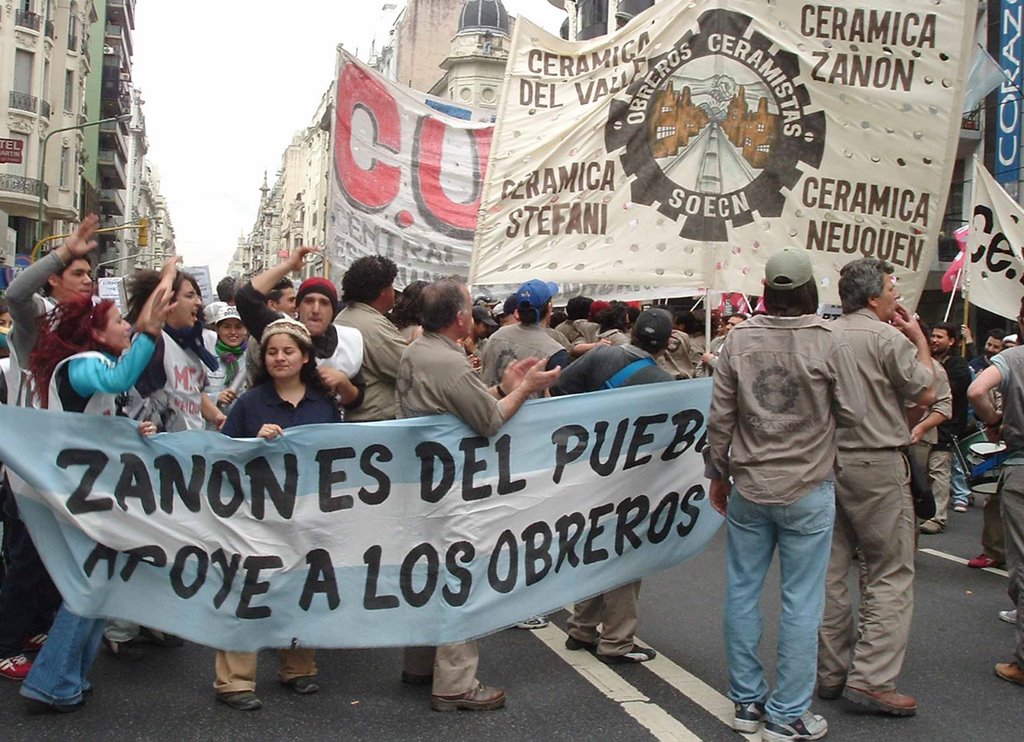 After a major move, a few weeks of vacation and enduring Buenos Aires' heat (it's summer time here), I'm getting back into the swing of things. Which means writing, filming and working. I'd like to make a few announcements about new videos and articles out and about. First, Ágora TV has featured a new section to videos with English subtitles online. Videos Click here to check them out There are several videos on Argentina's factory takeovers such as Zanon and BAUEN, as well as videos on the School of The Americas. This section is growing, so check in from time to time. I've gotten many questions for an analysis or review of Argentina's social movements. I have several articles out in publications that give a review of social movements. There's a lot going on, but many of the struggles have become disarticulated due to President Nestor Kirchner's policy to coopt social organizations. There are some very exciting struggles ongoing, which will come back into momentum in the next coming weeks. Finally, I did a major overhaul on my blog, Latin America Activism. Previous posts and articles are now labelled into categories for easy access.
Northeastern Anarchist
 | Montpelier Downtown Workers’ Union Zanon: Class Consciousness Through Self-Management Resistance in Pyeongtaek Anarchist Study of Iroquois Solidarity with Six Nations Workers, Management, and Worker-management and more... |
Northeastern Anarchist #12, Winter 2007
Zanon building class consciousness through self management
by Marie Trigona
As the largest recuperated factory in
In October 2005, FASINPAT (Factory without a boss - Zanon's cooperative) won a legal dispute, pressuring federal courts to recognize it as a legal entity that has the right to run the cooperative for one year. With the October expiration date nearing, the worker assembly voted to step up actions and community efforts. On
http://www.affinitiesjournal.org/index.php/affinities
Latin America’s Autonomous Organizing
MARIE TRIGONA
In February 2006 activists met in Uruguay for the fourth Latin American
Conference of Popular Autonomous Organizations. Over 300 delegates from
Brazil, Argentina, Bolivia, Chile and Uruguay organized this year's annual event as
a space to strategize autonomous organizing and coordinate direct actions. This
year's conference, held February 24-26 in Montevideo, focused on building
popular power in Latin America among organizations autonomous from the
state, political parties and Non-Governmental Organizations (NGOs).
Galpon de Corrales, a community center in a working class neighborhood in
Montevideo, coordinated the conference. The Galpon features a community
radio station, a community library and a large indoor space to hold cultural
activities. Activists from the community center take pride in the fact that the
Galpon is completely self-managed and sustaining, and several times a week
they organize a collective meal.
The participating organizations were generally oriented towards class struggle
and libertarian practices such as grass roots organizing, direct democracy and
mutual solidarity. Within the debate of how to build popular power, delegates
discussed strategies for communities to solve their own problems independently
of the state or other institutions.
The current context offered by Latin American state politics emerged as a focal
point during the two-day meeting. In each of the nations represented, social
organizations have faced new challenges due to the resurgence of "progressive"
social democratic governments. Take, for example, the case of Uruguay's social
movements, where many of these have demobilized after the inauguration of
Tabare Vazquez. At the conference all eyes were therefore on Bolivia due to the
recent victory of the Movement to Socialism’s (MAS) leader, Evo Morales. In all of
the workshops, participants discussed how to prevent the growing expectations
populations have of their social democratic governments from impeding the
accumulation of popular power.
Everything at the congress was auto-gestionado
Marie Trigona Latin America Activism
RENEGADE EYE
Saturday, February 03, 2007
Molly Ivins: 1944-2007
Syndicated columnist Molly Ivins died Wed of breast cancer. She died the day Senator Joe Biden made tthe remark that Barack Obama, was an articulate and bright black person. I'm sure she would have had some bombs to throw at him.
I met Molly Ivins in Minneapolis, when she was in her twenties, working for the Minneapolis Tribune. She was doing a feature story to run for several days about young radicals. It was also way to actively take part in the anti-Vietnam war movement. .Her columns made uppity women, angry Afro-Americans, antiwar activists and uppity women into heros. Molly was a tall glamourous red head, dating a community organizer involved with housing issues at the time. She was smart and funny. You missed something if you never got to meet her.
This is from her column written just before her death. I had know idea she was dying when I read this. My instincts were telling me she was saying something important. Raise hell. Think of something to make the ridiculous look ridiculous. Make our troops know we're for them and are trying to get them out of there. Hit the streets to protest Bush's proposed surge.
Her columns made fun of the rulers. Although humorous it is wrong how the mainstream media calls her a humorist. Molly was the reporter that exposed the infamous "Downing Street Memo". She was always furious about the laziness of the mainstream media. Her wrath was felt by both major US parties. Based in Texas, just covering local politics in a straight manner, came off as humor. What surpassed her politics, was that she was a darn good writer.
Molly's family was conservative. Her father managed John Connally's senatorial campaigns. I don't have an agenda, I don't have a program. I'm not a communist or a socialist. I guess I'm a left-libertarian and a populist, and I believe in the Bill of Rights the way some folks believe in the
Bible."
Maya Angelou wrote in her honor:
Up to the walls of Jericho
She marched with a spear in her hand
Go blow them ram horns she cried
For the battle is in my hand
Renegade Eye
I met Molly Ivins in Minneapolis, when she was in her twenties, working for the Minneapolis Tribune. She was doing a feature story to run for several days about young radicals. It was also way to actively take part in the anti-Vietnam war movement. .Her columns made uppity women, angry Afro-Americans, antiwar activists and uppity women into heros. Molly was a tall glamourous red head, dating a community organizer involved with housing issues at the time. She was smart and funny. You missed something if you never got to meet her.
This is from her column written just before her death. I had know idea she was dying when I read this. My instincts were telling me she was saying something important. Raise hell. Think of something to make the ridiculous look ridiculous. Make our troops know we're for them and are trying to get them out of there. Hit the streets to protest Bush's proposed surge.
Her columns made fun of the rulers. Although humorous it is wrong how the mainstream media calls her a humorist. Molly was the reporter that exposed the infamous "Downing Street Memo". She was always furious about the laziness of the mainstream media. Her wrath was felt by both major US parties. Based in Texas, just covering local politics in a straight manner, came off as humor. What surpassed her politics, was that she was a darn good writer.
Molly's family was conservative. Her father managed John Connally's senatorial campaigns. I don't have an agenda, I don't have a program. I'm not a communist or a socialist. I guess I'm a left-libertarian and a populist, and I believe in the Bill of Rights the way some folks believe in the
Bible."
Maya Angelou wrote in her honor:
Up to the walls of Jericho
She marched with a spear in her hand
Go blow them ram horns she cried
For the battle is in my hand
Renegade Eye
Subscribe to:
Posts (Atom)