Showing posts with label agoratv. Show all posts

Wednesday, December 12, 2007

News from Argentina

Plan Condor: Crimes without borders in Latin America

Former military dictator Jorge Rafael Videla and 16 other military leaders in Argentina will be prosecuted on charges of conspiring to kidnap and kill political activists in a scheme known as Plan Condor, developed by Henry Kissinger and George Bush Sr., head of the CIA at the time. Dictators in Uruguay, Chile, Paraguay, Brazil, and Argentina killed opponents in the 1970s and 80s under the plan, also known as Operation Condor. The United States and Latin American military governments developed Operation Condor as a a transnational, state-sponsored terrorist coalition among the militaries of South America. In Argentina alone some 30,000 people were disappeared as result, leaving loved ones to seek justice decades later.

Fight against forced disappearances

The practice of forced disappearances was systematized in the Southern Cone by military governments in the 1970’s with U.S. financial support and trainings. It is estimated that 90,000 people in Latin America have been disappeared since the 1950’s. And the practice continues today in places like Colombia, Mexico, Guatemala and Argentina.


Buy a DVD and support Grupo Alavío!

Grupo Alavío would like to send a special holiday greeting and give a special fund raising appeal. Keep the group’s video production and website Ágora TV up and running by purchasing a DVD. We are completely viewer-funded and volunteer based: your contributions help us to produce ground breaking videos from the Third World. Ágora TV provides a radical space for cutting edge video activists all over Latin America.

Ágora TV is a community television production collective that currently broadcasts over the internet. The project reaches a global audience of grassroots activists and citizens tired of status quo media. We work on issues including Argentina’s recovered factory movement, labor conflicts,social movements, indigenous struggles, and gender equality. The Buenos Aires-based video collective Grupo Alavío built the website (www.agoratv.org) in 2006 as an organizing tool and alternative media space for groups that would not otherwise have access to the airwaves.

For more than 15 years, Grupo Alavío has participated in working-class struggles and dedicated efforts to supporting them with social and political documentaries. Making technologies and skills accessible and available to exploited sectors by democratizing audiovisual production is a priority of Grupo Alavío. Through Ágora TV, Grupo Alavío is radically changing how media is created, managed, and distributed.

All films have English subtitles and are in U.S. DVD format. Shipped from the US.

Cost: $15 plus shipping for individuals, $30 plus shipping for universities

Contact: Marie Trigona

mtrigona@msn.com

FILMS available for purchase:

1. Chilavert Recovered, 38 minutes, 2004 Newly released withENGLISH SUBTITLES

Chilavert is a leading member of the 'recovered factories' movement which developed during the collapse in 2001 when many factories in Argentina were taken over by the workers. As the owner of a printing plant began to shut it down and turn it over to his creditors, the workers seized control and formed the Chilavert Cooperative. The documentary gives a realistic overview of the recuperation movement and workers’ self-management.

2. Obreras en lucha (The struggle of Brukman workers).Spanish with ENGLISH SUBTITLES

This documentary tells the story of the' recuperation' of Brukman textile factory in Buenos Aires by its workers, after its owners decided to close it down in December 2001. Workers (most of them women) decided to occupy the plant on December 18, 2001to protest their reducing and delayed salaries. Only two days after, the economic and political crisis exploded in Argentina.This documentary contains impressive images of the expulsion of the workers from the factory by the police in 2003, the massive popular protests which followed and the brutal repression with which Duhalde's government replied. it contains as well interviews with workers and images from the assemblies at the factory.


3. Hotel BAUEN: Workers’ Cooperative

20min, 2004 Spanish with ENGLISH SUBTITLES

The Hotel BAUEN was an emblematic symbol of neoliberalism in Argentina.The hotel was constructed in 1978, in the glory of the military dictatorship, with government loans and subsidies. In the height of Argentina’s economic meltdown, the owners ransacked the hotel and closed the hotel’s doors,leaving the workers in the streets. In March 21, 2003the workers decided to occupy the hotel. The workers cleaned up the hotel and slowly began to rent out services. With over 150workersemployed at the hotel, BAUEN hotel has become a symbol for the working class.

4. Zanon (Constructing resistance)

18min, 2003, Spanish with ENGLISH SUBTITLES

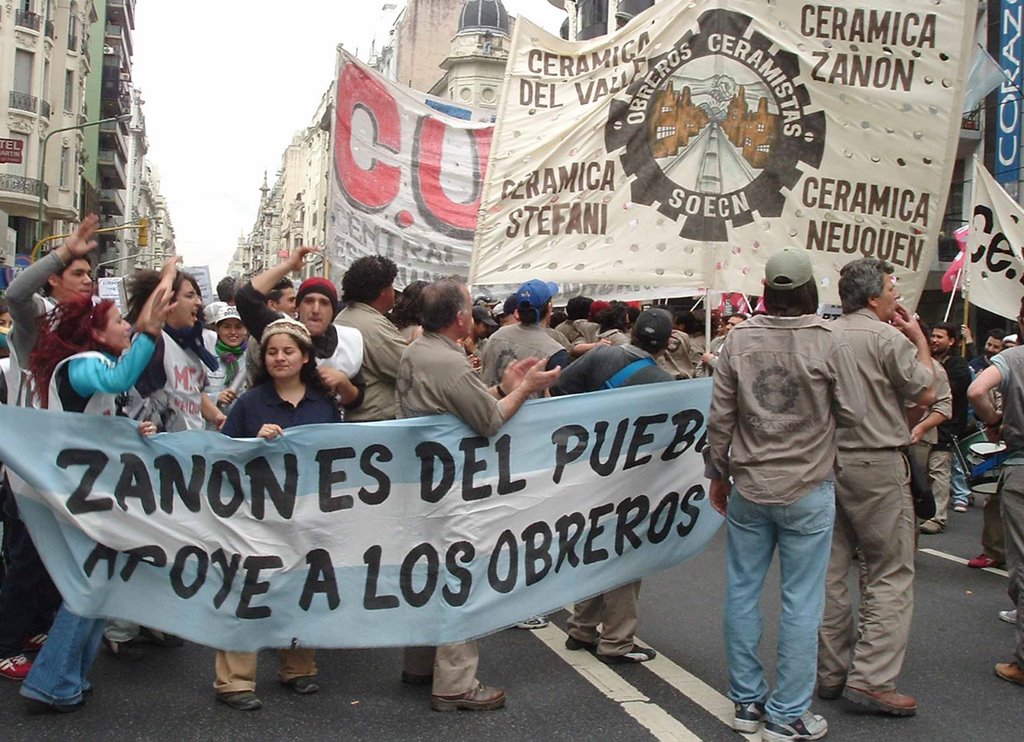
Argentina’sPatagonian province of Neuquén,is home of the Zanon ceramics factory.In 2001 Zanon’s owner fired the workers and abandoned the factory forgreener pastures. After resisting outside the plant, the group ofworkers decide collectively to recuperate and put the plant to produce.Since 2001, the workers at Zanon have occupied and managed the plant,which is Latin America’s largest ceramics factory. In the film, Zanonceramists narrate their day-to-day work, struggles and hopes tocontinue production under worker control.


5. La Foresta belongs to the workers

52min, 2005 Spanish with ENGLISH SUBTITLES

The film tells the story of a group of workers who are fighting to recuperate La Foresta meatpacking plant in La Matanza, on the outskirts of Buenos Aires city. Most of the factory’s employees have worked their for decades, through the good times and bad times. In 1999, the plant went bust, a series of businessmen rented the facilities, making quick profits and then abandoning the factory for greener pastures. Grupo Alavío’s film follows the 70 workers who’ve put up a legal fight to keep their factory and start up production without a boss or owner,under worker-self management.


6. Music in Solidarity with Zanon,

90min, 2005 Spanish with ENGLISH SUBTITLES

This film was produced as part of a video work shop for the workers. Musicin solidarity with Zanon: musicians León Gieco, Rally Barrionuevo, Ciro(Ataque 77) and other artists performed a concert in December, 2004. The workers organized the super event, with more than 10,000 supporters from the community of Neuquén.


7. Argentina:30 years after the military dictatorship (compilation of short films)

Letter to the Military Junta, 6min, 1996

Rodolfo Walsh wrote the “Open Letter to the Military Junta”on the first anniversary of the military coup in 1977 reporting the tortures,mass killings, and thousands of disappearances. The political writer was disappeared just one day after the letter was distributed. This 6minute video essay reconstructs Walsh’s powerful report, imagery from the bloody dictatorship and the writer’s disappearance.

Escrache a Videla, 12min, 2006

Events to mark the 30 years since Argentina's military junta kicked off with an escrache or “exposure” protest against the coup's first dictator,Jorge Rafael Videla. Over 10,000 people participated in the protest in front of Videla's home, where he is under house arrest in connection with numerous charges of human rights abuse. Human rights group H.I.J.O.S. brought a crane and gave the ending remarks directly in front of Videla's fifth floor apartment.

Memories of Struggle and Resistance: Rio Santiago Ship Yard, 10min, 2006

The dictatorship attempted wiped out an entire generation of working-class resistance, which the nation decades later is still recovering.This year for the first time, over 1,500 workers from the Rio Santiago ShipYard in Buenos Aires commemorated the ship yard's 48 disappeared.


8. Compañeras

45min, 2005, Spanish with ENGLISH SUBTITLES

Compañeras brings together four working women who give testimony of their lives and daily struggles. MAGDALENA,works on a small farm in the province of San Juan. KARINA is a train conductor. REGINA lives n VillaFiorito, she collects cardboard from the streets, classifies and then sells it. NINA is a militant from the 70’s, during which she exiled from Argentina to Nicaragua and participated in the Sandanista revolution. Stories that mix with other history, women who revindicate their identity as workers, but without easing to be mothers, without giving up the struggle, continuing to be compañeras.

9. The Face of Dignity, Memories of MTD Solano

58 minutes, 2002, Spanish with ENGLISH SUBTITLES

In the shambles of an economically ruined Argentina,a new practice of protest emerged, blockading roads. Since 1997, what is now known as the unemployed workers movement has taken root. Without access to the factory and utility of tools for liberation—strike,sabotage, and occupying the factory, unemployed workers sought out new practices for struggle. Unemployed confronted globalization by fighting for jobs. One of the most important experiences that emerged in these years was Unemployed Workers Movement-MTD (Movimiento de Trabajadores Desocupados) in Solano (inside Quilmes, a city in the province of Buenos Aires). MTD's formation was based on the principles of horizontalism, direct democracy, autonomy from the state and power, and the integral political formation among members. Work, popular education, democratic debate of ideas, sharing life in the struggle for work, dignity and social change are some of this memory's content.

10. For a 6 hour workday

20min, 2004, Spanish with ENGLISH SUBTITLES

Reducing the workday to six hours with a salary increase for all workers would create jobs for more than 3 million unemployed and lift many out o poverty. Subway workers who have been organizing wildcat strikes for salary increases have spearheaded Argentina's movement for a six-hour workday. In 2003, subway workers (in all sectors from ticket office to train drivers) won a six-hour workday.Since this victory,subway workers, other labor conflicts, economists and unemployed workers organizations have formed a movement for a6-hour workday for all workers, with increased salaries.


11. Organizing Resistance (Chronicles of Freedom, Martin,Recuperating Our Work) Spanish with ENGLISH SUBTITLES

Chronicles of Freedom (organizing resistance) , 45min, 2002

June26, 2002two activists Darío Santillán-22 and Maximiliano Kosteki-25from Argentina’s unemployed workers’ movement were killed during a road blockade of Pueyrredón Bridge in police repression. The repression was part of a known and announced government plan to control growing social protest. 33 were wounded from lead bullets, 160detained and hundreds injured from rubber bullets. Unquestionably,the deaths and repression have left an unforgettable mark on the movement—generating internal debates and self-criticisms. Chronicles of Freedom includes interviews on the right to identity, self-defense and organizing to confront state repression.

Martín, 2002, 7 minutes

Synopsis: Martín, 27 years old, Argentine, brother, compañero from the barrio Floridai n Solano was killed during a fight with a neighbor. The experimental narration explores inner-violence and questions the absurdity of the system’s violence that is imposed on us.

Recuperando nuestro trabajo, 2003, 18min

Argentina's worker occupied factory movement has been an example of resistance for workers all over the world. In response to the process of deindustrialization and flexible labor markets, thousands of workers have said enough to exploitation of the working class by bosses and owners.


Marie Trigona

Saturday, May 19, 2007

News from Argentina

This past month in Argentina has been anything but dull. Here’s a run through of recent events and personal reflections on where things are going. Check out videos on these news events at www.agoratv.org Also, feel free to visit my blog for further updates: http://mujereslibres.blogspot.com/

Train Riot breaks out

Enraged train commuters rioted in a major rail station in Buenos Aires on May 16. Delays in railway services sparked violent riots in Buenos Aires, when commuters set fire to parts of a train station during rush hour.

Angry passengers lobbed rocks at ticket booths, and set fire to automated ticket dispensers and police offices inside the Constitucion train station, the largest station in Buenos Aires with more than 300,000 users daily. About an hour after the violence erupted, riot police clashed with protesting passengers; shooting tear gas, rubber bullets and arresting 16 people.

Overcrowding has plagued the railway, leading from Constitucion station in downtown Buenos Aires to the capital's poor southern suburbs, since services were privatized in the 1990's.

Mothers of Plaza de Mayo Commemorate 30th Anniversary

The Mothers of Plaza de Mayo commemorated the 30th anniversary of their movement on April 30 in Argentina with a celebration of art and music. Thousands joined the mothers in the Plaza in the heart of Buenos Aires to thank them for their three decade long struggle for human rights and justice. After thirty years of fighting, they continue to face legal roadblocks preventing courts from putting ex-military behind bars for their human rights crimes while a key witness in these trials was disappeared in 2006.

In 1977, out of desperation and love for their children, a group of mothers began a protest to demand information about the whereabouts of their children. These youth were among the 30,000 people who were forcefully disappeared during the so-called dirty war carried out by Argentina’s military dictatorship between 1976 and 1983.

Juana Pargament, now 92-years-old, said that the Mothers of Plaza de Mayo have always gathered the strength to fight from their children. “30 years of struggle! Of course we are older now, we started out when we were younger. When they took our children away, it was painful, we suffered. But we had a strength that I can't put into words. It was also a difficult lesson, because we mothers had to learn to defend our children.”

Impunity and escrache popular

Following the Mothers of Plaza de Mayo’s example the group H.I.J.O.S. (Children for Identity Justice and Against Forget and Silence) formed in 1996 using the escrache as a tool for popular justice for their parents and against impunity.

H.I.J.O.S. (Children for Identity Justice and Against Forget and Silence) held an “escrache” protest outside the home of Alfredo Bisordi, the Magistrate Council president who is accused of deliberately obstructing the cases to convict ex-military leaders for state supported terrorism. Alvaro Piedra, a son of a disappeared, human rights lawyer and member of HIJOS says that after 30 years victims still await justice. “The escrache is a method to send a message and bring light to the situation that Bisordi supports impunity, throughout his career as a magistrate he has supported the military.”

Bisordi first incorporated into the judicial system during the military dictatorship and was the secretary for Judge Norberto Giletta, who became infamous for rejecting the missing persons reports that the Mothers of Plaza de Mayo and other parents presented to the courts. Bisordi has openly supported the dictatorship and has even gone so far as to pardon skin heads accused of racist physical attacks and call torture survivors “subversive terrorists.”

Human rights groups want Bisordi and the other three council members to be removed from their positions and for the trials to make progress. Piedras said that if the trials are delayed military may escape prosecution. “We’re trying the criminals 30 years after their crimes were committed, so the presentation of evidence is more difficult.”

Marie Trigona
http://mujereslibres.blogspot.com/
RENEGADE EYE

Friday, March 16, 2007

Venezuela Squeezes Out the International Monetary Fund

Thursday, Mar 15, 2007

By: Marie Trigona - Venezuelanalysis.com

Buenos Aires, Argentina, March 14, 2007--President Bush wrapped up his 5 nation-tour today dodging criticisms on immigration policy and opposition to the war in Iraq in Meridia, Mexico where protestors lobbed concrete rocks at his hotel. Venezuelan president Hugo Chavez dogged Bush during his own whirlwind tour of Latin America, signing trade accords to promote regional integration. Part of Chavez’s agenda is to squeeze the International Monetary Fund out of Latin America and replace it with a regionally based institution.

Speaking in front of thousands of supporters in Buenos Aires, Chavez announced plans to create Banco del Sur or Bank of the South, a socialist alternative to the Washington based IMF lending institution. Argentina has already agreed to transfer 10 percent of the nation's reserves to boost the Bank of the South, a financial institution that could serve as an alternative to the IMF.

Chavez said that the Bank of the South can break the vicious cycles of foreign debt. "We have paid a countless amount of resources to pay back foreign debt. In the past 20 or 25 years we have paid more than 2.2 billion dollars in debt. We have paid back the loans more than three times over.”

He also announced that Argentina and Bolivia have eagerly adhered to the development fund. “Seven years ago I was alone in South America with a proposal for the Bank of the South, a bank that is ours to replace the international financing system, the International Monetary Fund and the World Bank. 15 days ago with Argentina we signed an agreement and today we have agreed to move forward to outline the Bank of the South. Tomorrow, Bolivia will adhere to the Bank of the South. They are building a bank that is ours."

Leaders in the Southern Cone, so far from Venezuela, Argentina and Bolivia, have joined the bank project with hopes that such a bank would allow Latin American nations to avoid the policy conditions that generally come with IMF loans.

According to Alan Cibils, an Argentine economist specializing in foreign lending institutions, the Bank of the South is still in its early stages but could develop into a concrete alternative to the IMF and World Bank. “It could be that part of the function of this bank is to act as a lender of last resort for countries in crisis that need funds and instead of going to the IMF they would go to the Banco del Sur, so that's a possibility. The other possibility or the other alternative is that it acts as a development bank for development projects of the different countries. I think either way it's a good idea to have both of these functions.”

The IMF’s current crisis has further compelled leaders to look for regional alternatives for financing. “I think that it points to a very clear failure of the northern institutions specifically the IMF and also the World Bank and the effects of the policies they have promoted in Latin Ameirca and throughout the world,” says Cibils. He adds, “so having an alternative institution that is local and really obeys more to local needs than to the
need of northern finance I think is a good thing and is desirable.”

Despite enthusiasm, Cibils warns that the fund will have to overcome corruption and stay wary of draining economic reserves in the respective Latin American countries. “Now how this will be implemented and whether it will be able to act outside of the clientalism and corruption that you sometimes have in governments like Argentina for example is an open question.”

Carlos Aznarez international journalist with Resumen Latinoamericano says that Argentina and Brazil joined the Bank of the South project to keep up with competition with one another in the global market and in leadership of Mercosur. “Not all the countries think the same about the Bank of the South. The idea that is pushing Chavez is the idea to precisely use the funds and federal reserves from each country to promote economic growth in Latin America’s poorest countries.” Although he says he is skeptical over Brazil’s and Argentina’s intentions to adhere to the regional fund. “The direction this project is going to take depends on the ideological influence of Venezuela. Bolivia is the country that is going to receive substantial support because it doesn’t have a lot of economic alliances. And Brazil and Argentina are going to flirt with the Bank of the South.”

The Bank of the South is set to begin operations within four months with international reserves from all participating nations. Venezuela hopes that Nicaragua and Ecuador will soon join the fund, whose initial capital will be 10 percent of Caracas and Buenos Aires international reserves, or roughly seven billion dollars.

Marie Trigona is an independent journalist based in Buenos Aires. She can be reached at mtrigona@msn.com

Marie's Blog, Latin America Activism

RENEGADE EYE

Wednesday, February 07, 2007

Argentina's social movements

After a major move, a few weeks of vacation and enduring Buenos Aires' heat (it's summer time here), I'm getting back into the swing of things. Which means writing, filming and working. I'd like to make a few announcements about new videos and articles out and about. First, Ágora TV has featured a new section to videos with English subtitles online. Videos Click here to check them out There are several videos on Argentina's factory takeovers such as Zanon and BAUEN, as well as videos on the School of The Americas. This section is growing, so check in from time to time. I've gotten many questions for an analysis or review of Argentina's social movements. I have several articles out in publications that give a review of social movements. There's a lot going on, but many of the struggles have become disarticulated due to President Nestor Kirchner's policy to coopt social organizations. There are some very exciting struggles ongoing, which will come back into momentum in the next coming weeks. Finally, I did a major overhaul on my blog, Latin America Activism. Previous posts and articles are now labelled into categories for easy access.

Northeastern Anarchist

Montpelier Downtown Workers’ Union
Zanon: Class Consciousness Through Self-Management
Resistance in Pyeongtaek
Anarchist Study of Iroquois
Solidarity with Six Nations
Workers, Management, and Worker-management
and more...

Northeastern Anarchist #12, Winter 2007

Zanon building class consciousness through self management

by Marie Trigona

As the largest recuperated factory in Argentina, and occupied since 2001, the Zanon ceramics plant in the Patagonian province of Neuquén now employs 470 workers. Along with some 180 recuperated enterprises up and running, providing jobs for more than 10,000 Argentine workers, the Zanon experience has re-defined the basis of production: without workers, bosses are unable to run businesses; without bosses, workers can do it better. While these experiences are forced to co-exist within the capitalist market, they are forming new visions for a new working culture.

In October 2005, FASINPAT (Factory without a boss - Zanon's cooperative) won a legal dispute, pressuring federal courts to recognize it as a legal entity that has the right to run the cooperative for one year. With the October expiration date nearing, the worker assembly voted to step up actions and community efforts. On October 20, 2006, the workers won the longstanding legal battle for federal recognition of FASINPAT for three years.

Argentina’s working class has celebrated the Zanon workers’ temporary victory. With legal status, the FASINPAT can concentrate on planning production, improving working conditions, and doing community projects. As part of this celebration, the cooperative has invited other workers to visit Zanon to learn that they, too, can function without a boss or owner. The workers’ assembly has resolved that it is now in a position to teach others from its four and a half years of learning from self-management.

The workers at Zanon are rebuilding a national network of solidarity, which sustains the movement. Zanon workers regularly travel throughout the country to support a wide array of labor conflicts. As part of this initiative, several FASINPAT representatives toured the Greater Buenos Aires suburbs, hosting talks and special meetings with local worker organizations. Different from the usual political rallies, these meetings focused on building class consciousness and mutual solidarity among class-struggle-based organizations.

Affinities Journal
http://www.affinitiesjournal.org/index.php/affinities
Latin America’s Autonomous Organizing
MARIE TRIGONA
In February 2006 activists met in Uruguay for the fourth Latin American
Conference of Popular Autonomous Organizations. Over 300 delegates from
Brazil, Argentina, Bolivia, Chile and Uruguay organized this year's annual event as
a space to strategize autonomous organizing and coordinate direct actions. This
year's conference, held February 24-26 in Montevideo, focused on building
popular power in Latin America among organizations autonomous from the
state, political parties and Non-Governmental Organizations (NGOs).
Galpon de Corrales, a community center in a working class neighborhood in
Montevideo, coordinated the conference. The Galpon features a community
radio station, a community library and a large indoor space to hold cultural
activities. Activists from the community center take pride in the fact that the
Galpon is completely self-managed and sustaining, and several times a week
they organize a collective meal.
The participating organizations were generally oriented towards class struggle
and libertarian practices such as grass roots organizing, direct democracy and
mutual solidarity. Within the debate of how to build popular power, delegates
discussed strategies for communities to solve their own problems independently
of the state or other institutions.
The current context offered by Latin American state politics emerged as a focal
point during the two-day meeting. In each of the nations represented, social
organizations have faced new challenges due to the resurgence of "progressive"
social democratic governments. Take, for example, the case of Uruguay's social
movements, where many of these have demobilized after the inauguration of
Tabare Vazquez. At the conference all eyes were therefore on Bolivia due to the
recent victory of the Movement to Socialism’s (MAS) leader, Evo Morales. In all of
the workshops, participants discussed how to prevent the growing expectations
populations have of their social democratic governments from impeding the
accumulation of popular power.
Everything at the congress was auto-gestionado

Marie Trigona Latin America Activism

RENEGADE EYE