This is reprinted from one of my favorite blogs Louis Proyect: The Unrepentant Marxist.
Newt Gingrich: Look what you’ve been covering: North Korea firing missiles. We say there’ll be consequences, there are none. The North Koreans fire seven missiles on our Fourth of July; bombs going off in Mumbai, India; a war in Afghanistan with sanctuaries in Pakistan. As I said a minute ago, the, the Iran/Syria/Hamas/Hezbollah alliance. A war in Iraq funded largely from Saudi Arabia and supplied largely from Syria and Iran. The British home secretary saying that there are 20 terrorist groups with 1200 terrorists in Britain. Seven people in Miami videotaped pledging allegiance to al-Qaeda, and 18 people in Canada being picked up with twice the explosives that were used in Oklahoma City, with an explicit threat to bomb the Canadian parliament, and saying they’d like to behead the Canadian prime minister. And finally, in New York City, reports that in three different countries people were plotting to destroy the tunnels of New York.
I mean, we, we are in the early stages of what I would describe as the third world war….
Tim Russert: This is World War III?
Newt Gingrich: I, I believe if you take all the countries I just listed, that you’ve been covering, put them on a map, look at all the different connectivity, you’d have to say to yourself this is, in fact, World War III.
—-
Although this is probably just an exercise in hyperbole, it does tend to concentrate one’s attention on the dynamics of a third world war, if did occur some time in the future. As was the case in WWI, events tend to spiral out of control very rapidly. Of course, unlike WWI, a new war that is truly global in character will very likely involve the use of nuclear weapons and destroy civilization as we know it.
There is a tendency to downplay such dangers because the threat of “mutually assured destruction” during the Cold War meant that using nuclear weapons was virtually unimaginable. With the capitalist transformation of the USSR, however, there is no longer a counter-balance to the U.S. and the world’s number one super-power surely must feel the temptation to use its advantage against weaker adversaries.
The Pentagon began reviewing its options in 2001 and decided that the old rules no longer applied. A white paper signed by Rumsfeld said, “nuclear weapons could be employed against targets able to withstand nonnuclear attack (for example, deep underground bunkers or bioweapon facilities).” There was a genuine worry that such weapons might have been used against the Iraqi military in the run-up to the invasion.
One wonders if the top brass in the Israeli army might be thinking along similar lines in light of the fact that a 20 tons of explosives was not sufficient to penetrate Hezbollah’s bunkers in south Beirut and kill its leader Hassan Nasrallah, who commented after the abortive strike: “I can confirm, without exaggerating or using psychological warfare, that we have not been harmed.” If anything, the Hezbollah missiles might even be harder to destroy based on the conclusions of a former Lebanese army officer cited in a July 21 FT report. He said the longest range rockets were buried in the south and in the eastern Bekaa valley, “so deep that bombs cannot reach them and guarded by suicide commandos”.
If Hezbollah can withstand 20 tons of explosives, perhaps they can be destroyed with a tactical nuclear weapon rated at 100 tons. Nuclear weapons experts define such bombs as having a range between 100 tons and one million tons. Hiroshima was destroyed by a 120,000 ton device. But that would be overkill. A nicely placed junior bomb of a mere 100 tons would be more than up to the task.
The Israel nuclear program grew out of a conviction that anything was justified to guarantee its survival, including nuclear weapons. It is of course ironic that the term nuclear holocaust gained currency in the 1950s. As is frequently the case with the Zionist state, threats and outright demonstrations of inhumanity are legitimized by past injustices.
The Federation of Atomic Scientists estimates that Israel has between 100 and 200 nuclear weapons. Israel developed the bomb over 30 years ago but never referred to it publicly until the year 2000 when Knesset member Issam Mahoul–a member of the predominantly Arab communist party Hadash–filed a motion to debate the nuclear issue. The motion was prompted by selections from the first-ever publication of the transcript of the trial of Mordechai Vanunu, imprisoned in 1986 for revealing the existence of Israel’s bomb program.
Vanunu, as opposed to the gangsters running Israel, demonstrates a commitment to true Jewish values as these remarks to a 2005 press conference after his release from prison demonstrate:
“I have no more secrets to tell and have not set foot in Dimona for more than 18 years. I have been out of prison, although not free, for one year. Despite the illegal restrictions on my speech, I have again and again spoken out against the use of nuclear weapons anywhere and by any nation. I have given away no sensitive secrets because I have none. I have not acted against the interests of Israel nor do I wish to. I have been investigated by the police again and again, and re-arrested twice, but they have found nothing. I have done nothing but speak for peace and world safety from a nuclear disaster… I did not seek to harm Israel, but rather to warn of an enormous danger. I do not seek to harm Israel now. I want to work for world peace and the abolition of nuclear weapons. I want the human race to survive.”
From http://www.vanunu.freeserve.co.uk/
In 1959, Hollywood released “On the Beach,” a film about WWIII based on Neville Shute’s best-seller. It was a memorable film that detailed the last days on earth of a group of survivors who are driven to the Arctic Circle to escape the radiation that has engulfed the planet. All of them die. The war began after Egypt bombed Great Britain using Russian-made planes, which the British interpreted as a Soviet attack. It was surely plausible then, as it is now, that the Middle East would spawn a nuclear war.
In the year 70 AD, there was a Jewish revolt against the Roman Empire led by the “Zealots” who objected to Roman rule just as Palestinians in Gaza and the West Bank object to Jewish rule today. Under the leadership of Elazar ben Ya’ir, the Zealots seized control of Masada from the Roman garrison stationed there.
In the fight to defend Masada from Roman assault, the Jews decided to kill themselves rather than relinquish control. Today Masada is used by the Israel Defense Forces and youth movements for swearing-in ceremonies, where participants swear the oath that “Masada shall never fall again.”
Tuesday, July 25, 2006


Tuesday, July 18, 2006
Lebanon: G8, Arab States Fail Lebanon's Civilian Population

The Arab governments, and the G8, are turning their back, on Lebanon, giving Israel, a green light to continue its policy of collective punishment, toward Lebanon. The infrastructure is being decimated. Every important port, highway and airport was destroyed. Much of the infrastructure was built ironically by the Saudis. The Lebanese government is doing a great job evacuating Europeans and Americans, while Lebanese are living in shelters for safety.
What makes it different, than before; is that Hizbollah does what it says it will do. Nasrallah, the leader of Hizbollah warned he would show what he can do, and an Israeli ship was hit. It was at first denied by Israel's media. It was later unable to be hidden, because four sailors died, and the ship was towed in. His next threat is to bomb, the industrial sector of Haifa, where chemicals are stored. Hizbollah claims it has rockets, that can hit Tel Aviv. The Israeli army confirmed that.
Hizbollah is supported in Southern Lebanon. It has clearly a reactionary perspective, of gaining reforms from Israel, by hurting its population. Unfortunately it doesn't understand,any concept of class struggle, and appeal to Israeli opinion. Zionism is much the same, with bigger weapons.
Will Syria and Iran intervene? Syria was weakened after it left Lebanon. It doesn't want an influx of refugees, particularly from a country it disrespects. Hizbollah's weapons are made in Iran, Israel's are made in Seattle and Duluth.
Nobody knows how long, the siege will continue. Israel may be able to drive Hizbollah, a few kilometers inland, and claim victory. The actual solution lies with Palestinians, given land and rights, in a socialist secular Israel, surrounded by a federation of socialist states. As for peace, neither the Zionist or Hizbollah leadership want it. In the USA, the Evangelical Zionists are not going to stop the rapture. This is a wet dream to them. Bill Clinton called for support to Israel.
Not all Israelis support the government's policy. The latest adventure, caused a split in Ashkenazi Jewry. A leadership like Hizbollah's has no understanding of taking advantage of it.
This is a good blog covering Lebanon minute by minute: Updates on the aggression against lebanon .RENEGADE EYE
Friday, July 14, 2006
The Destroyed Republic of Congo
This story about events in Republic of Congo, was written by Greek Blogger Talos for Histoligan. He also wrote it for The European Tribune. At his blog, there is a follow-up post. This post is longer than most of my posts, but I thought it is well written, and worth posting.
/ death and destruction / outside the visible media universe /
"I am convinced now, that the lives of Congolese people no longer mean anything to anybody. Not to those who kill us like flies, our brothers who help kill us or those you call the international community. Even God does not listen to our prayers any more and abandons us."
Salvatore Bulamuzi, a member of the Lendu community whose parents, two wives and five children were all killed in recent attacks on the town of Bunia, north-eastern DRC. - from an Amnesty International 2003 report.
If there was ever any real doubt that Africans are simply not considered important by the rest of the world - and particularly by the rest of the world's media - the sheer fact that the little news item, linked to from this post's title, was indeed, a little news item, should put it to rest. I quote:
Some 1,200 people in the DRC die daily from conflict-related causes. More than 20 per cent of the children die before their fifth birthday and one in 10 die in the first year of life. The refugee agency’s appeal last year for the repatriation and reintegration of Congolese refugees received only 14 per cent of the needed funding, or $10.6 million out of the $75 million required.
Meanwhile, of $14.7 million requested for UNHCR's programme for internally displaced people (IDPs) in a country the size of Western Europe, only $3.2 million had come in.
Now this is not the result of war - this is just the aftermath of a war: the deadliest war after WWII, whose victims direct and indirect numbered by 2004, a year after the peace accord was signed, around 4 million people. These were butchered, fell ill, starved or wasted away in the period of just five years. If the 1,200 figure is any guide we're talking about an extra ~0.8 million dead since the official ceasefire.
No wonder then that the UN has listed the Congo disaster as one of the "10 Stories the World Should Hear More About" or that Reuters had it at the top of its "forgotten" disasters list.
The sheer numbers are so huge as to be almost inconceivable. Yet it turns out that the per capita foreign aid that Congo receives is minimal, when it gets there at all. Why is that? Why is Congo receiving, per capita, 25 times less foreign aid than Kosovo for example? How are the needs prioritized? After all as dire as the situation in Kosovo might be, there certainly aren't any plague epidemics and reports of little girls being boiled alive, so by all indications one would expect a similar level of news exposure and humanitarian aid.
An interesting answer comes from Larry Thompson, Director of Advocacy for Refugees International, in an article posted in the International Council of Voluntary Agencies' website, he suggests: Why do some humanitarian emergencies receive more attention than others?
Answers to this question usually focus on three topics. First, media coverage of the emergency; secondly, the national interests of the aid donors, and third, the influence of aid organizations.
* Media coverage. This is what is often called "the CNN factor" Humanitarian emergencies which receive extensive publicity, such as Kosovo and, recently, Afghanistan are believed to get more attention and assistance from donors. Thus, humanitarian emergencies which are unpublicized, such as the Congo, may receive less assistance. The theory behind the "CNN factor" is that people and governments respond to the needs of people they see on their television screens.
* National Interests of the AID donors. Humanitarian assistance is perceived by the big donors as an arm of their foreign policy. Afghanistan is a recent example in which the United States and its allies perceived that providing humanitarian aid to Afghan civilians was important to achieving political and military objectives.
Humanitarian aid in Kosovo in 1999 had an even closer link to the interests of the large powers, especially the Europeans. Certainly, one reason why large amounts of aid was provided to Kosovar refugees in Macedonia and Albania was to prevent the refugees from trying to immigrate to other countries in Europe. "Keep the refugees comfortable in Macedonia - and they won't try to go to Paris" was how one relief worker described to me a factor underlying the generosity of European aid donors. U.S. humanitarian aid to Haiti in the mid 1990s had much the same purpose: keep the Haitians at home.
* Influence of aid organizations. Another factor influencing the level of humanitarian aid is the lobbying and influence of aid and citizen's organizations for a particular cause. Southern Sudan, for example, is cited as one area in which donors have provided humanitarian assistance over a long period of time primarily because aid agencies and non-governmental organizations have maintained pressure on donor countries to provide assistance.
An even better example might be the cause of the Tibetans versus that of the Uighers [note: that's Uighurs properly]. The plight of the Tibetans, whose culture is being overrun by the Han Chinese, is familiar to most of us. But how many have ever heard of the Uighers - a people in western China who have a similar cause? Why? Some observers have said the difference is that the Tibetans have a support structure of foreigners and foreign organizations plus a charismatic leader - and the Uighers do not.
So, what is the answer to the question as to why Kosovar refugees received $207 each in UN assistance in 1999 and Congolese refugees and displaced persons received only $8? The Kosovars had on their side at least two of the above three factors: their plight had the attention of the media and they were important to the national interests of the large donors of international assistance. The Congo had none of the three factors listed above operating in its favor.
The author then goes on to add such factors as racial and ethnic kinship, traditional ties and accessibility of stricken area to humanitarian organizations...
Yet there are other sides to this: who's arming the conflict, what's fueling it and who profits?
On the first question the answer is "a lot of people": from the US military aid that helped arm the warring parties in the first place, to the fact that 17% of all weapons in the DRC were found to be made in China, to "arms dealers, brokers and transporters from many countries including Albania, Bosnia and Herzegovina, Croatia, Czech Republic, Israel, Russia, Serbia, South Africa, the UK and USA", there is certainly money to be made selling weapons - and its very easy to smuggle them in through porous borders - with countries that were themselves embroiled in the war. It seems that the ban on arms exports to any of the warring factions is more or less moot: AK-47's are jokingly referred to as Congolese credit cards...
As for the root cause of the fighting, it suffices to note that in the DRC:
"...The Congo River system has 10 percent to 12 percent of the world's hydroelectric capacity. More than 50 percent of all the tropical hardwoods in Africa are inside the Congo. It has been in the top 10 in terms of production of five or six major minerals: gold, industrial diamonds, copper, cobalt and coltan - the material from which cellular telephones are made..."
So while it is a given that all sorts of local and neighbouring military units and armed groups were struggling to gain control of and riches from Congo's fabulous mineral and forest wealth, at great pain and cost to the local population, it is worth remembering a UN report on plunder in the DRC, that pointed to quite less marginal figures as culprits in the wartime pillage. In fact as Keith Harmon Snow and David Barouski write on Znet: ...Some people are aware that war in the Congo is driven by the desire to extract raw materials, including diamonds, gold, columbium tantalite (coltan), niobium, cobalt, copper, uranium and petroleum. Mining in the Congo by western companies proceeds at an unprecedented rate, and it is reported that some $6 million in raw cobalt alone: an element of superalloys essential for nuclear, chemical, aerospace and defense industries exits DRC daily. Any analysis of the geopolitics in the Congo requires an understanding of the organized crime perpetrated through multinational businesses, in order to understand the reasons why the Congolese people have suffered a virtually unending war since 1996...
he UN has 17000 troops in the area and all sorts of diplomats and mediators, doing what they can (and a few implicated in a major scandal as well), but to limited effect - though one has to give the UN credit for brokering the peace process in the Congo - whatever the shortfalls of this peace may be. They are quite proud - and justifiably so - of the fact that they are about to oversee elections in the DRC and of the general progress achieved:
Look at where the country was even three years ago, at the time the [peace] agreements were signed, and look now, with most of the country pacified and the [armed groups in the] east increasingly being put under pressure.
The great hope here is the determination of the Congolese people. There are an estimated 28 million voters here. [Of them,] 25.6 million went out and registered. That's not like driving up to the shopping centre and going to register. These people have had to walk 20km or 30km, stand in line for seven or eight hours, perhaps come back the next day in order to get that voting card.
Then these same people went out - two-thirds of them, 15 million - in December to vote for a constitution that most had never seen and very few had ever read, because they saw this as the next ticket to be punched on the way to elect their own leaders.
Locals seem to be less optimistic about the elections:
...There are hardly any colours flying for any of the other candidates contesting the election. It looks as if Oriental Province is a sure thing for the young and incumbent president. Almost every observer IRIN encountered said the same thing: "Kabila has the money, so he will win."
At Yasira market, a vendor sells unlicensed drugs; others offer smoked fish, bananas and cassava cake wrapped in leaves. Aside from petty trade, the economy is at a virtual standstill. The electorate here, as in other villages throughout the impoverished heart of the Congo, is needy: "We want money, beer or T-shirts," one voter said.
In Kisangani, people walked around in T-shirts emblazoned with the images and names of candidates a month before the official start of campaigning.
"In all this misery, you can buy a poor man with a piece of soap," said Sister Marie Madeleine Bofoe, head of the Catholic NGO Caritas in Isangi.
This also illustrates a paradox: an election to end despotism is making an entire society gamble with its future. "We don't know any of the candidates, and we have no idea who to vote for," said Bebale Bombole, a fish vendor.
With more than 9,600 parliamentary candidates and a campaign period limited to one month, many voters will not be able to make an informed decision...
Meanwhile the opposition isn't really impressed by the process either:
We have said to everybody that the electoral process imposed on the Congolese people is not a good one. The impression we have gotten is that our [international] partners don't want to organise [proper] elections. We can't understand why our partners are just pushing us to go to elections without asking the question, "But what about after the elections?"
With all this as background, the EU is about to embark on a military mission to the DRC to help with the elections. The mission will "support MONUC in its peacekeeping efforts where necessary; the EU is responsible for protecting and -- if necessary -- evacuating election personnel, election observers and U.N. personnel. They will also protect and remove civilians out of danger zones, if such form, and provide MONUC with information from the EU's military intelligence services." The mission will consist of 2000 troops and be under German command. There are serious misgivings about this deployment in Germany however. Deutsche Welle notes:
"..how serious can Europe really be about this mission, when Central Africa's big hope rests on the shoulders of just 2,000 European soldiers, many of whom will never actually be stationed in the country? And what are they supposed to secure in this country saddled with unrest? A poorly prepared election in which former warlords will surrender to the ballot?
If the observers are right, then interim President Joseph Kabila will profit more than anyone else from the presence of European soldiers in DR Congo. As far as security goes, he prefers to rely on his private army. Kabila is friendly with the French, who are involved in power politics in the region and therefore play a decisive role in the conflict. Paris is only concerned with stability and the status quo in Africa, regardless of whether dictators or democrats come out on top. Since no one wants to hear about that in Berlin, France was able to lure the Germans into DR Congo by assuring them that the mission would strengthen the European Union's position as a global security power...
...That all sounds very nice, but DR Congo is a poor choice for improving the EU's reputation. As soon as the situation escalates, the European mini-force will have to make a run for it -- and leave a lot of disappointed people behind.
It seems that the main motive for this expedition is less the protection of the (already flawed) Congolese elections and more a grand opening for the European Security an Defense Policy and, possibly, the protection of French interests in the country. Already the opposition is calling EU Envoys in the country "public enemies":
...According to Bomanza the International Electoral Commission (IEC) has been instructed to organize the polls to convert them into a plebiscite for Kabila. For this the European Development Commissioner, Louis Michel bears a large responsibility. His support for Kabila can be traced back to January 2002, when he managed to convince Congolese participants at a round-table meeting in Brussels to accept Kabila as the president of the future transitional government, said Bomanza.
"The Congolese people consider the EU's Special Envoy in the Great Lakes, Aldo Ajello, and Louis Michel as its public enemies", he added.
While the sentiment on the street in Kinshasha isn't exactly always pro-european:
Tyres were burning on Kinshasa's main boulevard, tear gas hung in the air and the whole angry mob was screaming at once.
But one voice eventually rose above the rest: "The Belgians and the rest of their European friends will have to watch out," shouted Jean Bosco Muaka.
"This place is no longer their colony and, if they aren't careful, we may have to burn a few of them," the lawyer and parliamentary candidate added as some fellow protestors ran their fingers across their necks in a menacing gesture.
Just weeks ahead of Democratic Republic of Congo's first free elections in 40 years, visiting U.N. Security Council delegates this week told politicians to tone down election rhetoric and avoid inflaming ethnic tensions.
But Monday's protests, called by opposition parties unhappy with preparations for the July 30 polls which are meant to draw a line under years of war and chaos, demonstrated mounting hostility to foreign involvement in Congo.
"There is a clear 'anti-international community' sentiment growing out there," a U.N. official told Reuters.
"They see us as having already decided who will be elected," said the official, who asked not to be named. "They are totally frustrated with the process and could start taking it out on soft targets, which is worrying."
The scope, the circumstances and the timing of this EU unit is troubling: rather than being sent there under UN command with some tangible humanitarian goal, the EU's presence is seen as legitimizing rather suspicious elections - in a country in which at least one of its member states has both interests and clients. Having said that, this mission is indeed at the UN's request and is thus surely legitimate. Whether it is wise, relevant or disinterested, is another matter.
Meanwhile, from another point of view, this operation is described as "cosmetic" by those that wish to see a more "militarily involved" EU. Jean-Yves Haine and Bastian Giegerich write in the IHT that:
...The mission's rationale has more to do with French-German cohesion and with the EU's desire to bolster the credibility of the European Security and Defense Policy after the fiasco over the European constitutional treaty's rejection in referendums in France and the Netherlands. The actual reality on the ground in Congo is only a secondary factor...
To sum it up the two facts that are making me suspicious of whether anybody has a clear and acceptable goal in mind is that a. the EU force will be there to safeguard against "bad losers" and oversee the elections which b. most consider very one-sided and the opposition is renouncing as rigged - so if the elections are "flawed" the EU force will be using force against people who will rightfully demonstrate. So are "we" (in the EU) helping in setting up another de facto dictator by lending him credibility or are "we" doing whatever the UN tells us with no agenda of our own...? I'd love to read some local perspective on this - so I would be grateful for any suggested sources (or your personal views if you are from the DRC or the region).
Anyway, the story developing in the DRC needs some drastically more serious exposure - and since the Real Media aren't doing that job, I wonder if bloggers can step up and try to publicize the extent and urgency of the DRC's ongoing humanitarian catastrophe, that is currently claiming one Bosnia every three months...
Monday, July 10, 2006
The Guggenheim Abu Dhabi: No Nudes

See: No Nudes. I reprinted this article from an ABC Arts and Entertainment blog. It shows Guggenheim, engaged in self censorship, not to offend Islamists.
No nudes in world's biggest Guggenheim?
By Cristen Tilley. Posted: Sunday, July 9 2006
Frank Gehry has been asked to design the world's largest Guggenheim (Photo: Reuters)
For those of us whose favourite holidays combine shopping and a bit of culture, there's another destination jostling for your leisure dollars: the United Arab Emirates.
Dubai is well known for indulging consumerist desires, but now the Guggenheim Foundation's announced it intends to build its largest art museum on Saadiyat Island (which apparently means island of happiness) in the capital, Abu Dhabi.
The Guggenheim Abu Dhabi, or GAD as it's known to its mates, will be designed by US architect Frank Gehry, who also drew up plans for the foundation's Bilbao museum (and is the subject of a Sydney Pollack doco).
Actor Dennis Hopper, fresh from a Guggenheim-sponsored motorcycle ride around the UAE, reckons the 30,000sq metre space will make Abu Dhabi a cultural capital.
But the latest addition could present a headache for curators - how to balance artistic expression and Islamic cultural sensitivities. Guggenheim Foundation director Thomas Krens says Muslim traditions will be respected:
Our objective is not to be confrontational, but to be engaged in a cultural exchange. There are things that we don't do in New York because we feel that it is not appropriate to do them in this city.
But a Guggenheim source has gone further, saying there will be no nudes or works with a religious theme. Krens says the touchy topic hasn't yet been discussed.
An art museum with no nudity? I won't be booking my ticket just yet.
See: No Nudes.
Wednesday, July 05, 2006
Nepalese Maoists Join New Government and Disarm
The Communist Party of Nepal (Maoist) reached an eight-point agreement to join the new government of Nepal. The Maoists signed an agreement with Prime Minister Girija Prasad Koirala, under the plan, the current parliament will be dissolved to make way for an interim administration that will include the CPN (M) and will operate under an interim constitution, which is currently being drafted. By May next year, elections will take place for a “constituent assembly” that will establish a new permanent constitution.
During an interview last week for state-run television, CPN (M) leader Prachanda declared that he would stand aside as supreme commander of his army once a new interim government was formed. “We are ready to put our army under the new prime minister. Then the guerrilla army would become the national army and no longer remain the Maoist army,” he said. No mechanisms have been spelt out, however.
Prime Minister Koirala said he wants the new government, to be a constitutional monarchy. That remark sparked protests, including of the Maoists. They hinted they will accept, whatever comes from the referendum.
India played a role, in calling on King Gyanendra, to step down. They see the incorporation of the Maoists into the government, as a model for how to handle Naxalites, their Maoist guerilla movement.
I sent a copy of the article, to Vidrohi at My Red Diary. His response: What Crap!
Maoists have joined the government because the government has agreed to call elections to the constituent assembly. Maoists want, and correctly so, to be a part of the processes that would lead up to the formation of the constituent assembly. Once the constituent assembly is called, if the Maoists are in majority, and there are chances that they would be because of their massive political support, they would be able to force their constitutional framework, which may be socialist.
CPN(m) have made very wise decisions.
Denouncement of CPN(m) is the most expected behavior from the Trotskyite circles, who have always opposed all revolutionary changes, except for one.
For the cause,
Vidrohi
Be sure to read: World Socialist Web Site Article About Nepal.RENEGADE EYE
Tuesday, June 27, 2006
The Occasional Open Thread
Thank you to The Socialist Unity Blog for this idea. This thread is open to whatever you want to discuss; politics, art, blogging, etc. This is the thread, to say the things, that don't fit other threads.
See the John Brown parody site, Thavage Juthice, which parodies Savage Justice. The blog was created by John's rightist admirers. John has been a great contributor to the comments on this blog, getting heat left and right. I'm too boring to be parodied.
I'm reading Deutscher's biography of Trotsky. I'm having to arm myself, to debate my Maoist friends.
I'm involved with the Minnesota Fringe Theater Festival, producing a show featuring Sentir Venezolano, a Venezuelan folkloric dance company, featuring dance, percussion, and vocal music. I'm also helping to promote The Minnesota Heartland Tango Festival.
I'm amazed how I find about weekly people who link to this blog, from blogs I have never visited. See: Who Links To Me. I don't think that agreement should be the only basis to trade links. I link on the basis of entertainment value, smartness, and visiting my blog. I also link to blogs that I plagiarise.
I believe Sonia is authentically a nudist from Tonga. That is more of a controversy on her own blog.RENEGADE EYE
Wednesday, June 21, 2006
Cuba: Revolution Revisited.
I'm reprinting an overview article, summarizing a six part review of Samuel Farber's "The Origins of the Cuban Revolution Reconsidered" (University of North Carolina Press,2006), reprinted from Paul Hampton's Blog at Workers\' Liberty. I found this entry challenging and provocative.
Although critical of Fidelistas, it is not a call to support the blockade, or the reactionary opposition to Castro.
The Cuban revolution revisited: Part I – Overview
What was the class character of the Cuban revolution of 1959-61? More than any other Marxist over the last forty-five years, Sam Farber has tried to tackle this question from the standpoint of Third Camp working class socialism.
Farber was born and grew up in Cuba. Since the early 1960s he has been an active revolutionary socialist, most recently as a member of the Solidarity organisation in the United States that publishes Against the Current magazine.
His earlier book, Revolution and Reaction in Cuba 1933-1960 (Wesleyan University Press, 1976) is the most coherent Marxist explanation of the Cuban revolution to date. Now this new book, The Origins of the Cuban Revolution Reconsidered (University of North Carolina Press, 2006) updates his interpretation in the light of scholarship published over the last thirty years.
Farber uses original documents, biographies and other sources emanating from Cuba and elsewhere, fleshing out some issues that were previously not well known or understood. In particular he uses declassified US State Department files and Soviet documents to clarify a number of crucial matters.
What happened in the Cuban revolution?
There is little dispute about the broad outlines of the Cuban revolution 1959-61.
Before the revolution, Cuba was ruled by a military dictator Fulgencio Batista, who seized power in a coup in 1952. A range of organisations - and even sections of the military - challenged Batista’s rule, including the group around Fidel Castro, which attacked the Moncada barracks on 26 July 1953. Although the attack failed and the participants imprisoned, they were released and exiled two years later.
Castro’s group, now known as the July 26 Movement (M26J), returned to Cuba in December 1956, launching a guerrilla struggle against Batista from the mountains of the Sierra Maestra. Other urban groups, such as the Directorio Revolucionario and the Partido Socialista Popular (PSP, the Cuban Communist Party) also opposed Batista. In April 1958 the M26J called a general strike, but it largely failed.
However Batista’s offensive against the guerrillas in July 1958 failed and by the end of the year his forces had been driven back. On 1 January 1959 Batista fled and his army collapsed. The M26J took over, celebrated by a general strike lasting four days.
Castro’s political revolution was consolidated when leading Batista figures were tried and executed and the new regime passed a series of reforms, notably an Agrarian Reform Law in May 1959. Castro himself became prime minister in February 1959. In November 1959 pro-Castro and Communist (PSP) supporters took control of the trade union movement.
Towards the end of 1959, the US government began making plans to overthrow the Cuban government – and Castro began making links with the USSR. In May 1960 the government took complete control of the media. In the following months US oil and other businesses were expropriated. In April 1961 the US sponsored Bay of Pigs invasion failed and Castro declared the “socialist” character of the Cuban Revolution – in reality a social revolution that created the first Stalinist bureaucratic social formation in Latin America.
Why was there a revolution in Cuba 1959-61?
Lenin argued that revolutions come about when the ruling class is no longer able to rule in the old way, and the mass of people are no longer willing to be ruled in the old way.
This means trying to understand the circumstances that made a revolution possible – but also clearly identifying the agents involved, their aims and strategies for power.
Any explanation of the nature of the Cuban revolution has to grapple with five key issues:
1) The political economy of Cuba before and after 1959;
2) The nature of the Castro group that led the revolution, and other parties contending for power (e.g. the PSP);
3) The role of the US government in pushing Castro towards Stalinism;
4) The role of the USSR and the PSP in attracting the Cuban regime towards its orbit; and
5) The role of the working class and other classes in the process.
Most “left-wing” explanations of the Cuban revolution address these issues in the following way:
1) They emphasise the backward, dependent nature of Cuban capitalism, dominated by imperialism and ruled by a dictatorship often depicted as a puppet of the US.
2) They depict the Castro group as radical nationalists, but pragmatic revolutionaries who evolved their programme and strategy as they went along.
3) They emphasise the US government’s imperial bungling, which pushed the new regime away from bourgeois-democratic rule towards “socialism”.
4) The role of the USSR is presented as benign or even progressive, coming to the aid of the Cuban government when it came under attack from the US.
5) The working class is presented as an integral part of a popular, multi-class alliance that eventually put its representatives (the Castroites, sometimes with the PSP) in control.
In most “Trotskyist” accounts, this is sometimes dressed up as “permanent revolution”, whereby a process of growing over from a national-democratic revolution to a socialist revolution is asserted, with Castro’s leadership playing the locum role for a Marxist party. Differences about the nature of Stalinist rule in Cuba revolve around the extent of bureaucratic “deformation” or “health” of a “workers’ state”.
The central problem with this approach is that it displaces the working class from the centre of the analysis, substituting the Castro group as the progressive agency. The working class is at best perceived as a subordinate prop for the Castro regime – rather than the victim of its rule. Despite the absence of mass workers’ organisations, such as soviets (factory councils) or factory committees, and the absence of a Marxist party leading a class conscious working class to take power in its own interests, proponents of this view describe with ever great detachment from reality the manner in which the Cuban working class “rules” vicariously through the agency of Castro’s state. They forget that a “workers’ state” created without the active intervention of the working class is no workers’ state at all.
There are also right-wing explanations of Castro’s rise to power.
1) These emphasise the developed nature of Cuban capitalism in the 1950s and suggest that Batista would have given way to some form of bourgeois democracy.
2) They depict the Castro regime as Stalinist from the start, as a conspiracy that carefully concealed its true nature within a broadly democratic movement before foisting its real designs on the Cuban people after two years in power.
3) The US government is usually presented as moderate, protecting the interests of its businesses, sometimes making mistakes – but essentially benign;
4) By contrast, the USSR is portrayed as pulling Cuba towards its orbit from the beginning.
5) The working class is presented as duped by Castro’s promises – or is simply irrelevant to government-level machinations.
The main problem with this view is that it completely misunderstands the international context in which the Cuban revolution took place and the various contending forces that vied for power. It too fails to grasp the reality of the situation for Cuban workers before and after 1959, so provides no conception of what workers could have done in the situation – or what lessons can be learned for today.
Neither of these broad views offers a class analysis of the Cuban revolution. Neither grasps the dynamics of the period, the motives of the key social agents nor understands the trajectory the regime took between 1959 and 1961.
By contrast, Farber’s view is much more nuanced. To summarise it tersely:
1) The political economy of Cuban capitalism in the 1950s was defined by uneven development and Batista’s regime is understood as a Bonapartist formation, balancing between social classes with little social base.
2) Castro’s group was a declassed populist movement in the tradition of Latin American caudillismo, an active agent with its own aims and with internal tensions and pressures – and faced competitors for power. It created its own form of Bonapartist rule before choosing the Stalinist camp.
3) US policy emanated from its imperial role in the hemisphere and its priorities in the Cold War - consistent with its treatment of other regimes in Latin America.
4) The USSR pursued its own imperial state interests and was involved from the early days in the regime – acting as a pole of attraction and actively promoted as a model by the PSP.
5) The Cuban working class lacked the kind of independent politics necessary to fight for its own interests and self-rule. Workers were not the social force that made the revolution, nor its ultimate beneficiary – indeed the working class was hegemonised and effectively exploited by the new class that came to rule by 1961, under what Farber has called a “bureaucratic collectivist class society”. (1976 p.237)
To sum up, Farber’s book is exceptionally useful, dispelling the veil of romanticism that surrounds Castro’s Cuba on the left. It is vital contribution towards reorienting the left and a tremendous contribution towards understanding the nature of the Cuban regime today. With Fidel Castro’s death likely to set off a chain reaction inside and outside Cuba, Marxists have a substantial task in seeking to understand the Cuban social formation and its direction. This book helps us to do that work.Renegade Eye
Friday, June 16, 2006
A Muslim Barbie - please!
A journalist recently called to ask what I thought about the Muslim barbie doll, which is properly veiled and covered up in the Islamic tradition. Doesn't it offer the veiled child something she can relate to?
Please I said:
When a slave child has a slave doll to relate to;
When a child labourer has a doll which comes complete with a sweatshop;
When a girl who has been genitally mutilated has a doll with mutilated genitals;
and when a child 'bride' has a baby barbie doll dressed in white to relate to;
Then, I suppose, this veiled doll will also make sense...
That is, of course, if and when we have reverted back to the Middle Ages and full on barbarity.
The doll may help parents, the parasitic imams or Islamic states and groups impose the hejab on some girls but that does not change the undeniable fact that child veiling is nothing but child abuse.
******
To find out more on why I think child veiling is child abuse, Click Here.
To read Mansoor Hekmat's In Defence of the Prohibition of the Islamic Veil for Children,Click Here. It is a brilliant defence of the child. You can skip the first few paragraphs and get right into the crux of his argument.Maryam Namazie.
Monday, June 12, 2006
Congo Square New Orleans, LA
"All that New Orleans is - is a result of Congo Square" -- Tommye Myrick, Assistant Director of the Center for African and African American Studies at Southern University at New Orleans.
Congo Square 1810
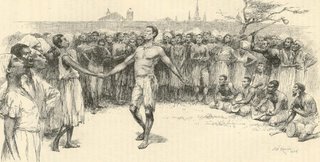
In 1804 Fort St. Ferdinand was demolished, leaving an area of land, used for the commonwealth, called "Circus Place", and later called "Congo Square". Even before 1800, it was a place, where slaves gathered on Sundays. There was a law that stated, "slaves must be free to enjoy Sundays, or they were to be paid fifty cents a day if they worked." In 1817, the slaves were only allowed to gather for games, dances, weddings and funerals.
When they gathered, hollowed drums were used. They were hit with all body parts. Primitive banjos joined the instrumentation. The music, influenced by Creoles, was not monotone, and at times lovely and subtle.
The dance was creative. Sensual movements, without arms or legs, were particular to slaves owned by Latino masters.
Congo Square 1910

After slavery was abolished Afro-Americans, continued to meet there on Sundays. the music was varied. A new form was heard. This form was played on Sundays, and the sound reverberated all over the city. It was the birthplace of JAZZ.
Pre-Katrina Congo Park

Now Congo Square is part of Louis Armstrong Park in New Orleans. If an outdoor concert or political demonstration, in New Orleans, needs a gathering place, with a story to tell, there is Congo Square.
Congo Square survived Katrina.RENEGADE EYE
Congo Square 1810
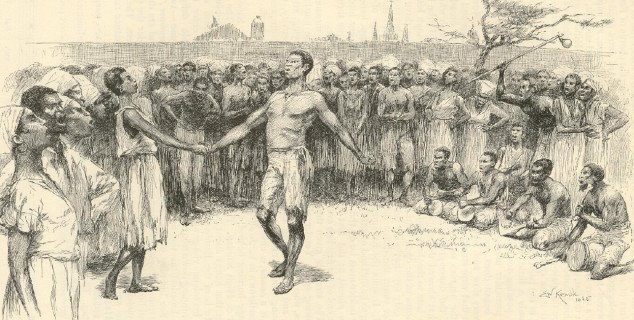
In 1804 Fort St. Ferdinand was demolished, leaving an area of land, used for the commonwealth, called "Circus Place", and later called "Congo Square". Even before 1800, it was a place, where slaves gathered on Sundays. There was a law that stated, "slaves must be free to enjoy Sundays, or they were to be paid fifty cents a day if they worked." In 1817, the slaves were only allowed to gather for games, dances, weddings and funerals.
When they gathered, hollowed drums were used. They were hit with all body parts. Primitive banjos joined the instrumentation. The music, influenced by Creoles, was not monotone, and at times lovely and subtle.
The dance was creative. Sensual movements, without arms or legs, were particular to slaves owned by Latino masters.
Congo Square 1910

After slavery was abolished Afro-Americans, continued to meet there on Sundays. the music was varied. A new form was heard. This form was played on Sundays, and the sound reverberated all over the city. It was the birthplace of JAZZ.
Pre-Katrina Congo Park

Now Congo Square is part of Louis Armstrong Park in New Orleans. If an outdoor concert or political demonstration, in New Orleans, needs a gathering place, with a story to tell, there is Congo Square.
Congo Square survived Katrina.RENEGADE EYE
Saturday, June 10, 2006
Seven Palestinians picnicking on Beach Killed And Thirty Wounded By Israeli Artillery Attack
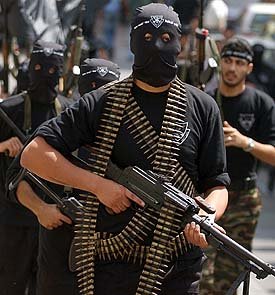
Hamas has called off its 16 month military truce with Israeli, after seven Palestinians were killed, and thirty were wounded, while picnicking at a beach in Gaza.
Israel has a history of inflicting collective punishment on Palestinians, causing widespread demoralization.
According to ABC.com, Kamal Ghobn said he had just arrived at the beach on a bus with about 50 relatives when the attack took place. "I was still parking the bus and everyone got out to go to the beach. As I locked the door I felt the thud of the shells and felt a sting in my side," said Ghobn, who was slightly wounded by shrapnel. Gobn said he saw four shells land.
The artillery fire scattered body parts, destroyed a tent and sent bloody sheets flying into the air. A panicked crowd quickly gathered, screaming and running around hysterically.
A sobbing girl lay in the sand, crying for her father. "Father! Father!" she screamed.
The body of a man lay motionless in the sand nearby.
Palestinian officials said seven people were killed and more than 30 wounded at the beach. Hardest hit was the Ghalia family, which lost six members, among them the father, one of his two wives, an infant boy and an 18-month-old girl.
On Thursday Israel conducted an aerial artillery attack killing Hamas leader Jamal Abu Samhadana. Thousands of Palestinians attended his funeral at a Gaza soccer stadium.
RENEGADE EYE
Tuesday, June 06, 2006
Haditha is the result of your battlefield ethics
I can't stop thinking about the children executed by US forces in Haditha in November last year. What were they doing right before they were killed in cold blood? Where they playing or sitting on their doorsteps watching the world go by?
What must they have thought of the world they lived in? How scared they must have been when they saw the marines aim directly at them? How much pain did they feel? How long did it take for them to die? Did they die alone or in their mothers' arms?
And how did their mothers feel - helpless to save the lives of their precious little ones?
News of Haditha has driven me insane with rage. If you have still not felt it – numbed by the daily news of killings in Iraq - just try putting the faces of children you love, maybe your own or those of your siblings or close friends, in the places of those beloved who were murdered that day. Beloveds who will be missed; who will never be kissed or kiss again; who will never be tickled, or cuddled. Who are no more...
***
In response to this outrage, attempts at covering it up, along with reports of other such outrages, the US government has ordered troops to undergo a crash course in battlefield ethics.
Please; have some respect for our intelligence.
Haditha is the result of your battlefield ethics – one that similar to Islamic terrorism – indiscriminately targets civilians.
***
For those who think that US militarism is more palatable than Islamic terrorism, think Haditha...
Maryam Namazie
Tuesday, May 30, 2006
Manifesto of the Third Camp against US Militarism and Islamic Terrorism
The present conflict between the Western governments and the Islamic Republic of Iran can have disastrous human, political and social consequences. The terrible experience of Iraq has shown to all the catastrophes that can result from economic sanctions and a military attack. Deterioration of living conditions, economic plight, death, destruction and displacement of people, and increased repression by the Islamic regime, would be some of the immediate consequences of economic sanctions or a military attack on Iran. This policy would unleash Islamic terrorism on a regional scale and escalate it internationally.
We must stand up with all our power to the US government’s and its allies’ bullying. We must put an end to the crimes of the opposite pole, i.e. Islamic terrorism. We must help the people of Islam-stricken countries to get rid of the menace of Islamic terrorist states and forces. American militarism and Islamic terrorism have brutalised the world. Neither of them has a solution to the present crisis and its resulting problems. Rather, they are themselves the cause of this crisis and its aggravation. Civilised humanity must rise up against both these poles and the suffering that they have imposed on the world. The human and genuine solution to the problem of nuclear weapons, to Islamic terrorism and its horrific crimes against the people of the world, and to the militaristic bullying of the US and Western governments lies in the hands of us people.
Amid all this, the struggle of the people of Iran for freedom holds a prominent and critical place. For years there has been a mass social movement in Iran against the Islamic regime and for liberty and equality. The triumph of this movement over the Islamic Republic of Iran would be a decisive blow to political Islam and Islamic terrorism throughout the world. It would also be a powerful response to the US government’s political-military interventionism aimed at regime change, in the name of “exporting democracy”, and imposition of reactionary puppet regimes on other societies. The victory of the Iranian people would be a giant step forward and a turning point in the struggle against militarist and Islamic terrorism and in defence of liberty, civilisation and universal rights for all throughout the world.
We, the undersigned, declare:
1- No to war, No to economic sanctions
Economic sanctions and a military strike on Iran will have catastrophic human, political and social consequences. What happened in Iraq should not be repeated in Iran. These threats must stop immediately.
2- No to US militarism, No to political Islam
In the conflict between the state terrorism of the West and Islamic terrorism, the civilised world is not represented. Both sides of this conflict are reactionary and inhuman. They must be driven back.
3- Nuclear disarmament of all states
Neither Iran, nor the USA, nor any other state should have nuclear weapons. The Iranian regime’s nuclear project must stop immediately. However, states which have the largest stockpiles of nuclear weapons themselves are not competent authorities to judge on the nuclear capability of other states. Halting the Islamic Republic of Iran's nuclear project is the task of the freedom-loving people of the world, in particular the people of Iran - just as the nuclear disarmament of all states and liberation from the global nuclear nightmare can only be achieved by the struggle of the people of the world.
4- Attacks on civil liberties in the West in the name of ‘war on terror’ must stop
The governments in the West are violating or restricting civil rights and liberties in the name of fighting the terrorist threat and safeguarding security. Increased surveillance and control of citizens, curtailing freedom of expression and movement and denying the rights of immigrants are some of the commonest forms that this attack on people’s rights is taking. This must be stopped. No excuse for an attack on civil rights and liberties is acceptable.
5- We actively support the struggle of the people of Iran against a military attack and against the Islamic Republic of Iran
For 27 years the people of Iran have been fighting against repression, violation of women’s rights, sexual apartheid, stoning, torture, execution of political prisoners and poverty and economic deprivation. The people of Iran want to and can determine their own political destiny. Support for the struggle of the Iranian people for freedom, the victory of this struggle against the Islamic Republic and the establishment of people’s own direct rule will be a crucial step in standing up to the US government’s bullying and a decisive blow to Islamic terrorism in the Middle East and the world.
6- The Islamic Republic must be expelled from the international community
The Islamic regime in Iran must be kicked out of the international community, just like the racist South African regime, for 27 years of crimes against humanity, for the brutal suppression of the rightful struggles of the people, for the execution of over one hundred thousand political prisoners, for establishing a sexual apartheid in Iran and for promoting Islamic terrorism in the Middle East and throughout the world. We call for the non-recognition of the Islamic Republic as the representative of the Iranian people, for the ending of diplomatic ties with it and the closure of its embassies everywhere. We call for the expulsion of the regime from international institutions.
We invite all humanitarian, secular, anti-war and freedom-loving organisations, forces, parties and individuals in the world to sign this Manifesto and join the Third Camp to confront both poles of terrorism.
Initial list of signatories:
Mina Ahadi, Coordinator, International Committee against Stoning, Germany (including organisation).
Homa Arjomand, International Campaign against the Sharia Court in Canada and Director of Children First Now, Canada (including organisation).
Ophelia Benson, editor of Butterflies and Wheels, deputy editor of The Philosophers' Magazine, and co-author of 'Why Truth Matters', USA.
Nazanin Boroumand, Coordinator, Never Forget Hatun Campaign, Germany (including organisation).
Denis Cobell, President of the National Secular Society, Chair of Right to Refuse to Kill, and former Asst. Editor of Hyde Park Socialist, UK.
Deeyah, singer and composer, USA.
Caroline Fourest, writer, editor in chief of Prochoix, and author of several books, France.
Mersedeh Ghaedi, political prisoner in Iran for 8 years, Norway.
Tommy Gorman, writer, Ireland.
Hakeem Hasan, Secretary of the Health Care Workers' Council in Nasiriyah, Iraq (including organisation).
Reinhard Hascha, Historian, Germany.
Farshad Husseini, Deputy Director, International Federation of Iranian Refugees, the Netherlands (including organisation).
Khayal Ibrahim, Head of Women's Liberation of Iraq, Germany (including organisation).
Parvin Kaboli, Spokesperson of the International Campaign for Defence of Women's Rights in Iran, Sweden (including organisation).
Hartmut Krauss, editor of 'Hintergrund', Germany.
Terry Liddle, Chair of Lewisham Humanist Group, UK.
Azar Majedi, Chair of the Organisation of Women's Liberation, UK (including organisation).
Manochehr Masouri, webmaster of the International Committee against Executions, Sweden (including organisation).
Sean MacAughey, journalist, Ireland.
Reza Moradi, activist of the Young Communists' Organisation (including organisation), UK.
Anthony McIntyre, writer, former Republican prisoner and H-Blocks blanket protester in Maze prison in the 70s and 80s, Ireland.
Kevin McQuillan, former chairperson of the Irish Republican Socialist Party, Ireland.
Maryam Namazie, Writer, Director of the Worker-communist Party of Iran's International Relations, and 2005 winner of the National Secular Society's Secularist of the Year award, UK.
Richard O'Rawe, author of Blanketmen, Ireland.
Liam O Ruairc, Communications Worker, Ireland.
Fariborz Pooya, Director Iranian Secular Society, UK (including organisation).
Mohammad Reza Pooya, editor of Secular, the Netherlands (including publication).
Terry Sanderson, veteran of secular and gay activism, author of nine books with a journalistic career spanning 30 years and vice president of The National Secular Society, UK.
Michael Schmidt-Salomon, Giordano Bruno Foundation, Germany.
Antoine Sfeir, director of Les cahiers de l’Orient, and author of several books such as Les réseaux d’Allah (2001) et Liberté, égalité, Islam: la République face au communautarisme (2005), France.
Jalil Shahbaz, representative of the Defence of Secularism and Civil Rights in Iraq, Germany (including organisation).
Issam Shukri, Secretary of the Central Committee of the Left Worker-communist Party of Iraq, Iraq (including organisation).
Bahram Soroush, Public Relations of the International Labour Solidarity Committee of the Worker-communist Party of Iran, UK (including organisation).
Hamid Taqvaee, Secretary of the Central Committee of the Worker-communist Party of Iran, (including organisation).
To add your signature to the Manifesto, email thirdcampmanifesto@ukonline.co.uk. Moreover, please feel free to publish it.
For more information, the press can contact any of the signatories or Maryam Namazie at thirdcampmanifesto@ukonline.co.uk, telephone: +44 (0) 7719166731.
Maryam Namazie
Sunday, May 28, 2006
Minutemen Install 10 Mile Fence Against Immigrants in AZ...For Full Immigrant Rights, Not Amnesty
The anti-immigrant "The Minutemen," are building a 10 mile fence in southeastern Arizona, to stop immigrants, from entering the US. It is a protest, from the right of George Bush, who has asked for 6,000 National Guard troops. They want even more troops, and a wall from California to Texas. The Minuteman Civil Defense Corps plans to install a combination of barbed wire, razor wire, and in some spots, steel rail barriers along the 10-mile stretch of private land.
Anti-immigrant hysteria, has been a residue at times of imperialist war. In the time of World WarI, strikers mostly Mexican,members of the IWW (industrial Workers of the World) were forced at gunpoint, to be shipped to the Arizona desert, in a boxcar, to die of thirst. Sacco and Venzetti were executed. In WWII, Japanese Americans were put in concentration camps.
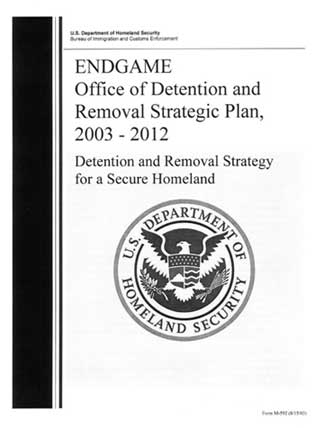
The Army Corps of Engineers have awarded Kellogg Brown & Root subsidiary of Halliburton Corporation, a $383 million grant to build "immigration detention centers", to each hold 5,000 detainees. They are to hold,an unexpected influx of immigrants, people fleeing from a natural disaster (another New Orleans), or for new programs that require additional detention space. Its goal is to remove all "removable aliens". This is part of the Dept of Homeland security's "Project ENDGAME."
Both the Democratic Party and the Republican Party, committed to divisive low wage programs, for immigrants. The amnesty programs provide citizenship, after paying thousands of dollars in taxes and fines, and waiting eleven years. We should oppose amnesty, also because it's a concept that applies to criminals. Amnesty for what?
The massive demonstrations, for immigrant rights, caught the political establishment by surprise. Most immigrant rights group, are subordinate to the Democratic Party. National flags were discouraged, while American flags were encouraged. Both parties represent the corporations desire, to pay the lowest wages to immigrants. To win the fight, Democrats and Republicans, can't be counted on.
See: The Internationalist.
RENEGADE EYE
Saturday, May 27, 2006
I Was Tagged Again
I was tagged by sonia-belle(adults only). I'm unable to escape this time.
1)If you are tagged, you must answer the question or questions, assigned by the person who tagged you.
2) You must credit the person who tagged you.
3) You can then choose other bloggers to tag.
Name ten of life's simple pleasures.
1) Old school ethnic food, as opposed to nuevo cuisine.
2) The internet (blogging).
3) Argentine tango, flamenco, and other dance experiences.
4) Jane Austen, Isabel Allende, and many others, fiction and non-fiction.
5) Cinema including Bollywood, Hitchcock and indies.
6) Magazines, high and low end.
7) Sex (Vanilla and Flavored).
8) Jazz, tango, roots, classical, show tunes CDs.
9) Long walks.
10) Art gallery openings (free food).
*These are in no particular order. All include high and low end.
I'll pick this list of blogs to tag. Please check them out.
Louis Proyect: The Unrepentant Marxist
Shhh...
Histologian
thoughtstreaming
RENEGADE EYE
1)If you are tagged, you must answer the question or questions, assigned by the person who tagged you.
2) You must credit the person who tagged you.
3) You can then choose other bloggers to tag.
Name ten of life's simple pleasures.
1) Old school ethnic food, as opposed to nuevo cuisine.
2) The internet (blogging).
3) Argentine tango, flamenco, and other dance experiences.
4) Jane Austen, Isabel Allende, and many others, fiction and non-fiction.
5) Cinema including Bollywood, Hitchcock and indies.
6) Magazines, high and low end.
7) Sex (Vanilla and Flavored).
8) Jazz, tango, roots, classical, show tunes CDs.
9) Long walks.
10) Art gallery openings (free food).
*These are in no particular order. All include high and low end.
I'll pick this list of blogs to tag. Please check them out.
RENEGADE EYE
Monday, May 22, 2006
Katherine Dunham 1909-2006
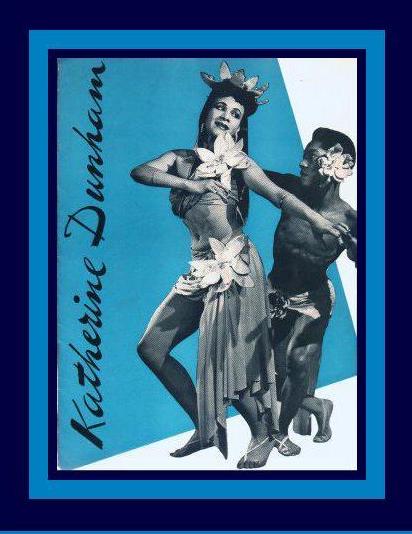
Today the world mourns the death of the renown choreographer, dancer, anthropologist, teacher, priestess, and activist Katherine Dunham.
She received her B.A. from the University of Chicago in 1936, in social anrhropology. Awarded a Rosenwald Travel Fellowship in 1936 for her combined expertise in dance and anthropology, she departed after graduation for the West Indies (Jamaica, Trinidad, Cuba, Haiti, Martinique) to do field research in anthropology and dance. Combining her two interests, she linked the function and form of Caribbean dance and ritual to their African progenitors. While a student at the University of Chicago, she persued her interest in dance, she had since her teen years.
The West Indies experience changed her life forever. She lived half time in Haiti, studying dance and anthropology. She was a princess in the Vodoun religion. She lectured widely, and wrote three books about her experience, DANCES OF HAITI (her master's thesis, published in 1947), and ISLAND POSSESSED (1969), underscoring how African religions and rituals adapted to the New World.
Her contribution to dance, is what is called "Katherine Dunham Technique," was the introduction to the dance world, the addition to modern dance the African and Caribbean styles. Her students included Marlon Brando, James Dean, and Eartha Kitt.
The Dunham experience was traditional folkloric movement, combined with Hollywood dazzle. When you see a movie from the late 1940s to the 1950s, with scenes of the natives dancing in a ritual, think Dunham.
The Katherine Dunham Dance Company toured the world from the 1940s to the 1960s.
As an activist she participated in a fast of 47 days, to protest US treatment of Haitian refugees. She also refused to perform in front of segregated audiences. She taught dance in East St Louis, to divert kids from gang activities.
During the 1980s, Dunham received numerous awards acknowledging her contributions. These include the Albert Schweitzer Music Award for a life devoted to performing arts and service to humanity (1979); a Kennedy Center Honor's Award (1983); the Samuel H. Scripps American Dance Festival Award (1987); induction into the Hall of Fame of the National Museum of Dance in Saratoga Springs, N.Y. (1987). That same year Dunham directed the reconstruction of several of her works by the Alvin Ailey American Dance Theater and "The Magic of Katherine Dunham" opened Ailey's 1987-1988 season.
In her later years, she was destitute. She died in a New York City, living in a long term care center. She gave up the limelight, to help the poor in the US, and Haiti.
She was the best known, and most important pioneer, in introducing African and Caribbean influence to classical, stage and cinema dancer. It is difficult to write about her accomplishments, without writing a book. Renegade Eye
Sunday, May 21, 2006
A Perspective of Flamenco Music and Dance

This is a sonia-belle(adults only) moment.
Between 800-900 AD, a large migration of of Untouchables from the Punjabi region of India, consisting of animal traders and trainers, acrobats, dancers, musicians, palmist and metalworking journeyed. They were called Roman/Gypsy. It is known that atleast part of them, roamed through Asia, to Europe, and landed in Spain. A second group came to Southern Spain, from North Africa. The second group had dark skin, and more the customs of the indigenous people along their route. To this day, both groups of nomads, do not mingle or intermarry.
During the Inquisition in Spain, Gypsies of both groups, were forced into ghettos. The isolation and repression, preserved the purity of the music. In the 18th century, they were granted more freedom, and the art form developed more.
If you have observed East Indian dance; you'll notice the footwork consists of stomping with feet, in a manner often found in flamenco. The other influences include Arab music, Jewish synagogue music, West African slave music, Latin American, Spanish folkloric, and Islamic elements.
Flamenco dance is in 2/4 rhythms. It doesn't have the pelvic movements of Middle Eastern dance. The open knees are an African influence. Flamenco started as a singing and clapping form.
Argentine tango has a connection to flamenco. Certain strains of tango, is adopting flamenco guitar, to an orchestra, with modifications of rhythm. The early tango was called tango flamenco.
I read a theory, that in the Philippines, the Spanish forbid studying martial arts. The natives practiced flamenco dance, to practice kicks and arm movements.
Nuevo flamenco is the modern form, popular in Spain, that incorporates rock, jazz, techno etc.
Unfortunately enjoying and participating in the arts, is a class priviledge. Despite the indigenous origins of this form, it is confined to performances locales as expensive restaurants.
See Spanish Gypsy and Flamenco Dance History.RENEGADE EYE
Tuesday, May 16, 2006
Ayaan Hirsi Ali: Resigns from Dutch parliament. Coming To America?

Somali born Dutch parliamentarian, and women and refugee rights activist Ayaan Hirsi Ali, resigned her government post, after admitting to lying on her application, for Dutch citizenship. She has been under attack from Islamists, since renouncing her faith in 2002, and being the producer and writer of "Submission," a documentary she made with slain by Islamists filmmaker Theo Van Gogh, depicting the oppression of women under Islam.
A few years ago, Ayaan admitted to lying, to get entry into Holland. It wasn't mentioned until a television show recently, brought up the issue. That fostered the Immigration Dept to revoke her Dutch citizenship.
She is outspoken against Islamists, and has been guarded, since she referred to Islamic culture as backward. Ayaan moved to a fenced community, but was forced to leave, because the residents protested her living there. They thought it put them also in peril.
She was a signer of the Manifesto Facing The New Totalitarianism along with this blog's team member Maryam Namazie.
It is rumored she will be moving to the USA, to work for the neoconservative American Enterprise Institute. I think the European left, should have stood up in her defense. Ayaan should have had all the security and housing, taken care of by the Dutch government. If they didn't give it to her, it should have been done by the left.
She plans a sequel to "Submission."RENEGADE EYE
Saturday, May 13, 2006
Israel: Russian Youth Attack Synagogue in Petah Tikva
Thank you to RandomPottins, for alerting me to this story.
Report from Ha'aretz, 11 May 2006:
Neo-Nazi gangs assaulting ultra-Orthodox Jews in Petah Tikva
By Moti Katz
A week after the desecration of the Great Synagogue in Petah Tikva, nothing remains of the horror the worshipers encountered there last Thursday when they arrived for morning prayers. The walls, which had been sprayed with swastikas and blasphemy, have been newly painted, the floor polished and the curtain covering the holy ark replaced. However, the danger is far from over. For the past two years the ultra-Orthodox community there, which includes some 5,000 families and 300 synagogues, has been subjected to incessant attacks by street gangs from the former Soviet Union (FSU).
The gangs have been beating ultra-Orthodox men, hurling curses at them and desecrating synagogues. "These youths feel out of place in the Russian community they belong to, but they are not accepted in Israeli society either," says Bella Alexandrov, the director of the multi-disciplinary youth center in Petah Tikva. She distinguishes between two kinds of immigrants - punks and skinheads.
"The skinheads buy Russian videos about 'white power' that call for cleansing Russia of Jews. They don't get it from home. It comes from not belonging and not finding answers to their distress."
On Sukkot eve last year, a number of teens bearing knives burst into the big Lithuanian yeshiva Or Israel on Rothschild Street in the city center. They started beating pupils, and throwing prayer books and scriptures on the floor. Yeshiva head Rabbi Yigal Rozen has no doubt that these incidents are anti-Semitic.
"There has always been violence in Israel, but never directed at synagogues. This started only in recent years. A month after the Sukkot incident, two yeshiva students were attacked and beaten up by Russian teens. The police arrested three of the attackers," he says. Most of the victims were dressed like ultra-Orthodox Jews, Rozen says, and therefore concludes that the assailants could not be Jewish.
"It's time the police realized these are anti-Semitic attacks. These gangs are not after money. The charity boxes were not robbed, nor were the Torah books, which are worth a fortune," he says.
Skinheads in the parks
Many of the incidents occur in the parks in the city center because numerous low-income immigrant families from Russia live there, says Rahamim Arbel, Jewish cultural coordinator for Petah Tikva's community centers. "On Friday nights Russian teens gather in parks with lots of alcohol and bongs. It's very unpleasant for the residents of the neighborhood," he says.
Arbel himself was attacked two years ago. He was with his small son and two friends, and they were returning from a lesson. On Rothschild street they were accosted by a group of drunk teenage boys and girls, aged 15 to 16. "They started swearing at us. I whispered to the others to walk away. The girls ran after us spitting and kicking. We fled. I got over it but my son will never forget that day," he recalls. An elderly man was attacked on Friday night a year ago but did not go to the police.
"I live in the center, near a park where the Russian gangs gather on Friday nights. Returning from a family visit I approached the park," he says. "A few boys demanded money and threatened me with a broken bottle. I told them I had no money because it was the Sabbath and went on walking. They knocked my hat off, kicked my shin and started kicking my hat. I tried to run and they followed me, cursing and throwing empty beer bottles. They were definitely harassing me because of my religious dress, because others passed by undisturbed," he says. "My parents survived the Holocaust. I come from exile and know what persecution is; and that's what I felt. Their appearance and the chains around their necks reminded me of neo-Nazis," he says.
A security camera on the menorah
Acting Mayor Paltiel Eisental tries to be reassuring. The relations between the city's secular and religious residents are very good, he says. This is a small gang, not a widespread trend, he says. "You must distinguish between vandalism due to theft and what happened in the Great Synagogue last week, which was brutality and hatred. I don't believe Jews could have done that. Those were acts aimed against a nation, against an idea. It's Nazism," he says.
The city council held an emergency meeting last week after the synagogue's desecration, and decided to safeguard the synagogue and find the vandals and indict them. Eisental says the city has a vandalism patrol in problem areas, but is having trouble reinforcing it due to a personnel shortage. "Every Hanukkah we put a nice big menorah at the yeshiva's entrance, right on the street," says Rabbi Rozen. "This year we were forced to put a security camera on it so that it wouldn't be vandalized," he adds sadly.
See: Haaretz Daily
RENEGADE EYE
Monday, May 08, 2006
Hugo Chavez Seeking 25 Year Term? Not quite

This is reprinted from the blog Latin America News Review. It is a great resource on Latin American issues.
By Justin Delacour
Latin America News Review
May 8, 2006
A little scrutiny of a recent Associated Press report about Venezuela provides a lesson in how the English-language press often gets the story wrong. Take the first sentence: "President Hugo Chavez said Saturday that Venezuelan voters should have the chance to decide whether he should govern the country for the next 25 years."
No, such a referendum would not be about "whether he should govern the country for the next 25 years." A referendum would be about whether Chavez would be permitted to run every six years and --in the event that he were to continue winning elections-- serve multiple presidential terms. The AP report's opening sentence makes it sound as if such a referendum would do away with elections in Venezuela, as if its intent would be to grant Chavez a new 25-year term in office! The website of The Calgary Sun even titles the wire report "Chavez seeking 25-year term"!!
This is obviously an extremely poor piece of reporting. Chavez made it clear that, if the opposition committed to participating in the upcoming presidential election, he would not convoke a referendum to end presidential term limits. He explained that the intent of his threat to convoke such a referendum was not to perpetuate himself in power but rather to defend the Bolivarian Revolution.
Fortunately, Agence France Press (AFP) got the story right. The opening sentence of AFP's Spanish-language report reads, "Venezuelan president Hugo Chavez claimed Saturday that, if the opposition decides not to run candidates in the December presidential election, he could decree a referendum to permit his reelection for multiple terms until 2031."
So the choice for the opposition is simple. If they don't want a referendum that would end presidential term limits, they shouldn't pull out of the upcoming presidential election. As far as I'm concerned, the threat of a referendum is a perfectly reasonable (and democratic) way to dissuade the opposition from trying to delegitimize Venezuela's electoral process.
When Venezuela's opposition knows it's going to lose an election, it has a tendency to try to delegitimize the electoral process. Instead of facing up to the fact that it is unpopular, the business-led opposition tries to shift the blame for its electoral misfortunes to the National Electoral Council (CNE). The opposition claims that the CNE could commit "fraud" and that the vote might not be secret. Opposition conspiracy theories of this nature are legion. Never mind that there have been international observers on hand that have testified to the fairness of Venezuela's elections. Never mind that even the opposition's own polls show that Chavez is much more popular than they are.
In other words, many members of the opposition aren't really interested in trying to win elections because they know that they lack popular support. Many in the opposition prefer, instead, to try to create the impression internationally that Venezuela's electoral process is illegitimate.
One has to understand that, given the combination of the opposition's economic interests and political incompetence, it is very desperate. Since it is unable to attract popular support domestically, the opposition resorts to attempts to draw more U.S. hostility toward Chavez in hopes that such hostility might somehow weaken or destroy his presidency. Electoral boycotts are part and parcel of this strategy. The opposition wants to create the (false) impression internationally that Venezuela is another Ukraine and that Chavez wins elections by "fraud," etc. etc. That's what Chavez is up against.
OAS General Secretary Jose Miguel Insulza effectively summed up the problem that Chavez faces when he said the following about the opposition's boycott of legislative elections last December:
"We had a problem with the Venezuelan opposition, which assured us that they would not withdraw from the [electoral] process if certain conditions were met. These were met and, despite this, they withdrew."
Insulza continued, "if the path of abstention is chosen, then one cannot complain that the entire parliament is in the hands of one's political adversary."
RENEGADE EYE
Saturday, May 06, 2006
Blogger Notes and New Team Member Announced
I established this blog a little over a year ago. I thought I should post something about blogging in general. I enjoyed the level of dialog that occured on this blog, and made friends all over the world.
This blog has visitors that I have little agreement with, even on the left. A Maoist can argue directly with a Trotskyist, in a more civil fashion than on the street here. Some of the dialogs have been intense; just read any Hugo Chavez post I made. I have actually reversed positions because of what I learned from the dialogs.
I write a post, than surf for new people to respond. To get traffic, you have to sign others blogs. Another action is to be liberal about trading links. I don't agree with, or even understand the politics, of all my links.
I think shorter posts are better than longer. How can you receive comments if everything is said? Like the great artists who left part of a painting unfinished, so the viewers imagination can work. To comment you don't need to write a book, a short comment trumps no comment.
I have invited to post at this blog Maryam Namazie. I have been courting her for a few months, to contribute to this blog, to post anytime and on anything she wants. Maryam finally consent to be a team member. It is generous of her, since she is a new mother. She knows I have dusagreements with her party about communist history, and the nature of the Soviet Union. I have found in her, a strong voice against imperialism and Islamism at the same, and a fighter for secularism, human rights, and refugee relief work. With war drums sounding against Iran, her insights will add much to this blog. I'm stealing a short bio of hers from her website: Maryam Namazie is currently a producer for TV International English, a member of the Central Council of the Organisation for Women's Liberation and Director of the Worker-communist Party of Iran's International Relations Committee. She is also co-editor of WPI Briefing and the Worker-communist Review.
She has spoken at numerous conferences and written many articles on women's rights issues, violence against women, political Islam, and secularism - some of which have been translated into various languages. She has been interviewed on BBC TV and radio, including the Heaven and Earth programme and the Moral Maze, ABC TV Australia, quoted in Time magazine, the Independent, the Observer, the Guardian, Al Ahram Weekly, Persian media outlets, and had articles published in various sources, including Tribune, Gay Times, Medusa Journal, Gender Policy Review.
Previously, Namazie was the elected Executive Director of the International Federation of Iranian Refugee, a refugee run organisation with 60 branches in 15 countries worldwide; founded the Committee for Humanitarian Assistance to Iranian Refugees (CHAIR); was the Human Rights Advocates Training Programme Coordinator at Columbia University's Centre for the Study of Human Rights in New York and the NYC Refugee Coordinator/ US National Steering Committee Member of Amnesty International. She also ran a refugee women's leadership training programme in NYC.
She works and lives in the UK.
See: Maryam Namazie.
Subscribe to:
Posts (Atom)